JG

Jayesh Govindarajan

Things Jayesh Says on Podcasts

Where to Find Them

Jayesh Govindarajan has been a guest on Product Growth and The Growth Podcast .

Recently: “What an AI-Native Product Team Actually Looks Like at Salesforce” on Product Growth (November 2026); “What an AI-Native Product Team Actually Looks Like at Salesforce” on The Growth Podcast (November 2026).

What They Said

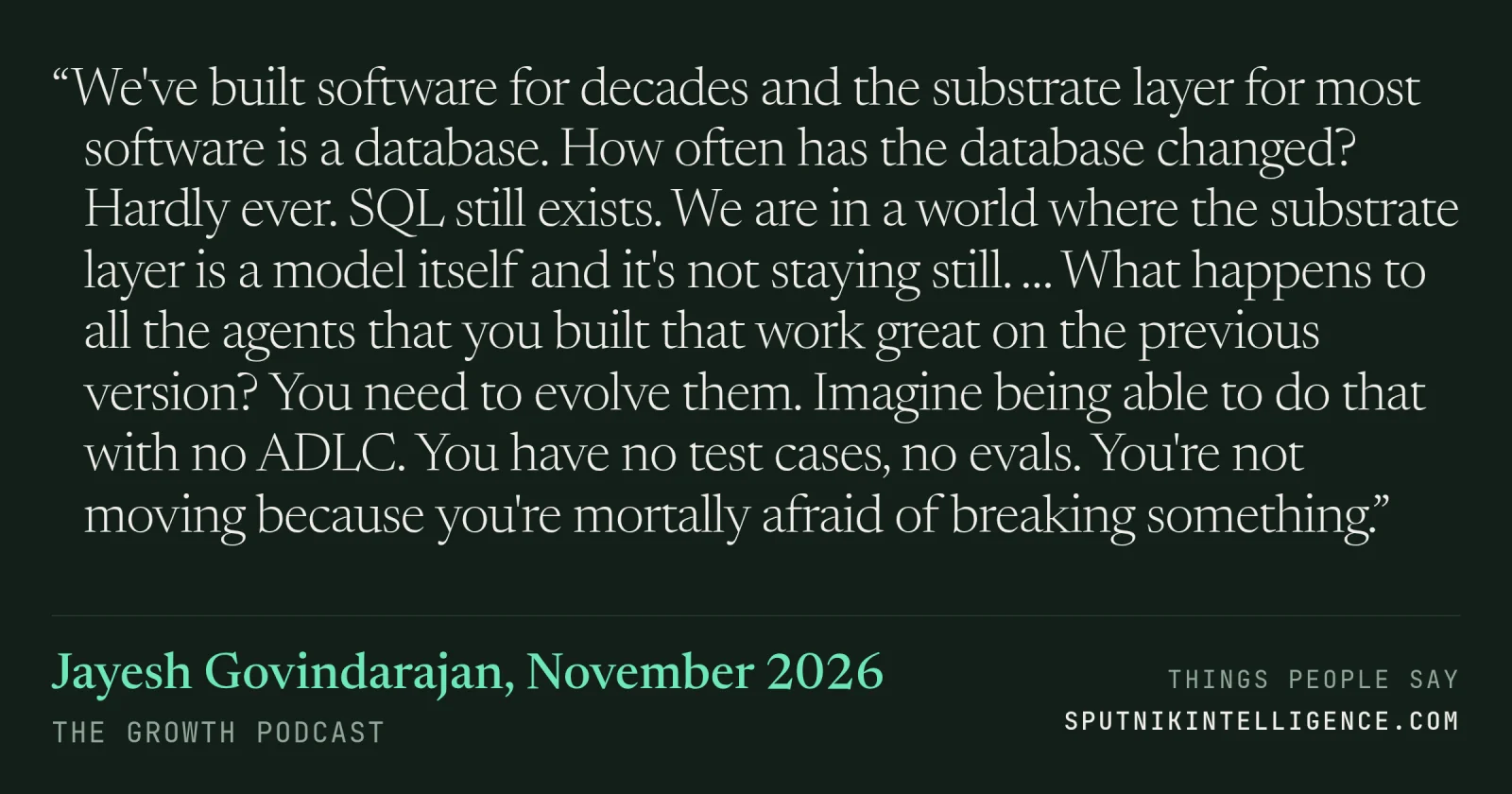
“We've built software for decades and the substrate layer for most software is a database. How often has the database changed? Hardly ever. SQL still exists. We are in a world where the substrate layer is a model itself and it's not staying still. … What happens to all the agents that you built that work great on the previous version? You need to evolve them. Imagine being able to do that with no ADLC. You have no test cases, no evals. You're not moving because you're mortally afraid of breaking something.” — Jayesh Govindarajan, The Growth Podcast

Asked whether the agent development life cycle forces teams toward continuous deployment, Salesforce's AI engineering head explains that the model underneath is constantly changing, so without evals teams can't safely upgrade.

The Growth Podcast · 2026-11-03 Permalink → Listen →
The Growth Podcast Around 42:19 into the episode
Jayesh Govindarajan

…things. And now they need this skill set to be able to evaluate these agents, to be able to make sure that they work, to be able to observe them, to be able to understand what is drifting, to be able to be told what's drifting and then bring the human in to correct it, to steer it, if you will.

Aakash Gupta

So it sounds like part of what is involved in the ADLC is moving a lot faster. If you were on a six-month ship cycle, it sounds like you need to almost go to a continuous deployment. It can self-heal whenever it wants cycle.

Jayesh Govindarajan

Yeah. And I think there's a very good reason why the pace is this way. It's because often the substrate layer, things that you build on, don't change as fast as they are today. Think about it this way. We've built software for decades and the substrate layer for most software is a database. How often has the database changed? How often has the programming language to program the database changed? Hardly ever. SQL still exists. We are in a world where the substrate layer is a model itself and it's not staying still. It is evolving at a very rapid rate. The changes between what we saw in the current version of Cloud and the previous version of Cloud is significant, right? So you have to, so what happens to all the agents that you built that work great on the previous one? You need to evolve them. You need to simplify them. And there are certain dimensions on which you need to simplify. Imagine being able to do that with no ADLC. You have no test cases, no evals. How are you going to go flip the, you're going to, you're just going to, if you didn't have all of that infrastructure built, the rate at which you move, the hugging of the tangent, if you will, it's not happening because you're mortally afraid of breaking something. But if you do, on the other hand, you can really go fast. And…

Aakash Gupta

Everything downstream has to change though, then, right? Your product marketing, your customer support, everybody has to shift to this much more agile way of working. Some companies are still stuck in the past, right? They're still shipping every couple months. How does a company go from zero to…

Jayesh Govindarajan

Yeah, I think the first thing is, I think you nailed it. You have to be building and releasing continuously. You have to be doing that in discrete chunks that matter to customers. At the end of the day, we're shipping something that we want to have impact with customers that adds value to…

Aakash Gupta

create lots of tech debt when they would switch to this.

Speaker names come from our own diarization. The position is estimated from where the line sits in the episode.
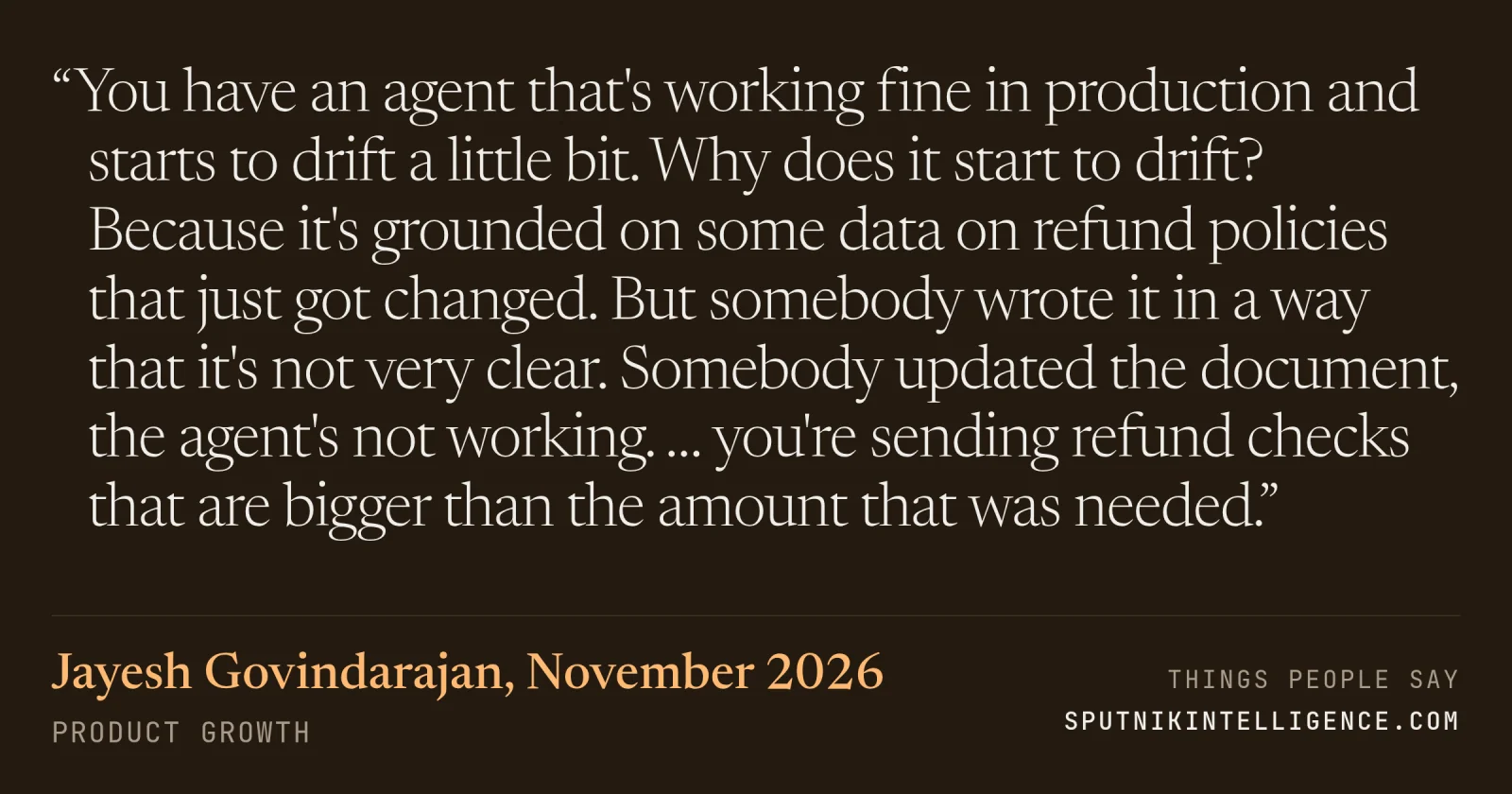
“You have an agent that's working fine in production and starts to drift a little bit. Why does it start to drift? Because it's grounded on some data on refund policies that just got changed. But somebody wrote it in a way that it's not very clear. Somebody updated the document, the agent's not working. … you're sending refund checks that are bigger than the amount that was needed.” — Jayesh Govindarajan, Product Growth

Asked to define the agent development lifecycle versus the usual software lifecycle, he gave a concrete example of why a live agent needs monitoring. The goal, he says, is an agent that can detect what context changed and correct itself.

Product Growth · 2026-11-03 Permalink → Listen →
Product Growth
Jayesh Govindarajan

…that you're building or testing the system that you're testing? Can you set a bar on what good looks like? Because that's what translates into evals. And then, like you said, I think access to all the prototyping tools, which I think is the easy bit now. I think that pretty much everyone gets.

Aakash Gupta

…pretty easy. The roles, we've given you some more clarity on. I think that third layer now is the life cycle that all of this is under. And you created this new term, ADLC. Yeah. Not the SDLC that we all know. So can you define those two terms for us and explain to us what makes the ADLC different?

Jayesh Govindarajan

…do you deploy it? And then having deployed it, how do you observe it so that it continually improves? So these five elements are taken together is what I call the ADLC lifecycle. The Holy Grail, of course, is an agent that you've built and it's in production and can self-heal to some extent. And I'm not talking some fancy rocket science sci-fi stuff on self-healing. I mean simple things. Like you have an agent that's working fine in production and starts to drift a little bit. Why does it start to drift? Because it's grounded on some data on refund policies that just got changed. But somebody wrote it in a way that it's not very clear. Somebody updated the document, the agent's not working. The refund, or you're sending refund checks that are bigger than the amount that was needed. Can it self-heal? It can. It needs to detect what context was changed, whether that context was changed the right way or wrong way. That's the knob that you want to get to. You want to get to a point where if you've designed this right, there are two loops. There's the inner loop, which is you conjuring…

Aakash Gupta

Does the ADLC only apply then if you're building agents?

Jayesh Govindarajan

I think it's broader than that. I think it has to do with an AI development lifecycle, which has an eval mindset baked in, which understands that anything built on data can drift because data can drift, because data itself drifts. And then having the right tool sets to observe that drift in…

Aakash Gupta

So it sounds like part of what is involved in the ADLC is moving a lot faster. If you were on a six-month ship cycle, it sounds like you need to almost go to a continuous deployment. It can self-heal whenever it wants cycle.

Speaker names come from our own diarization. The position is estimated from where the line sits in the episode.
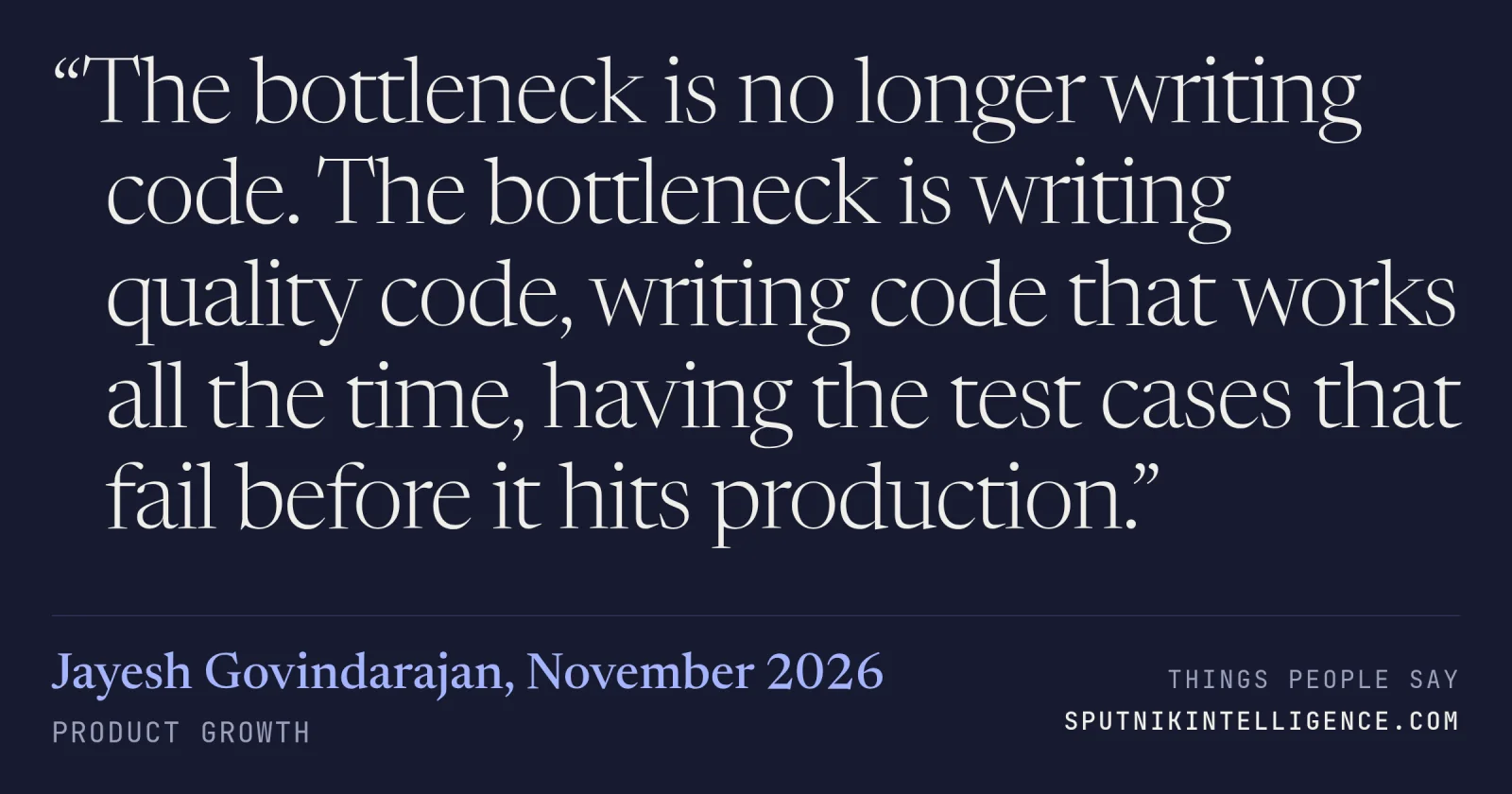
“The bottleneck is no longer writing code. The bottleneck is writing quality code, writing code that works all the time, having the test cases that fail before it hits production.” — Jayesh Govindarajan, Product Growth

Talking about tech debt and speed, Govindarajan said agents can now help with code review and security work. He sees the constraint on shipping as shifting from producing code to verifying it.

Product Growth · 2026-11-03 Permalink → Listen →
Product Growth
Jayesh Govindarajan

…trade-off. The trade-off is you don't want to break systems. If all you're going to do is iterate rapidly, once you have the kind of customer base that Salesforce has, things start to break and then that slows you down even further. You want to be able to balance and do both. Yeah. People used to

Aakash Gupta

create lots of tech debt when they would switch to this.

Jayesh Govindarajan

…for what that means from a tech debt perspective. But for the first time, we can have agents help with tech debt too. Like, how do you build this like this work we do with our amazing security team? There's work we do with our release management teams for building agents that are specialized, that do code reviews. How do you pull a PR, a high-quality PR, really fast? What are the bottlenecks? The bottleneck is no longer writing code. The bottleneck is writing quality code, writing code that works all the time, having the test cases that fail before it hits production. These are now the bottlenecks, each of which, if you go really deep, you can start to build agents for and speed up by itself. So, yeah.

Aakash Gupta

Okay. So, I think we covered the life cycle. I think the very last component at the very top of the pyramid is probably where you spend a lot of your time. How engineers, product managers, and executives who are really setting the strategy of what we're working on collaborate to build a roadmap.…

Jayesh Govindarajan

Great question. So, let me take a step back first. I think at a high level, I'd say taste, judgment play a much bigger part than they did before. That's what forms the intuition on the broad vector along which you want to move the organization, the team, the product. But I said broad vector, it's…

Aakash Gupta

I want to return to that role layer because you brought up the forward-deployed engineer. It's got to be the hottest, sexiest new role in tech. And for my audience, it's the forward-deployed product. Manager. That's super interesting to them. What do you see? Are these roles replacing the…

Speaker names come from our own diarization. The position is estimated from where the line sits in the episode.
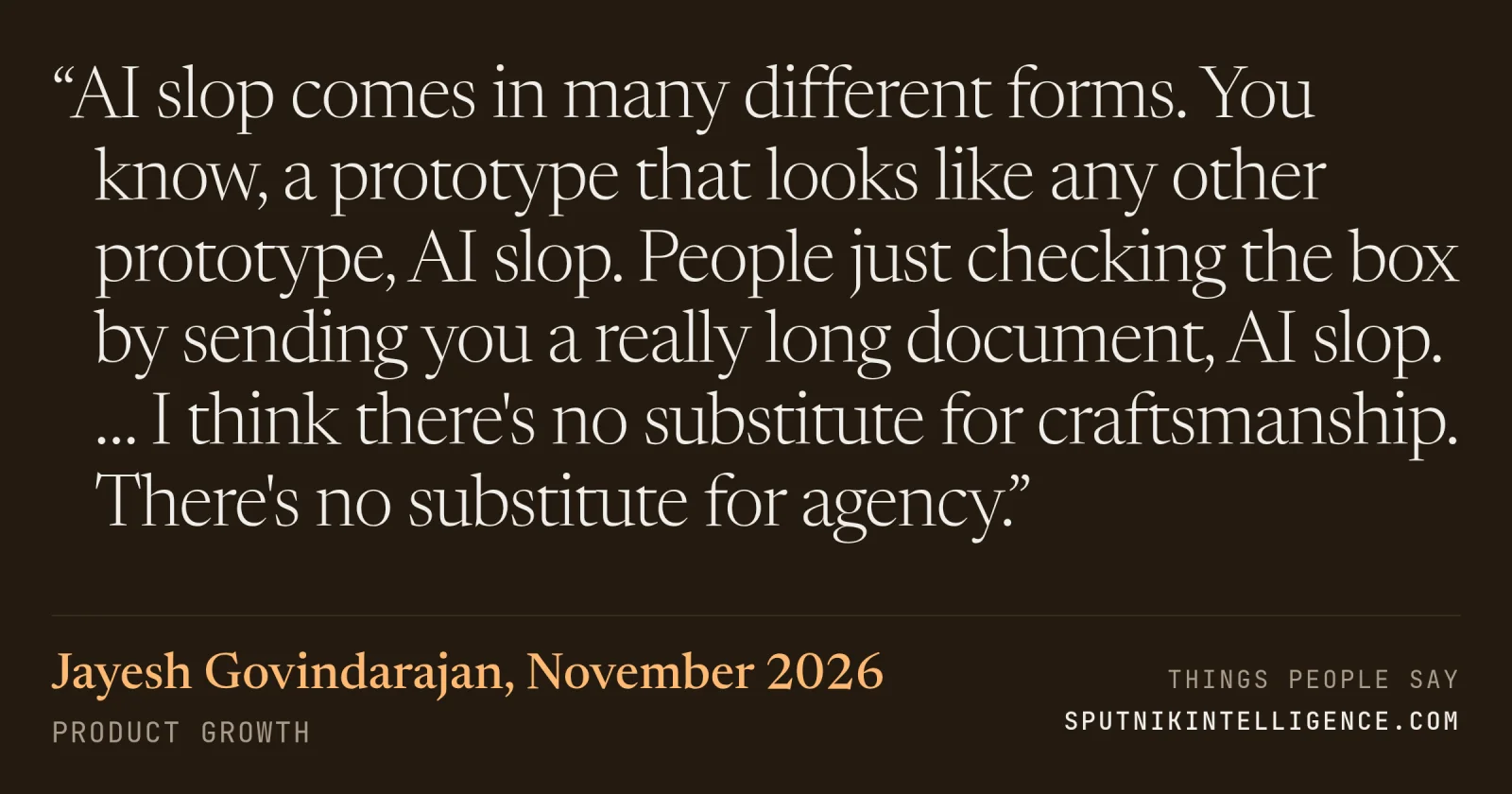
“AI slop comes in many different forms. You know, a prototype that looks like any other prototype, AI slop. People just checking the box by sending you a really long document, AI slop. … I think there's no substitute for craftsmanship. There's no substitute for agency.” — Jayesh Govindarajan, Product Growth

Aakash Gupta asked how Salesforce hires the new AI product manager. Govindarajan said he looks first for agency, then an agent-native mindset, skepticism and craftsmanship, and this is how he defines what a candidate must avoid sending.

Product Growth · 2026-11-03 Permalink → Listen →
Product Growth
Jayesh Govindarajan

more of that. So

Aakash Gupta

we've built the tool layer. People now understand the roles. To close off the role layer, how do you hire this new AI PM? What are you looking for?

Jayesh Govindarajan

…have that craftsmanship mindset. They're not producing AI slop. They're putting their name to it and they do not like to put a name to something that has AI slop. AI slop comes in many different forms. You know, prototype that looks like any other prototype, AI slop. People just checking the box by sending you a really long document, AI slop. So these are sort of, there are clear do's and don't. I think there's no substitute for craftsmanship. There's no substitute for agency. I think those are two really important things to look for. Like, do they have attention to detail is a good example of craftsmanship. And then it's tooling. It is how do you translate that skepticism into test cases and evals that are failing when you build the system that you're building or testing the system that you're testing? Can you set a bar on what good looks like? Because that's what…

Aakash Gupta

Yeah, I think the tools are pretty easy. The roles, we've given you some more clarity on. I think that third layer now is the life cycle that all of this is under. And you created this new term, ADLC. Yeah. Not the SDLC that we all know. So can you define those two terms for us and explain to us…

Jayesh Govindarajan

Sure. So SDLC is the software development lifecycle, which we all know and love that have been building software for years. ADLC is an equivalent for the agentic world, the agent development lifecycle, if you will. What is the life? If the software you're producing is not just a deterministic piece…

Aakash Gupta

Does the ADLC only apply then if you're building agents?

Speaker names come from our own diarization. The position is estimated from where the line sits in the episode.
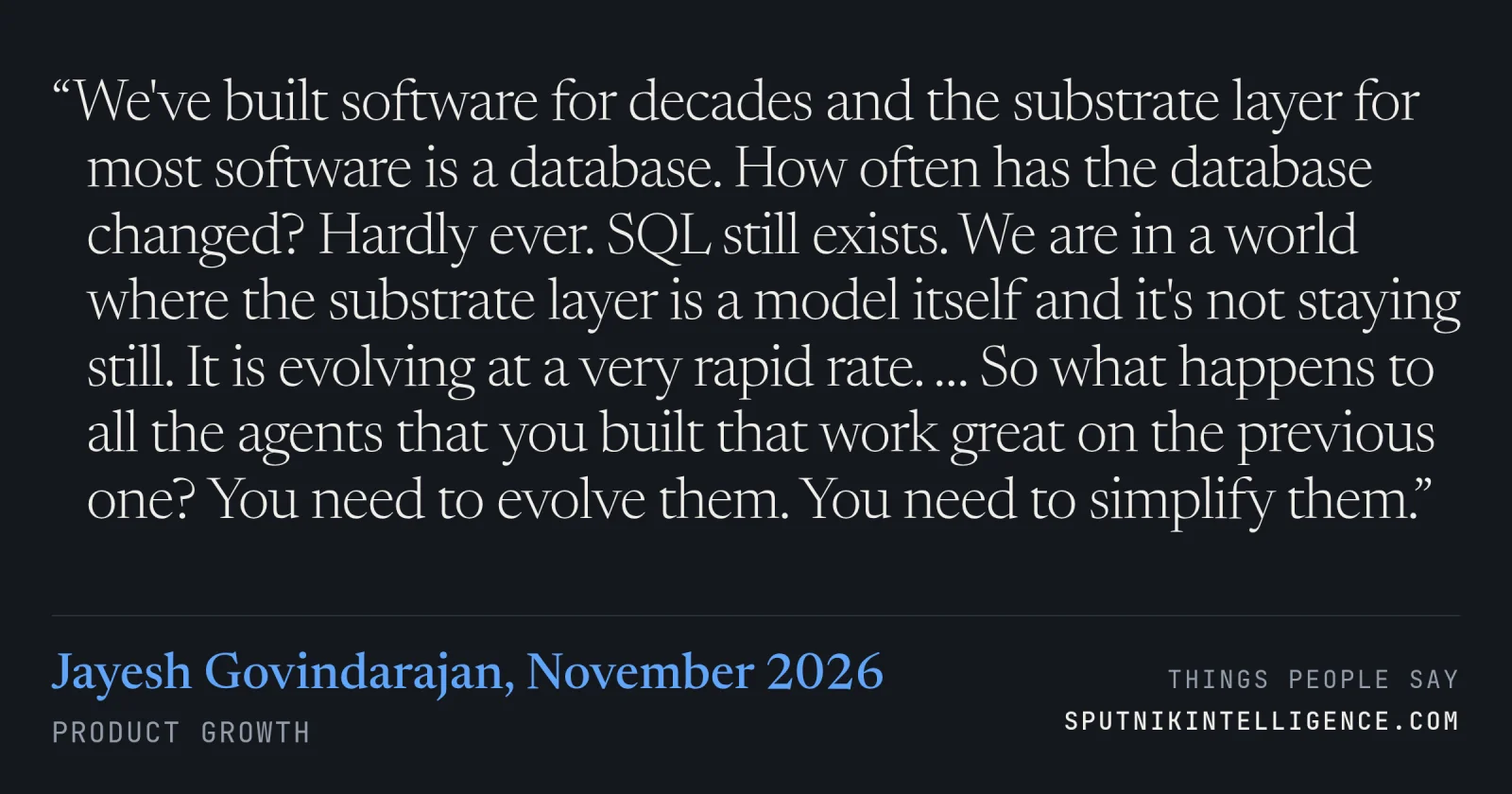
“We've built software for decades and the substrate layer for most software is a database. How often has the database changed? Hardly ever. SQL still exists. We are in a world where the substrate layer is a model itself and it's not staying still. It is evolving at a very rapid rate. … So what happens to all the agents that you built that work great on the previous one? You need to evolve them. You need to simplify them.” — Jayesh Govindarajan, Product Growth

Aakash Gupta suggested that moving to an agent lifecycle means shipping continuously instead of every six months. Govindarajan explained why: the model that agents are built on changes far faster than databases ever did, so agents have to be rebuilt with each new model.

Product Growth · 2026-11-03 Permalink → Listen →
Product Growth
Jayesh Govindarajan

…things. And now they need this skill set to be able to evaluate these agents, to be able to make sure that they work, to be able to observe them, to be able to understand what is drifting, to be able to be told what's drifting and then bring the human in to correct it, to steer it, if you will.

Aakash Gupta

So it sounds like part of what is involved in the ADLC is moving a lot faster. If you were on a six-month ship cycle, it sounds like you need to almost go to a continuous deployment. It can self-heal whenever it wants cycle.

Jayesh Govindarajan

…often has the database changed? How often has the programming language to program the database changed? Hardly ever. SQL still exists. We are in a world where the substrate layer is a model itself and it's not staying still. It is evolving at a very rapid rate. The changes between what we saw in the current version of Cloud and the previous version of Cloud is significant, right? So you have to, so what happens to all the agents that you built that work great on the previous one? You need to evolve them. You need to simplify them. And there are certain dimensions on which you need to simplify. Imagine being able to do that with no ADLC. You have no test cases, no evals. How are you going to go flip the, you're going to, you're just going to, if you didn't have all of that infrastructure built, the rate at which you move, the hugging of the tangent, if you will, it's not happening because you're mortally afraid of breaking…

Aakash Gupta

Everything downstream has to change though, then, right? Your product marketing, your customer support, everybody has to shift to this much more agile way of working. Some companies are still stuck in the past, right? They're still shipping every couple months. How does a company go from zero to…

Jayesh Govindarajan

Yeah, I think the first thing is, I think you nailed it. You have to be building and releasing continuously. You have to be doing that in discrete chunks that matter to customers. At the end of the day, we're shipping something that we want to have impact with customers that adds value to…

Aakash Gupta

create lots of tech debt when they would switch to this.

Speaker names come from our own diarization. The position is estimated from where the line sits in the episode.

Collections They Appear In