
Tyler Folkman

Things Tyler Says on Podcasts

Chief AI Officer at JobNimbus | Building AI that solves real problems | 10+ years scaling AI products | LinkedIn Top Voice

Where to Find Them

Tyler Folkman writes The AI Architect , writes Fish Food for Thought , writes next play and writes Millennial Masters . They have also been a guest on Product Growth and The Growth Podcast .

Recently: “I Ran 60 AI Agents for a Full Day on Jev, the Model That Can't Talk. It Cost 35 Cents.” on The AI Architect (September 2026); “I Cut My AI Coding Bill From $200 to $20 by Routing Jobs, Not Downgrading” on The AI Architect (September 2026); “The Fastest Model Lost My Benchmark” on The AI Architect (September 2026); “How to Build Effective Product Loops in Claude Code, with Chief AI and Product Officer at JobNimbus, Tyler Folkman” on The Growth Podcast (September 2026); “How to Build Effective Product Loops in Claude Code, with Chief AI and Product Officer at JobNimbus, Tyler Folkman” on Product Growth (September 2026); “I Stopped Betting My Work on One AI Model” on The AI Architect (August 2026).

What They Said

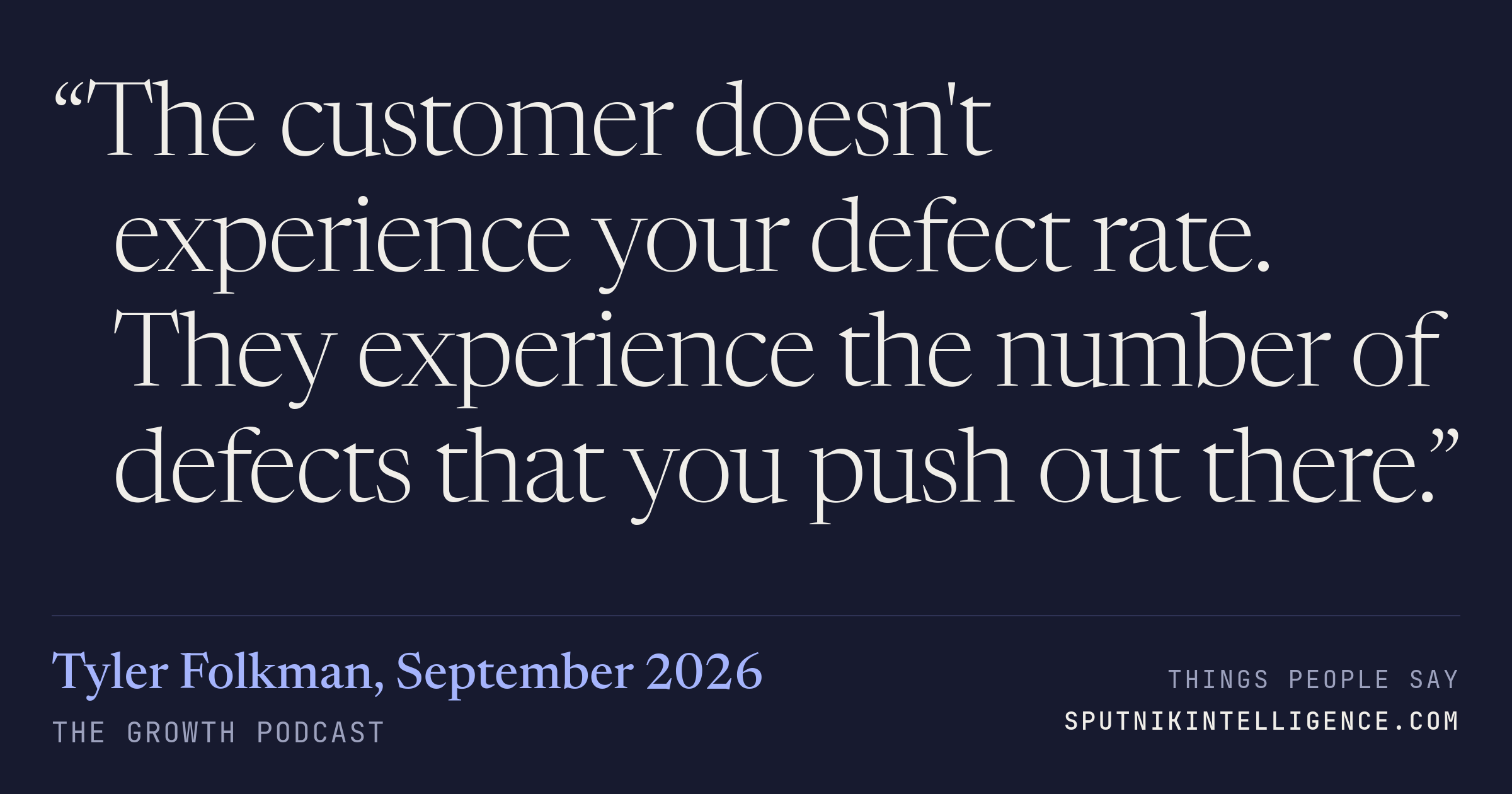
“The customer doesn't experience your defect rate. They experience the number of defects that you push out there.” — Tyler Folkman, The Growth Podcast

Folkman was explaining why the uptime of large companies looks worse than it has in years. His argument is that their quality did not get worse, they are simply shipping far more code at the same defect rate, so the same percentage now reaches many more people. It is his case for spending AI-won speed on quality checks rather than on shipping again.

The Growth Podcast · 2026-09-04 Permalink → Listen →
The Growth Podcast Around 52:15 into the episode
Tyler Folkman

Right. And it's not like, to be clear, like, I don't see that happening on our team. I think we've had some not like go all the chain, but there's been things that maybe gotten higher than you'd wanted to see. And I think it's not because people don't want to do quality work. They're feeling like they have this tool that helps them faster. And so they want to keep moving faster. Because now everyone's using it. People also aren't unaware. If you went back like a year and you were doing this, people maybe were like, holy crap, this guy's insane or this girl's insane. Now people are like, that's just AI. Like, I know this is not like thoughtful. So think about it. Use AI to help you do research, to push you to think, have it even give you its ideas. But if you end up in a meeting and your answer is Claude said that or told me that or did this thing, outside of just like normal data gathering, like it's like a code machine or a searching machine for you, that's bad. And I hear that from time to time. People are like, yeah, Claude said it would take this long to build this feature. I'm like, whoa, Claude does not know how long it won't take. And that was more like six months ago that people that I would hear that when Claude was newer on the scene, especially for PMs. I'm like, no, Claude does not. You ask Claude how long it'll take six months ago, and it's like, oh, a week. And they'd say, go build it, and it'd be like, built.

Aakash Gupta

It was crazy. It would overestimate everything. Okay. So I think I got a good sense of what loops are, what hooks are, when I need to use them. Talk to me a little bit about from product to engineering. What engineering loops should be out there? What engineering hooks should be out there? And then PMs, like interfacing with engineers. When does the PM work? PM loops end and the engineering loops begin.

Tyler Folkman

Some of the most important loops for engineers right now are quality loops. The thing that people don't talk enough about, in my opinion, is if you ship, let's say, twice as fast with AI and your quality rate maintains the same rate. Let's say you have a 1% bug defect ratio or something. Your customer experiences twice as many bugs if your quality doesn't improve. The customer doesn't experience your defect rate. They experience the number of defects that you push out there. And so we're seeing this. I mean, you look at big companies, their uptime is the worst it's been in a long time. And my opinion is it's not that their quality got worse, actually. It's that they're just. Just shipping more code. And so more things go wrong at the same rate. And we've seen that. And so we've really started and tried to invest in quality improvements through loops for engineering, like our standards, checks, automated end-to-end type testing. There's a billion things you can do there. But if you don't have AI working on the quality side, you're going to move faster and your customers will feel like you've gotten worse at building things, even if you didn't, because they will experience the velocity of more bugs. So that's where I would start. If you're looping, loop on quality for engineers.

Aakash Gupta

And should PMs be pushing PRs? Where does that go till? Should PMs be working on engineering tasks at all? I

Tyler Folkman

think it's definitely appropriate for PMs to work on engineering tasks where it makes sense. Like, let me give an example. I don't know if I'd put a PM working on our back end billing system and making upgrades to it that could impact people's money flow and all that. There's a lot of like important decisions to be made there that are more architectural. I think it's fairly reasonable to push some front-end changes where we have good decoupling from the back end, good APIs, where we have good CI/CD, good quality testing. The more you trust your system to do a lot of that checking, the more I think it's okay for anybody, UX, PM, Eng, to push. And so like I kind of mentioned before, you are at the mercy of your systems before AI. Great systems do really well with AI. If you're a company that had really bad systems and relied a lot on humans and slowness to kind of protect you, you don't want PMs coding in there because you barely want probably your engineers coding in there. But great systems, I think there's no reason PMs can't jump in and help. And the one thing I would be careful of is make sure it's agreed upon in the team because it can create some shadow work for engineers because you want code reviewed. That's the same for any engineer. And I've seen PMs be like, yeah, I just pushed this. I was working on the side. Can someone take a look? And now you've generated maybe hours of work for someone that wasn't planned on. And you might get frustrated because you're like, hey, I'm trying to ship stuff. And they're frustrated because it wasn't like agreed upon that that would be part of their workload. And as an engineering community, this is one of the things we're struggling with: how do we manage the code onslaught? Because you could have AI generate basically infinite code. So how do you do that? Systems is one thing people are thinking about, but the dirty truth is most companies' engineering systems weren't perfect before. So they're not perfect now. And I tend to push quality, like I said, on the loops because I almost think that the quality advantage of AI can beat the velocity advantage because it lets you ship safer.

Aakash Gupta

Okay, so that's one part of it, which is PMs doing engineering work. It sounds like PMs shouldn't be trying to become engineers, but if they're doing some front-end changes where, again, they have put in probably more time on it than the reviewer would need to, then it might make sense. What about the other side, which is engineers doing vibe PMing?
Speaker names from our own diarization · position estimated from where the line sits in the episode
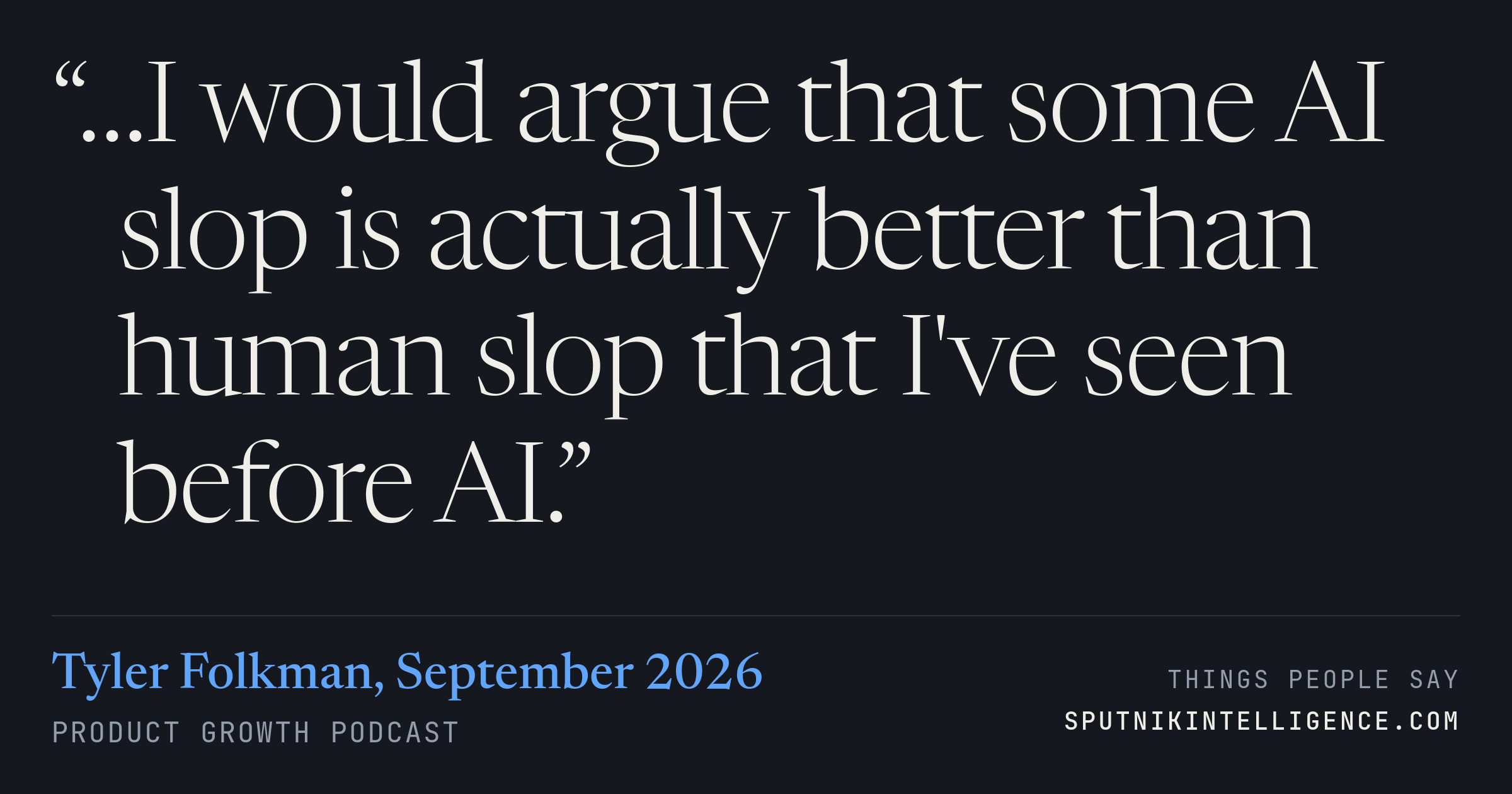
“…I would argue that some AI slop is actually better than human slop that I've seen before AI.” — Tyler Folkman, Product Growth

Aakash Gupta has just asked Folkman how to build a workflow that avoids slop. Folkman pushes back on the premise before answering, pointing out that the pre-AI baseline was not good documents and good code but people copying from Stack Overflow. He is chief AI and product officer at a company selling AI workflows, which makes the concession an odd one to volunteer.

Product Growth · 2026-09-04 Permalink → Listen →
Product Growth
Tyler Folkman

Nobody does. A lot of times, I think you're kind of almost kicking the effort over to another person, right? Like, you just keep bouncing the level of effort around where it's like, oh, I need you to do this thing. Okay, I'll have AI do it and then I'll send it back to you. And you're like, Okay, I mean, I could have done that. So, like, what was the value add

Aakash Gupta

exactly? So, how do we create like a non-slop loop? Maybe you can help us like program a loop from scratch. And

Tyler Folkman

non-slop is kind of interesting because you hear the word slop thrown around a lot. And I would argue that some AI slop is actually better than human slop that I've seen before AI. And so, one thing I like to remind people is before AI, we did not live in a perfect utopia of only good documents and good code running around the universe. A lot of stuff was bad. People don't like to remember, but we used to copy and paste code from Stag Overflow, right? Like it was not that different than AI, just less efficient. So, for me, when I think about writing a good skill, and we could even go through this. Go back here. I'll just make a temp directory. So, like, if you're going to make a skill, honestly, one of the first things you can do is, and I'll just type here, but I actually think if in the best case, you're going in here and we'll just do skill.md, which is very basic. It's not including any code. I would write the first pass by hand. There's actually a lot, not a lot, but I've read some papers that suggest that skills authored by humans are often better than the ones authored by AI. And I think the reason for that is you know more and can express more of like what you want this thing to do. And if you offload that to AI, you might tell yourself it's it's kind of like you know, e-bikes are kind of popular. I live. Like, yeah, I got an e-bike, but don't worry. Like, I still want to get exercise and we'll pedal. Once you get on the e-bike, you're not pedaling. Like, that's just the truth for most people. So, with AI, once you kind of get on the AI loop, it can be really hard to be like, now I'm going to inject my thinking because the loop's moving so fast, right? It's like you're on the e-bike and it's moving and it's fun and you're getting the dopamine. It can be a little bit hard to get off that treadmill. So, how do you start? I'd start like a human and just be like, help me make good decisions. I specifically struggle, and I'm just going to make stuff up with decision fatigue and would love someone to use more, what's like a good word for this contrarian thinking, but also help push me to make a decision. And you can tell I suck at typing now since AI. When enough thinking's been done, I also like to know latest research and have a partner that questions, pushes me, uses the Socratic method and calls my BS. Also, be succinct. I always add this because, man, if you use Opus 5, the thing likes to talk

Aakash Gupta

about the average length of responses between like and Opus 4.6. They're like in one realm, and then Opus 5 is just like so wordy.

Tyler Folkman

It's so wordy. It definitely for me regressed. It sounds more like AI than any AI I've used. It's insane.

Speaker 4

Quick thought experiment for you. Is there anything in this video you should be trying on your own? If there is, try it. Take a screenshot, post it on LinkedIn, and tag me. I'd love to see what you're learning. Now, a quick word from our sponsors before we get into the back half of the pod. I used to live in Report Purgatory. Every team had a different number. Every weekly review started with someone reconciling spreadsheets. We stopped hiring more analysts and gave the reconciliation to an AI employee instead. Victor is an AI employee that lives on Slack and Microsoft Teams. It connects to 3,000 plus tools your team already uses, ships real deliverables, and every action goes through your team for approval first. It's the closest thing I've seen to a small team running like a much larger one. Let me share three things that Victor does that changed how my team operates. First, Ask Victor has replaced our Monday metric scramble. Someone types flag any customer whose usage dropped 40% week over week and draft an outreach loom for the account owner to approve. 90 seconds later, the next step is ready. Second, scheduled tasks run the work that nobody wants to remember. Every morning, Victor checks overnight support tickets, drafts replies for the on-call to approve, and escalates anything mentioning churn. Nobody had to ask for it. Finally, spaces ship internal tools in minutes. Ask for a renewals dashboard, Victor builds it with authentic database and posts the link to your channel. The team can stop opening four tabs to get the same view. So stop chatting with AI and start working with it. Get started at Victor.com. There's $100 in free credits with no card required at viktor.com/slash akashgupta3. You can find that link in the description. Quick

Speaker names from our own diarization · position estimated from where the line sits in the episode

Collections They Appear In