
Luca Rossi has just described the bind: agent-assisted review raises code quality but saves the human reviewer no time, so the reviewer stays the bottleneck. Pilarinos answers that the ritual itself is the mismatch, not the tooling around it. Rossi restates it back as producing at agent speed and reviewing at human speed.
organization can define what are the risks, like what's the blast radius for any potential code review. And depending on where it comes into that risk assessment, if it's low, let it go. Right. So if it's, yeah. So like you just have people who are only looking at the things that matter, right? The things that are important to go and look at.
Yeah, and I completely agree. Even in my own small-scale experience, it feels like the real unlock is when you can find reliable ways to have parts of the code that gets pushed that doesn't need you to inspect it manually and do the human code review. Because otherwise, my feeling, but I would love your take on that is, of course, code reviews with agents help a lot in keeping quality high at a code review time. But as a human reviewer, if I still need to do a review, they're not making me save a lot of time because I still have to go through the code, right? So I'm increasing quality, but I'm not increasing my own productivity in a way that is that meaningful. So chances are I'm still bottlenecked, you know, if the amount of PRs has grown a lot.
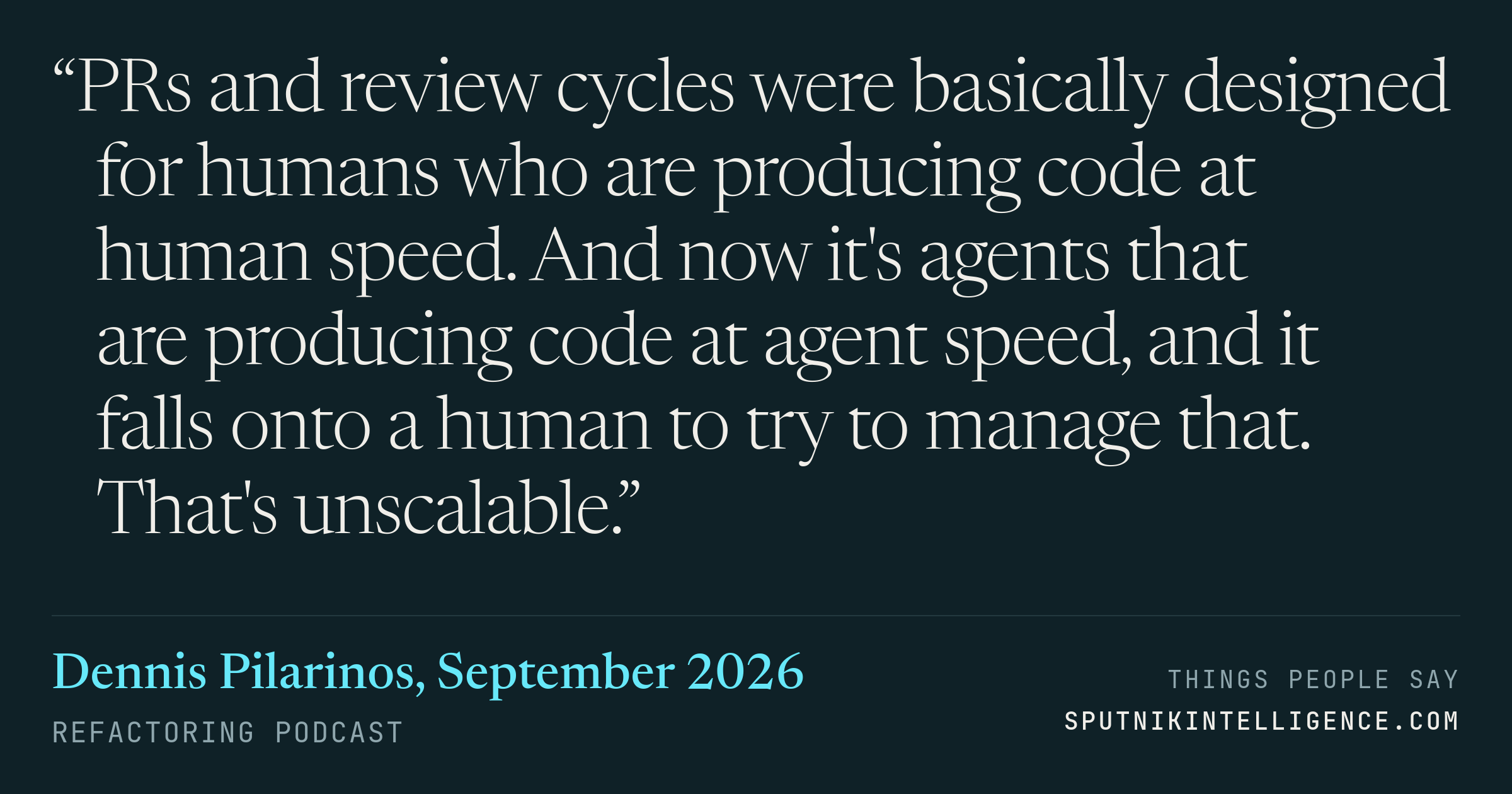
Yeah, I mean, I think PRs and review cycles were basically designed for humans who are producing code at human speed. And now it's agents that are producing code at agent speed, and it falls onto a human to try to manage that. That's unscalable.
Yeah. Yeah. Basically, the mismatch is that we want to produce code at agent speed and review it at human speed. And obviously, something has to give here.
Yeah. It kind of reminds me of like, I have this meme in my head of like a man standing on the other side of a machine, like the machine's, I don't know, spewing out widgets or what have you. And it kind of reminds me like a black and white, one of those things that you see on Instagram or the memes where like it's spitting out all this stuff and the guy's trying to like frantically take care of it. Maybe it was like, I love Lucy or, you know, something with pies or whatever, right? Like anyway, that's the thing that comes to mind.
Yeah, that's probably, I'm thinking about software engineers juggling pies and it's probably a good picture versus for the current state of code reviews that it's very bad. So you mentioned code quality before. And of course, in all surveys and research, keeping code quality high and all the concerns about code reviews are like top of mind of engineers when it comes to writing code with AI. Are you seeing like code quality going down or are you seeing instead teams being able to keep it at a good level by doing this and that? What's the state of code quality from your vantage point?