SF

Steve Furber

Things Steve Says on Podcasts

Where to Find Them

Steve Furber has been a guest on EE Times Current (2 times) , The Peterman Post , The Developing Dev and The Peterman Pod .

Recently: “How Two First-Timers Created the World’s Most Popular Processor | Steve Furber” on The Peterman Post (November 2026); “How Two First-Timers Created the World’s Most Popular Processor | Steve Furber” on The Developing Dev (November 2026); “How Two First-Timers Created the World’s Most Popular Processor | Steve Furber” on The Peterman Pod (November 2026); “Fixing AI’s Bottlenecks: Memory, Scale, and Sparsity” on EE Times Current (April 2026); “ARM Inventor Steve Furber on SpiNNaker 1, 2, and Beyond” on EE Times Current (November 2023).

What They Said

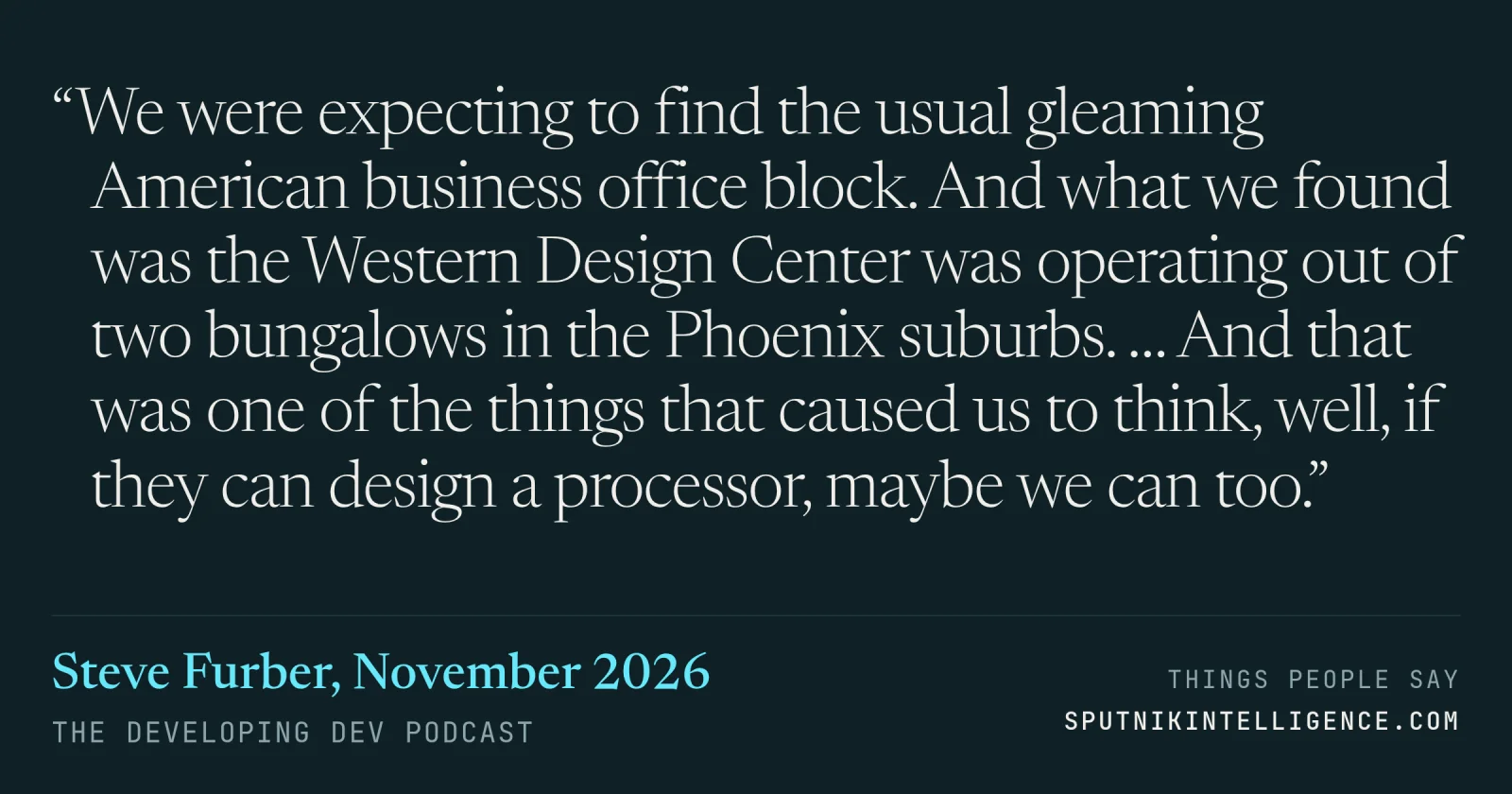
“We were expecting to find the usual gleaming American business office block. And what we found was the Western Design Center was operating out of two bungalows in the Phoenix suburbs. … And that was one of the things that caused us to think, well, if they can design a processor, maybe we can too.” — Steve Furber, The Developing Dev

Furber recalls a 1983 visit to the company designing the 6502's successor. Seeing how small the operation was made chip design look less intimidating, and helped convince Acorn's first-time team to design what became the ARM processor.

The Developing Dev · 2026-11-16 Permalink → Listen →
The Developing Dev
Steve Furber

…ARM chip had a three-level pipeline, which meant it could do fetch, decode, execute, and complete one instruction per tick. Not all the instructions were single tick, but most were. And yeah, it's just a lot of the industry was slow to recognize this and then slow to work out what to do with it.

Ryan Peterman

When you were deciding. To build ARM. I understand that when you also visited America. What was the difference in the work cultures in computing between the UK and the US and your perspective?

Steve Furber

Our visit to the States, I think was in October 83, was to the Western Design Center in Phoenix, Arizona, where I think it was just Sophie and I went and we were expecting to find the usual gleaming American business office block. And what we found was the Western Design Center was operating out of two bungalows in the Phoenix suburbs. These bungalows had some fairly unusual equipment around them, but they were getting school kids in over the summer to design cell libraries. And our main interest there was they were developing a successor to the 6502, which was the 65C816, if I remember right, which had a bit of an address extension, so it would address more memory than the 6502. And Acorn did use that in some of their products subsequent to the BBC Micro. But it wasn't the big step forward, it was an incremental improvement. And we came away from seeing those bungalows, which were sort of much less professional than we were anticipating, let's put it that way. And that was one of the things that the causes think, well, if they can design a processor, maybe we can too.

Ryan Peterman

Did Acorn ever consider building their own fab for these chips?

Steve Furber

No.

Ryan Peterman

And why is that?

Speaker names come from our own diarization. The position is estimated from where the line sits in the episode.
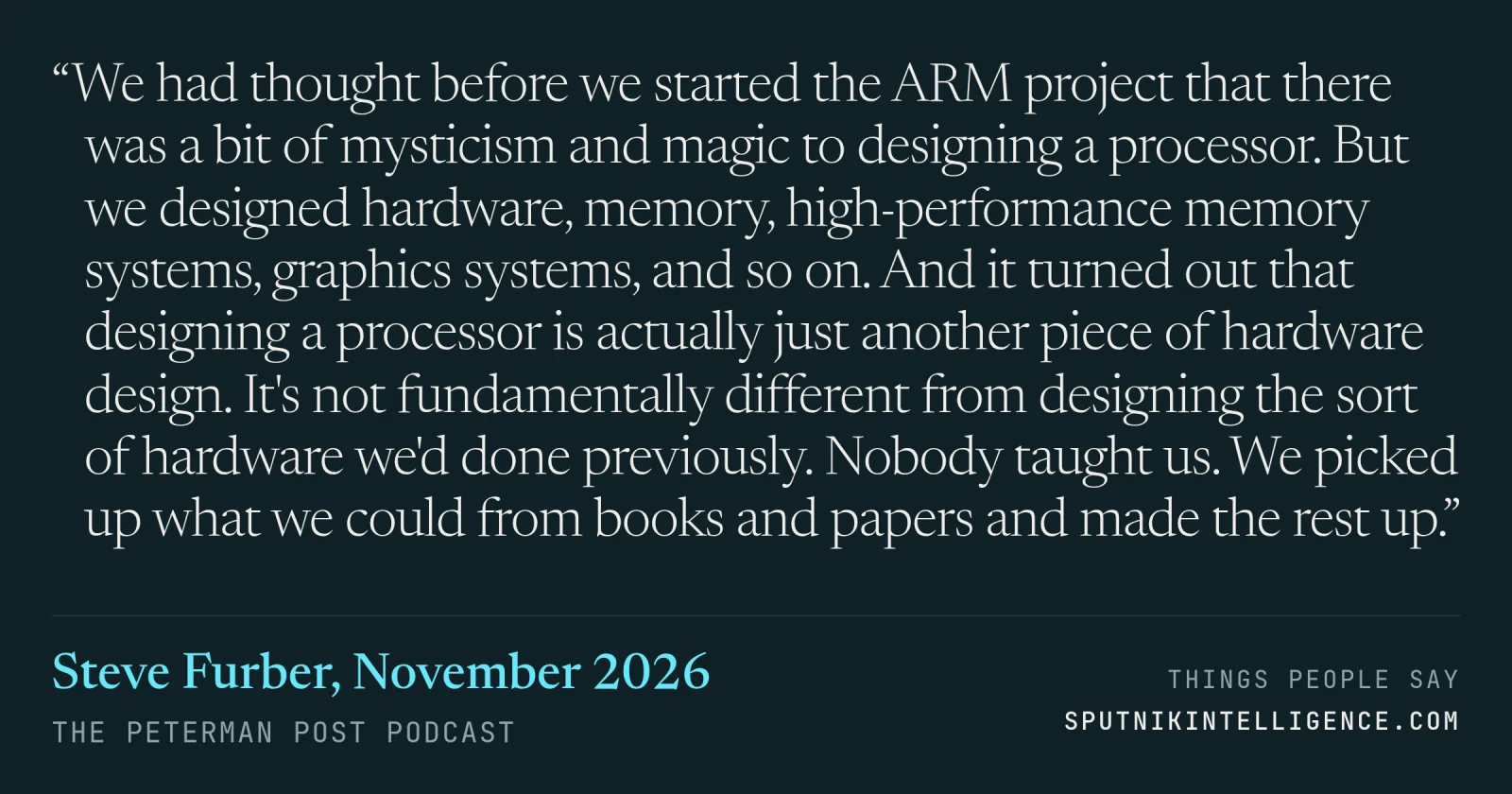
“We had thought before we started the ARM project that there was a bit of mysticism and magic to designing a processor. But we designed hardware, memory, high-performance memory systems, graphics systems, and so on. And it turned out that designing a processor is actually just another piece of hardware design. It's not fundamentally different from designing the sort of hardware we'd done previously. Nobody taught us. We picked up what we could from books and papers and made the rest up.” — Steve Furber, The Peterman Post

Ryan Peterman asked how a small team with no processor experience designed the first ARM chip. Furber says they learned from the published Berkeley RISC papers and found processor design less mysterious than they expected.

The Peterman Post · 2026-11-16 Permalink → Listen →
The Peterman Post
Steve Furber

…and pieces of paper. You'd do it with a diagram you drew on a computer and then you could probably still want to color it in by hand for the first iteration, you know, on the computer. But back then, in 1983, finding a computer you could do that on usefully was harder than finding a photocopier.

Ryan Peterman

When I hear all of this, my immediate thought is: how did you learn all of this? Because not that schooling is everything, but your PhD was in aerodynamics. So I get the sense that you had to pick up all of this kind of by doing it. Where did you learn all of this?

Steve Furber

I think we made it up. I mean, we had, you know, the Berkeley papers to refer to, and I think we had there was a book written on the Berkeley RISC processes by Katavinis. It was his PhD thesis. I think he's still a professor at a university in Greece. And that went into quite a lot of detail as to how the Berkeley RISC processors were conceived and put together. And I think we just worked from that and made things up. I mean, yes, nobody on the Acorn team had had any involvement in designing a processor before. It was our first attempt for all of us. But we were quite experienced at designing hardware. We had kind of thought before we started the ARM project that there was a bit of mysticism and magic to designing a processor. But we designed hardware, memory, you know, high-performance memory systems, graphic systems, and so on. And it turned out that designing a processor is actually just another piece of hardware design. It's not fundamentally different from designing the sort of hardware we'd done previously. Nobody taught us. We picked up what we could from books and papers and made the rest up.

Ryan Peterman

OpenAI, Anthropic, and Cursor all use this product to make their lives easier. WorkOS is an API platform that adds enterprise features like SSO, Skim, and RBAC to your app. These are things that you need to sell to other companies, but aren't the main focus of what you're building. And now they've…

Speaker 3

And I mean, the results were incredible. You mentioned maybe a nine times speed up compared to some of the competing offerings. And I guess why was this team so successful? Because this was your first time ever doing it and there was a bit of mysticism around this process to even begin with. And…

Steve Furber

I think. The culture at Acorn at that time was very strong. We'd done a number of quite challenging things and pulled them off. You know, there were things the BBC Micro did that nobody had done before, one of which was telesoftware. This was still before the days of the World Wide Web. And to…

Speaker names come from our own diarization. The position is estimated from where the line sits in the episode.

Collections They Appear In