The episode was about the SEC's proposal to let public companies report twice a year instead of quarterly, partly to make going public more attractive. Steinberg argued that it won't work, since companies already do the quarterly work and the savings are small.
…talk about this current SEC's priority is capital formation, is that potentially on a collision course with the stripping of investor protections? Because the reason that investors want to put capital into the U.S. is precisely because they have confidence that there will be investor protection.
Right. I mean, that's what it seems like to me. Like the provision of capital should be conditioned on the idea that I would be protected as an investor.
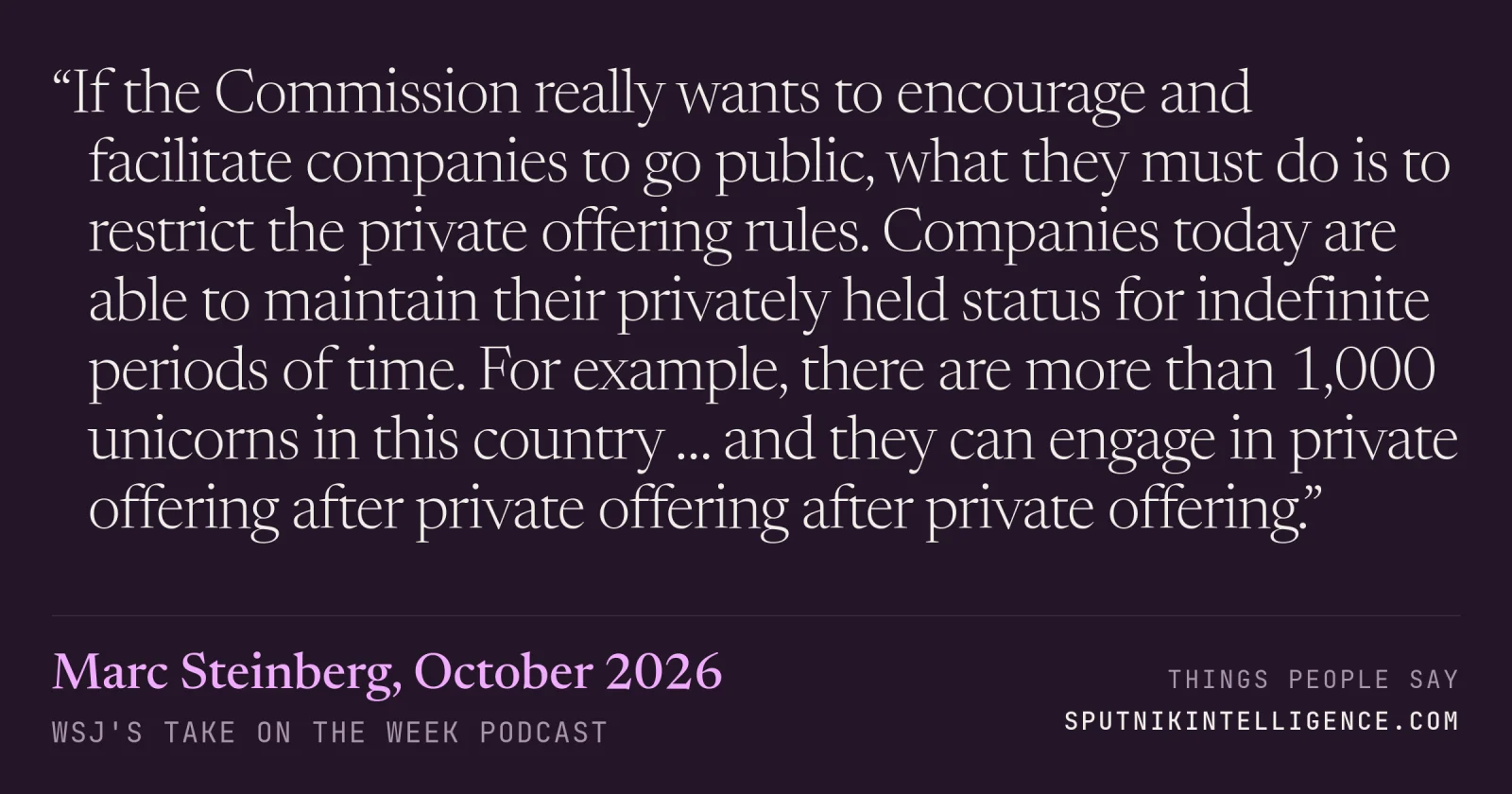
…to go public. And he thinks that this type of going to semi-annual reporting will help induce companies to do this. He is wrong. He is wrong, first of all, based upon much of this discussion we've already had, and that is the companies are already engaging in these quarterly financial review activities. The cost savings are minimal, as shown by the Commission's own studies. And thirdly, if the Commission really wants to encourage and facilitate companies to go public, what they must do is to restrict the private offering rules. Companies today are able to maintain their privately held status for indefinite periods of time. For example, there are more than 1,000 unicorns in this country, companies that have assets of over a billion dollars, and they can engage in private offering after private offering after private offering with a lack of material information being disclosed in some of these deals and thereby avoid being elevated into the public markets. If the private offering rules are made more restrictive, this will induce these larger companies to go into the public…
But are companies asking for this? I mean, does it benefit companies to have this change?
And so far as I'm aware, the companies were not lobbying for this. They were not seeking this. Now, there are some companies that are in favor of the semi-annual reporting. For example, Eli Lilly wrote a letter saying that they would go to semi-annual reporting, as I believe, as did Exxon, if I…
Is it a cost-saving thing? Why would a company like Eli Lilly want to move to semi-annual reporting?