AG

Al Gore

Things Al Says on Podcasts

Where to Find Them

Al Gore hosts Speed & Scale and writes Book Club with Michael Smerconish . They have also been a guest on StrictlyVC Download (4 times) , Zero: The Climate Race (4 times) , Climate One (3 times) , StarTalk Radio (2 times) , Outrage + Optimism: The Climate Podcast (2 times) , Heatmap News , Bloomberg Surveillance , Grit , Future of StoryTelling (FoST) , Ground Truths , GZERO World with Ian Bremmer and You Might Be Right .

Recently: “Al Gore: Fossil fuels are losing their two main markets” on Zero: The Climate Race (November 2026); “Al Gore on AI, ‘An Inconvenient Truth,’ and the Biggest Surprises of the Past 20 Years” on Heatmap News (September 2026); “Al Gore on the $4.5 Trillion Clean Energy Opportunity” on StrictlyVC Download (September 2026); “Al Gore: Fossil fuel companies are destabilizing democracy and environment” on Zero: The Climate Race (November 2025); “Al Gore says 'We may have passed peak Trump'” on Zero: The Climate Race (November 2025); “Inside COP: Al Gore on Fossil Fuel Lobbying and (In)convenient Truths” on Outrage + Optimism: The Climate Podcast (November 2025).

What They Said

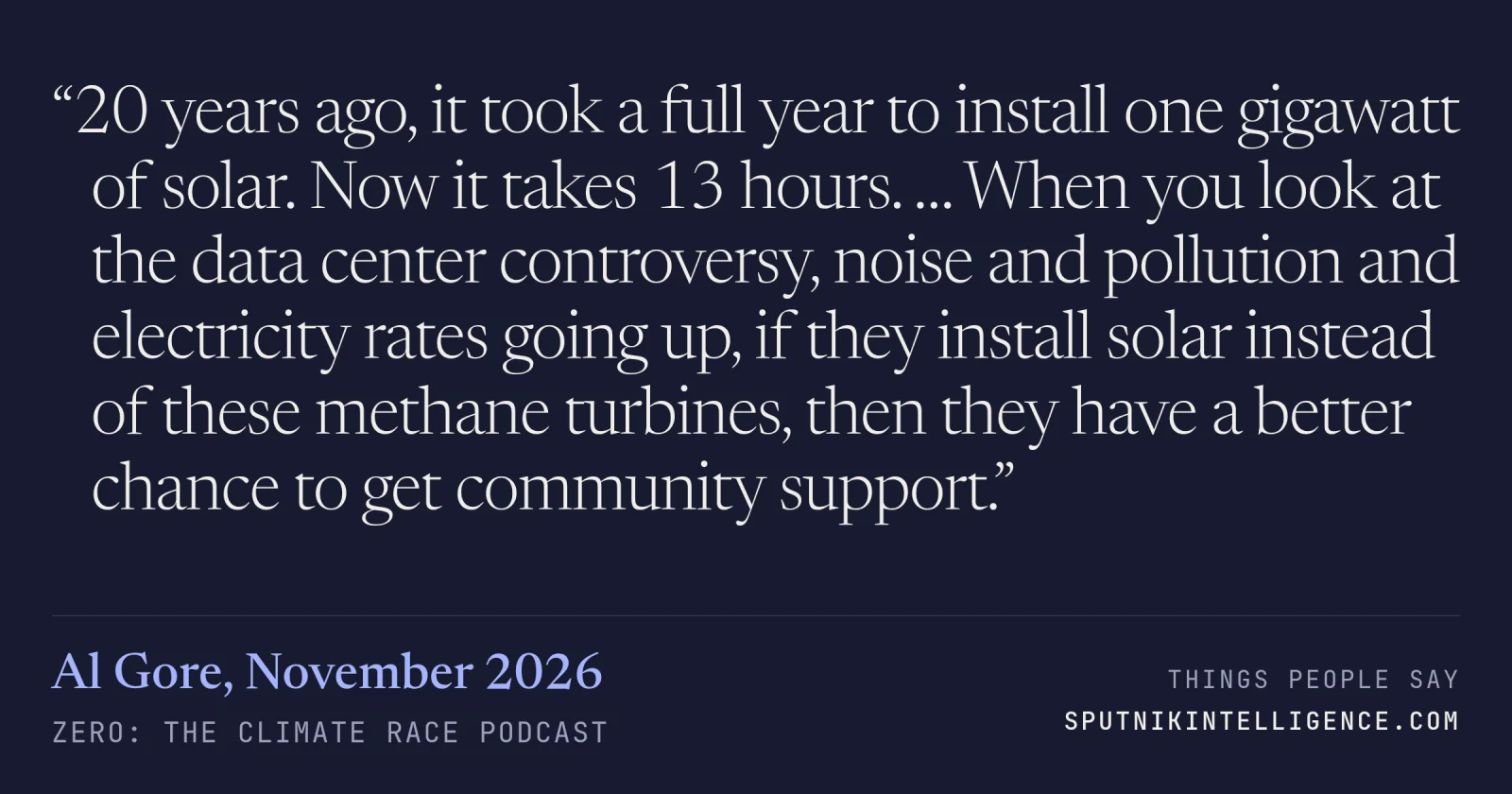
“20 years ago, it took a full year to install one gigawatt of solar. Now it takes 13 hours. … When you look at the data center controversy, noise and pollution and electricity rates going up, if they install solar instead of these methane turbines, then they have a better chance to get community support.” — Al Gore, Zero: The Climate Race

Asked how to shift public opinion on climate when urgency is missing, Gore lists reasons he expects a positive tipping point. He ties falling solar costs to the local backlash against data centers.

Zero: The Climate Race · 2026-11-17 Permalink → Listen →
Zero: The Climate Race Around 32:04 into the episode
Al Gore

…as they're trying to sabotage negotiations on climate for the same reason. But I don't think that can continue forever. I think there are going to be very determined business projects to accelerate at scale the development of substitutes for these petroleum-based petrochemicals and plastics.

Akshat Rathi

…were above, on a global scale, above 2 degrees Celsius. Extreme weather events are getting worse. You've had Nepal, you've had the Pakistan floods a few years ago. And yet there isn't that desire to act urgently in the public consciousness. How do you change the public consciousness on this issue?

Al Gore

…borders within 25 years. And I think that the awareness of how these impacts are increasing is quite significant. And on the sustainability technology side, 20 years ago, it took a full year to install one gigawatt of solar. Now it takes 13 hours. And that is going down further. 0.1 cents per kilowatt hour for the electricity produced. That's why they're dominating the scene now. And when you look at the data center controversy, noise and pollution and electricity rates going up, if they install solar instead of these methane turbines, then they have a better chance to get community support. And I think they're going to, in a lot of sectors, they're going to be shifting more toward renewable energy.

Akshat Rathi

Before coming into the conversation, I was telling people I'm going to interview you, and I wanted to ask them, you know, what is it that you would want to hear from Al Gore most? And they said, we love it when he rages about the moral righteousness of the case for climate action, and that is still…

Al Gore

that works on the internet. I didn't know it had come to Bloomberg television. But what kind of rage would you like, Arshai? I mean, I can certainly summon it on short notice.

Akshat Rathi

Well, I hope you continue to do it across all platforms for many years to come because it's important and climate action still is definitely. Well, let me just
Speaker names come from our own diarization. The position is estimated from where the line sits in the episode.
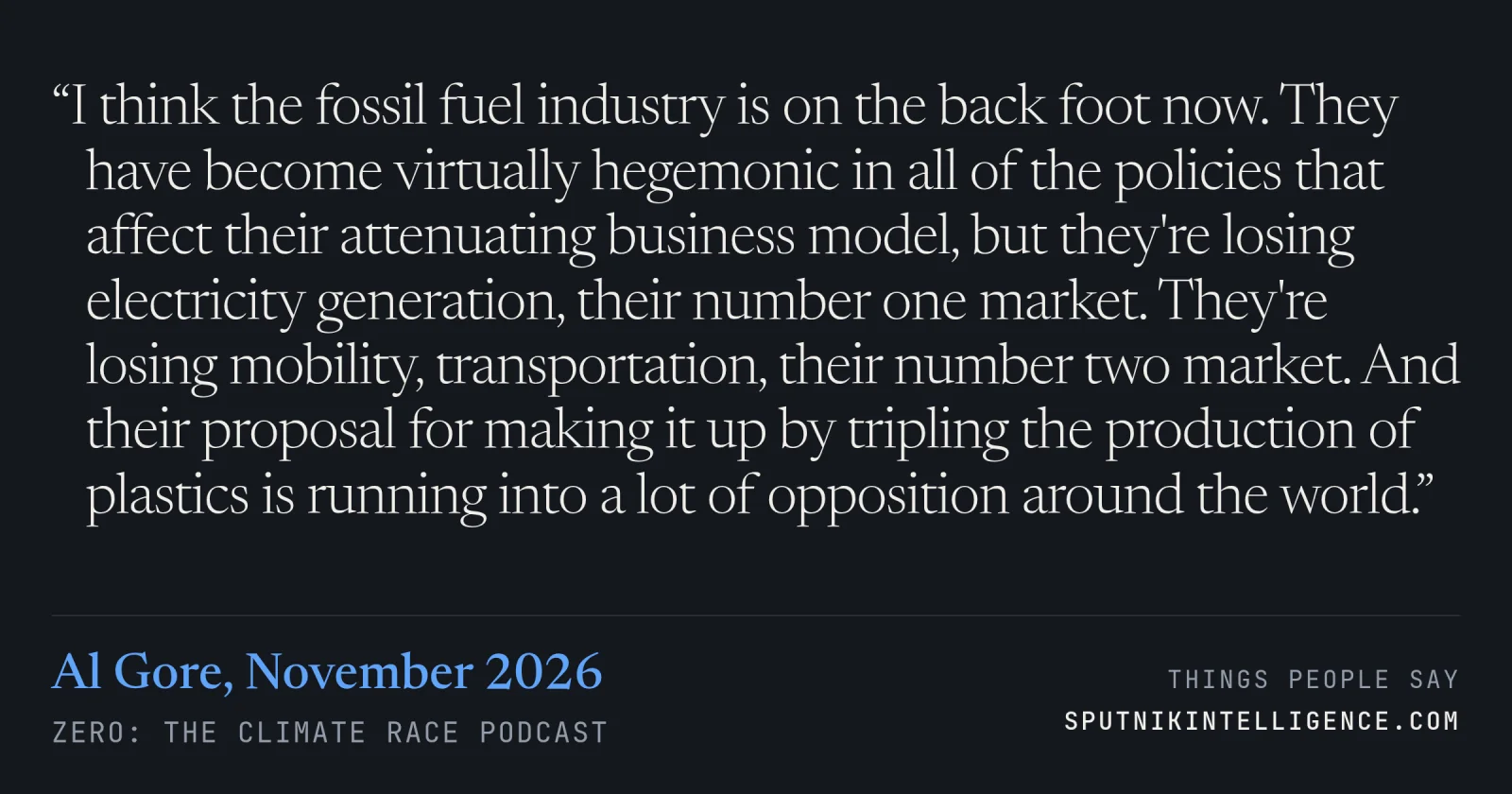
“I think the fossil fuel industry is on the back foot now. They have become virtually hegemonic in all of the policies that affect their attenuating business model, but they're losing electricity generation, their number one market. They're losing mobility, transportation, their number two market. And their proposal for making it up by tripling the production of plastics is running into a lot of opposition around the world.” — Al Gore, Zero: The Climate Race

Asked what he would put in a new documentary 20 years after An Inconvenient Truth, Gore lists finance, permitting, heat pumps and AI. He then sets out where he thinks the fossil fuel industry is losing ground.

Zero: The Climate Race · 2026-11-17 Permalink → Listen →
Zero: The Climate Race Around 30:30 into the episode
Al Gore

…well-formed proposals. I think the world will welcome that when it happens. And if there is a new president in January of 29 who's articulate and bold and has good proposals and a good team, I don't think that the bad feelings over the Trump years will be a bar to reestablishing U.S. credibility.

Akshat Rathi

Now, coming to an inconvenient truth, came out 20 years ago. It moved a lot of people to act on climate. If you were to make a documentary of that kind today, what would you say in it?

Al Gore

…exploring the improvements in efficiency. Nick Stern and his colleagues at the London School of Economics published a very influential study a few months ago showing that the use of AI to reduce emissions may be much more formidable than the increased emissions from the data centers. I think we'll have to wait and see. It's also being used by fossil fuel companies to expand their production. But I think the fossil fuel industry is on the back foot now. They have become virtually hegemonic in all of the policies that affect their attenuating business model, but they're losing electricity generation, their number one market. They're losing mobility, transportation, their number two market. And their proposal for making it up by tripling the production of plastics is running into a lot of opposition around the world. How's that working out for the rest of us? I think it's a bit preposterous to think that they've blown up the UN negotiations on plastics as they're trying to sabotage negotiations on climate for the same reason. But I don't think that can continue forever. I think there are going to be very determined business projects to accelerate at scale the development of substitutes for these…

Akshat Rathi

So I hear you saying a lot of the development in the last 20 years that you would put in this new documentary, if you make one, would be around technology. But the thing that needs to happen beyond the technology is the social side. Your case in the movie was to get people to see the urgency needed…

Al Gore

Well, I think there are a number of factors that are likely to change that. You know, in the 20th century, there was an American economist named Rudy Dornbush who has an economic law. I use air quotes named after him. And Dornbush's law says things take longer to happen than you think they will…

Akshat Rathi

Before coming into the conversation, I was telling people I'm going to interview you, and I wanted to ask them, you know, what is it that you would want to hear from Al Gore most? And they said, we love it when he rages about the moral righteousness of the case for climate action, and that is still…

Speaker names come from our own diarization. The position is estimated from where the line sits in the episode.

Collections They Appear In