
Bobby Samuels

Things Bobby Says on Podcasts

CEO at Protege | Unlocking Data Access for AI Development

Where to Find Them

Bobby Samuels writes a16z and writes Raising Health . They have also been a guest on Summation with Auren Hoffman and The Information's TITV . They also write for Protege on Substack.

Recently: “Protege CEO Bobby Samuels on the data nobody has unlocked yet” on Summation with Auren Hoffman (October 2026); “The Oracle Problem: an invisible bottleneck to AI and medicine” on a16z (August 2026); “The world needs an AI lab — for Data” on a16z (March 2026); “Building the Marketplace for AI’s Most Valuable Asset” on Raising Health (February 2026); “Building the Marketplace for AI’s Most Valuable Asset” on Raising Health (February 2026); “Why Data Is AI's Biggest Problem, Solana's ETF Ambitions & Your AI Shopping Agent | Aug 21, 2025” on The Information's TITV (August 2025).

What They Said

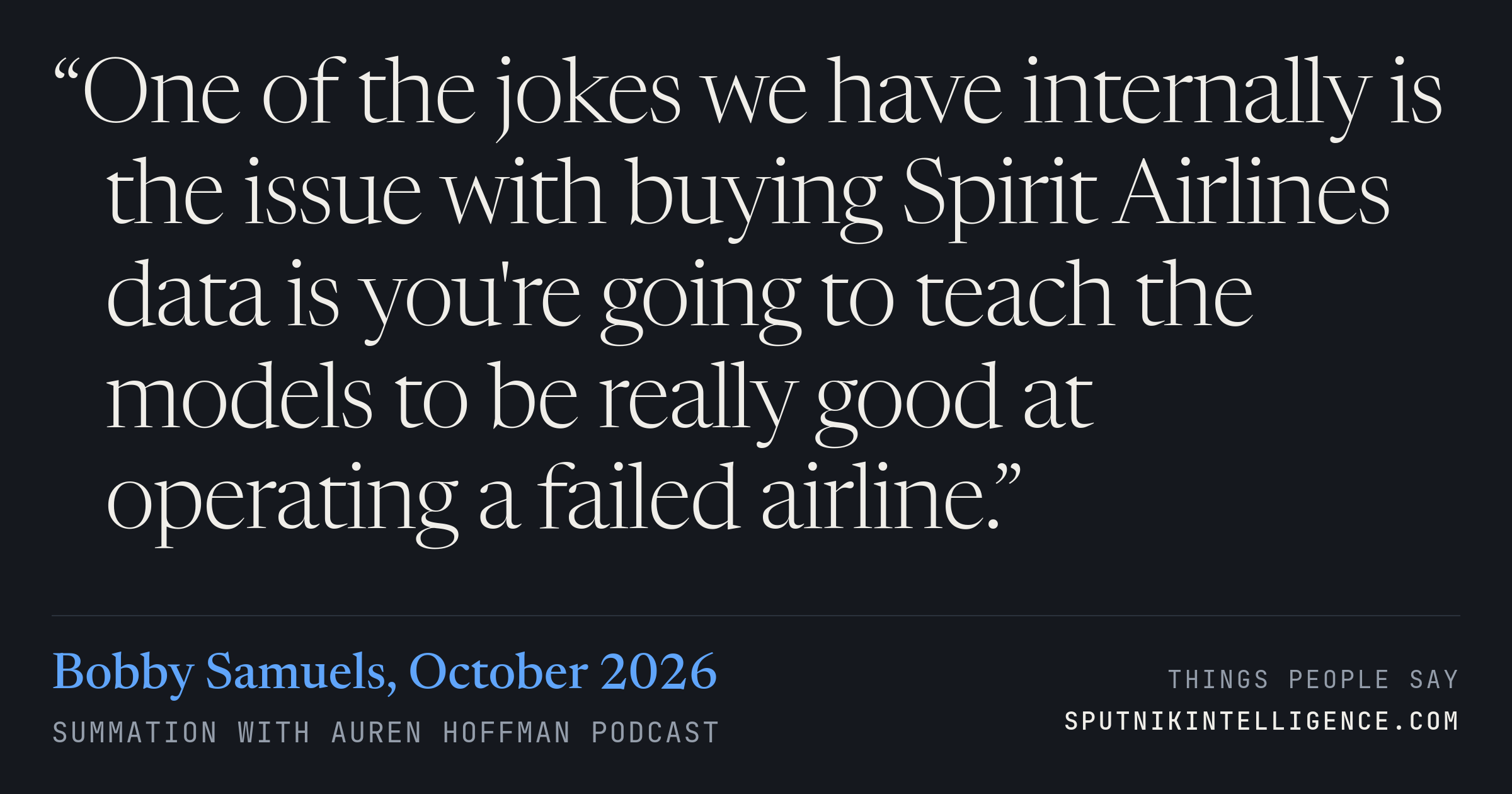
“One of the jokes we have internally is the issue with buying Spirit Airlines data is you're going to teach the models to be really good at operating a failed airline.” — Bobby Samuels, Summation with Auren Hoffman

Samuels and Auren Hoffman were discussing companies that wind down failed businesses and sell off their internal data, and whether that could become a revenue stream for others. Samuels's company brokers real-world data for AI training.

Summation with Auren Hoffman · 2026-10-13 Permalink → Listen →
Summation with Auren Hoffman Around 21:30 into the episode
Bobby Samuels

…public. That's how they make money, yeah. Yeah, and like this selling the data. I mean, I actually, it's an interesting thing for like non-profits to think about where this is like material could be like a material revenue stream for them. Um, if they, if they're licensing some of this data,

Auren Hoffman

oh, interesting, and yeah, that could also probably like there's a whole other set of ways you're interacting in a nonprofit that might be different than a for-profit or something like that.

Bobby Samuels

Yeah, I mean, that is one of one of the jokes we have internally is the issue with buying Spearlin's Spirit Airlines data is like you're going to teach the models to be really good at operating a failed airline, right? Right, totally, right, right. So, you might uh run into the same thing if you're figuring out how to

Auren Hoffman

charge the uh consumers for literally every single thing that they do, including a bag of peanuts or something. Yeah, perfect, perfect, just using our AI. Uh, like about 20 years ago, one of my friends was doing early version of AI, and the way he was training the data was the Enron emails. Um, I…

Bobby Samuels

Totally. And that I think I've heard of other folks subsidizing. I mean, I think it sounds like he was on the earlier side of doing that, but I've heard of other folks doing that. Again, like it is this meta question of what are you ultimately, what are you teaching the models to ultimately do if…

Auren Hoffman

No, I mean, in some ways, you are a store, right? You're going sourcing interesting goods and then you're selling those goods multiple times. And part of what you do is just being able to do procurement and sourcing it. And then, how does like a data store end up being very valuable? And it's, and…
Speaker names from our own diarization · position estimated from where the line sits in the episode
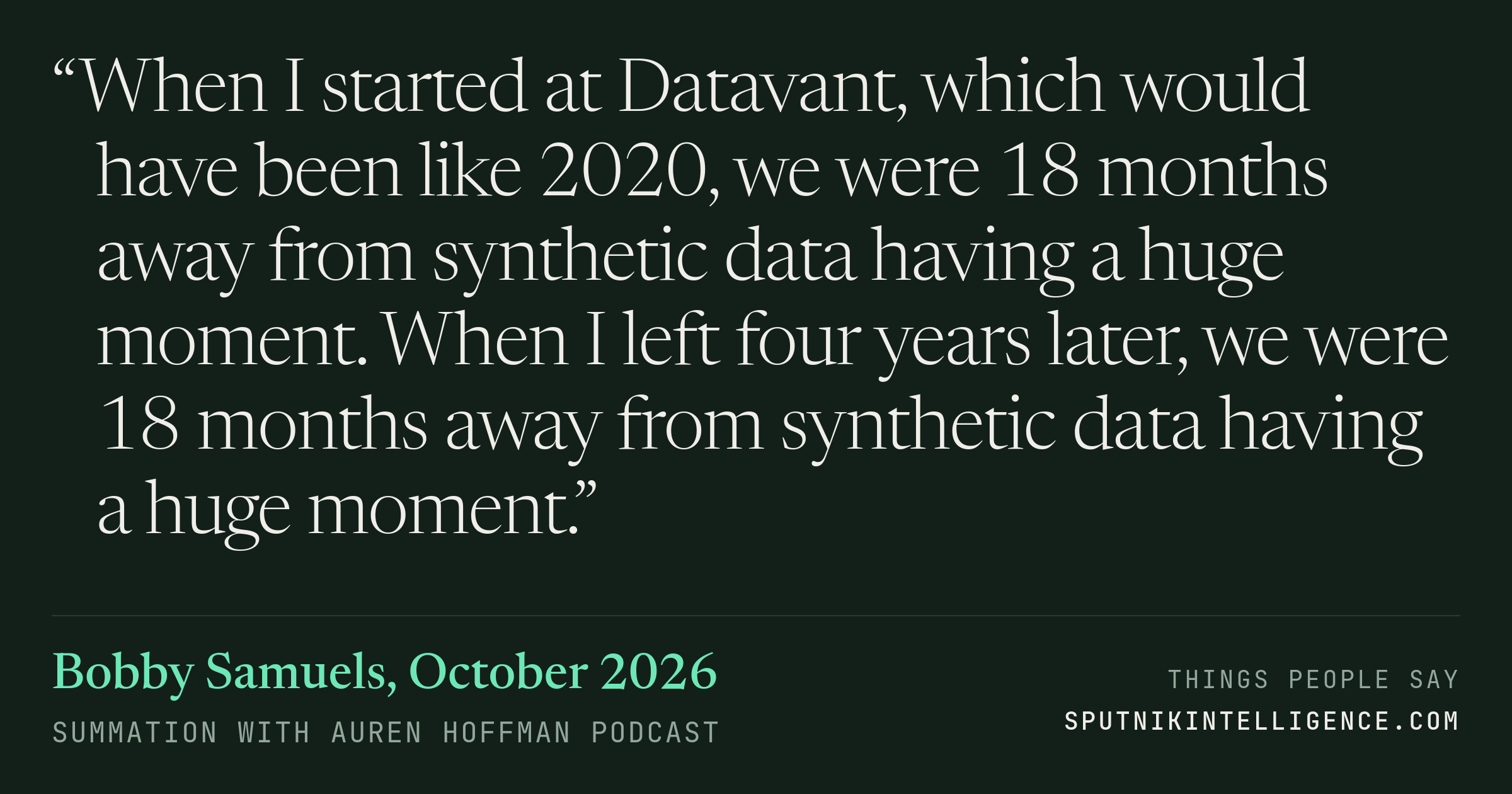
“When I started at Datavant, which would have been like 2020, we were 18 months away from synthetic data having a huge moment. When I left four years later, we were 18 months away from synthetic data having a huge moment.” — Bobby Samuels, Summation with Auren Hoffman

Auren Hoffman asked why synthetic data was so hot a few years ago and why fewer people talk about it now. Samuels says it's compelling when data limits scaling, but nuanced tasks need real-world data. Data made up by people or by AI comes out stilted and full of bias.

Summation with Auren Hoffman · 2026-10-13 Permalink → Listen →
Summation with Auren Hoffman Around 54:27 into the episode
Bobby Samuels

…a bunch of applications subject to the same rules that make any company good. And so if you're just doing another Me Too kind of company, you're going to, it's going to be hard. But I think your point around like the, you're always going to, things don't stay static. Yeah. Things don't stay static.

Auren Hoffman

Now, there was a point, maybe, maybe a couple of years ago where everyone was talking about synthetic data. And for whatever reason, people aren't talking about that as much anymore. Like, why was it so hot a few years ago? And why is it like less hot now?

Bobby Samuels

So in the healthcare world, when I started a data van, which would have been like 2020, we were 18 months away from synthetic data having a huge moment. When I left four years later, we were 18 months away from synthetic data having a huge moment. And it always feels like we're like right there. But look, I think that there is a, there's something super compelling about the idea of in the context of a scaling of scaling laws where data is a huge constraint. If you can scale up with synthetic data, that is like a very, very compelling concept. And I think the research community has sort of gone back and forth over time to your point on whether it is valid. I think that as data has gotten more focused on not even niche use cases, but things that are a little bit more nuanced, it is clear that real world data is where things need to go. And I mean, you can think about it, like if a company wants to build an agent to create a deck, PowerPoint deck, you want to have the deck itself, but you want to have all…

Auren Hoffman

guess you kind of like, if you're the Pentagon or something, okay, like you might need to create synthetic data around like a war with an adversary because like the, okay, there is no data about, well, you know, there is no data about that. So maybe somehow we need to create it. I don't even know…

Bobby Samuels

I think that there is a place for synthetic data. The ones that I, the use case I see is like most compelling is you basically like want to, if there's like highly sensitive data that you want to be able to look at before you license or can only be shared in very sensitive situations, you basically…

Speaker 3

Yeah. But I'm open to being proven wrong. Totally, me too.

Speaker names from our own diarization · position estimated from where the line sits in the episode

Collections They Appear In