Eric Pan

Things Eric Says on Podcasts

Where to Find Them

Eric Pan has been a guest on Schwab Network (2 times) , The AI Podcast (NVIDIA) and The Amp Hour Electronics Podcast .

Recently: “Seeed in Shenzhen with Eric Pan” on The Amp Hour Electronics Podcast (October 2026); “Everyone Can Build a Robot: Open Source Embodied AI With Seeed Studio | NVIDIA AI Podcast Ep. 300” on The AI Podcast (NVIDIA) (May 2026); “Pan: American Investors are Making Good Choices” on Schwab Network (February 2026); “Pan: Dry Powder Sitting on Sidelines, Waiting on Trade Deals” on Schwab Network (June 2025).

What They Said

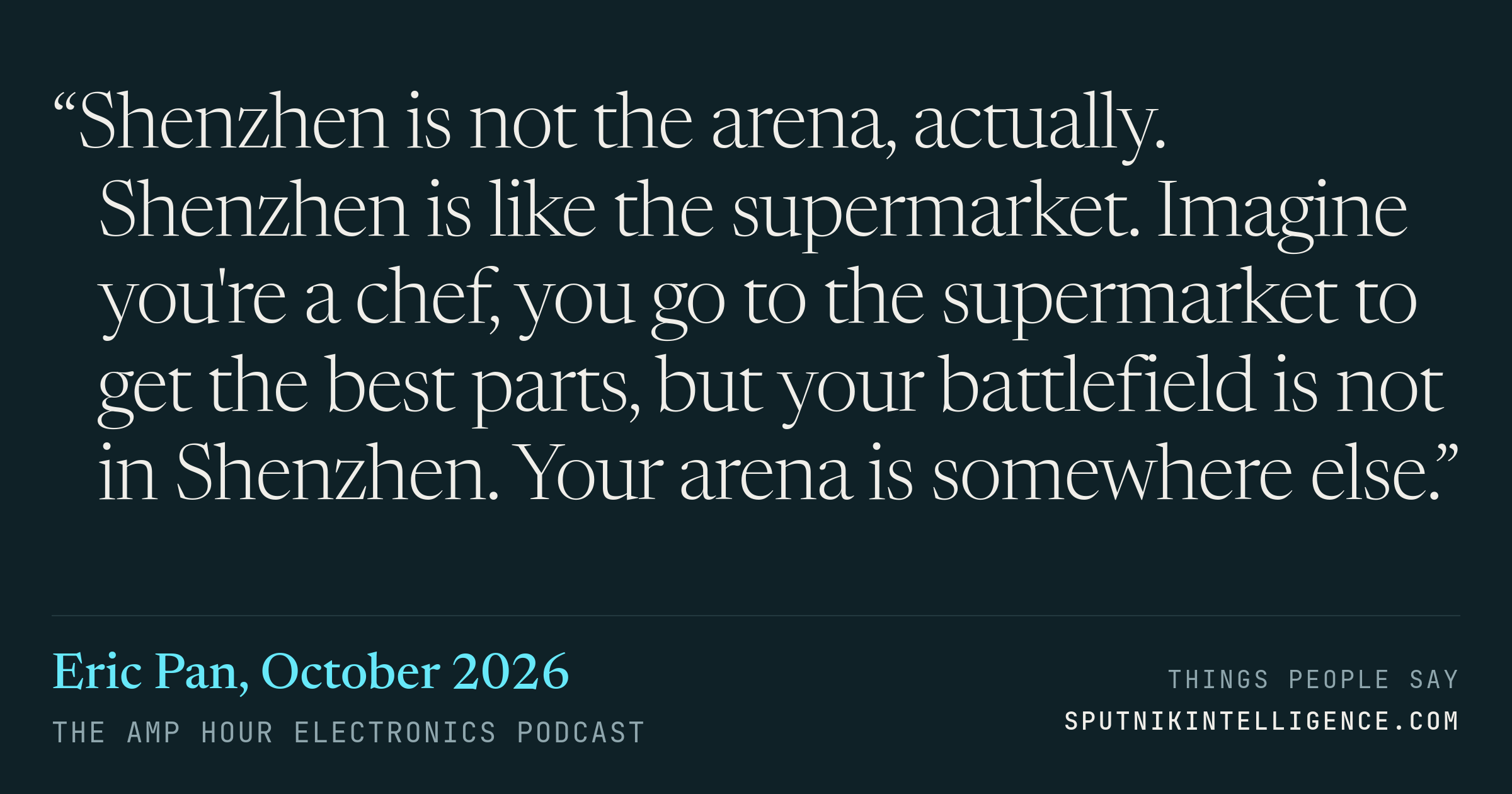
“Shenzhen is not the arena, actually. Shenzhen is like the supermarket. Imagine you're a chef, you go to the supermarket to get the best parts, but your battlefield is not in Shenzhen. Your arena is somewhere else.” — Eric Pan, The Amp Hour Electronics Podcast

Pan is describing how he thinks outsiders should use Shenzhen's electronics industry. The real work, he says, happens in your own town or your own field, which may be farming or energy rather than electronics. Shenzhen is where you collect the ingredients.

The Amp Hour Electronics Podcast · 2026-10-07 Permalink → Listen →
The Amp Hour Electronics Podcast Around 38:42 into the episode
Eric Pan

Yeah, I think for the last 18 years, we're trying to help people to build hardware. But for the last three to four years, I think we are trying very hard to convince people not to build hardware. Interesting, which means like if you design something in North Korea and use GLC to deliver the boards, it might still be too slow. But you look at existing gadgets, look at existing hardware and customize it, or just put your firmware, put your data, your model into that to be part of. Your context, that's much faster and more reliable.

Chris Gammell

Yeah, so it's kind of like a zoom out effect of like, uh, so it's like going more holistic in terms of just being like a service provider of like, you know, put in file, get gadget back. It's like, no, no, let's let's look at the best solution that will actually allow you to go to market, go to get scale quickly, that sort of thing. So it's almost like an advisory role, that kind of piece of it.

Eric Pan

If I put into a picture, it's like Senzen is not the arena, actually. Senjen is like the supermarket. Imagine you're a chef, you go to the supermarket to get the best parts, but your battlefield is not in Senjin. Your arena is somewhere else. Maybe in your hometown that you need to fix some local challenges, maybe in your industry, which is not intronics, which might be agriculture, which might be like entricity. Now you use the resources in Senzen, but you cook a quarter zone that fit into your scenario. I think that might be a much better way. So it's Senzen is not competitive with everybody. But I think at least us, I think we are trying to enable people to innovate with Senjin.

Chris Gammell

That's good. I really like that. It's like, you know, you're talking to me and you're like, Chris, what value are you going to bring by growing a new varietal of like scallions, right? The world, like, yeah, they might be great scallions, but the world probably doesn't need that. But if I make something that has scallions that I can go and shop for and find the best ones at Chenzhen or elsewhere, piecing that all together, I could maybe kind of move up the stack and build all that stuff as well. Yeah, it is. I like that analogy quite a bit.

Eric Pan

Yeah, I think let's see Senzhen as a common base, but the frontier is all over the world.

Chris Gammell

Well, we would be remiss if one of those big ingredients is servos. I recently bought an SO101 kit from Seed, put it together. Oh, thank you. It's fantastic. Yeah, it's beautifully, beautifully documented, very easy to assemble. The kit was great. And now I have a little desktop robot follower and leader, leader, and follower arm. Obviously, that is, I think, one of the most like the simplest examples of the many, many robots that you guys are building and really just physical AI more broadly. Like, what is your high-level view of this, right? Like, you know, you're the boss man. Where do you see this all going within Seed and within the industry?
Speaker names from our own diarization · position estimated from where the line sits in the episode
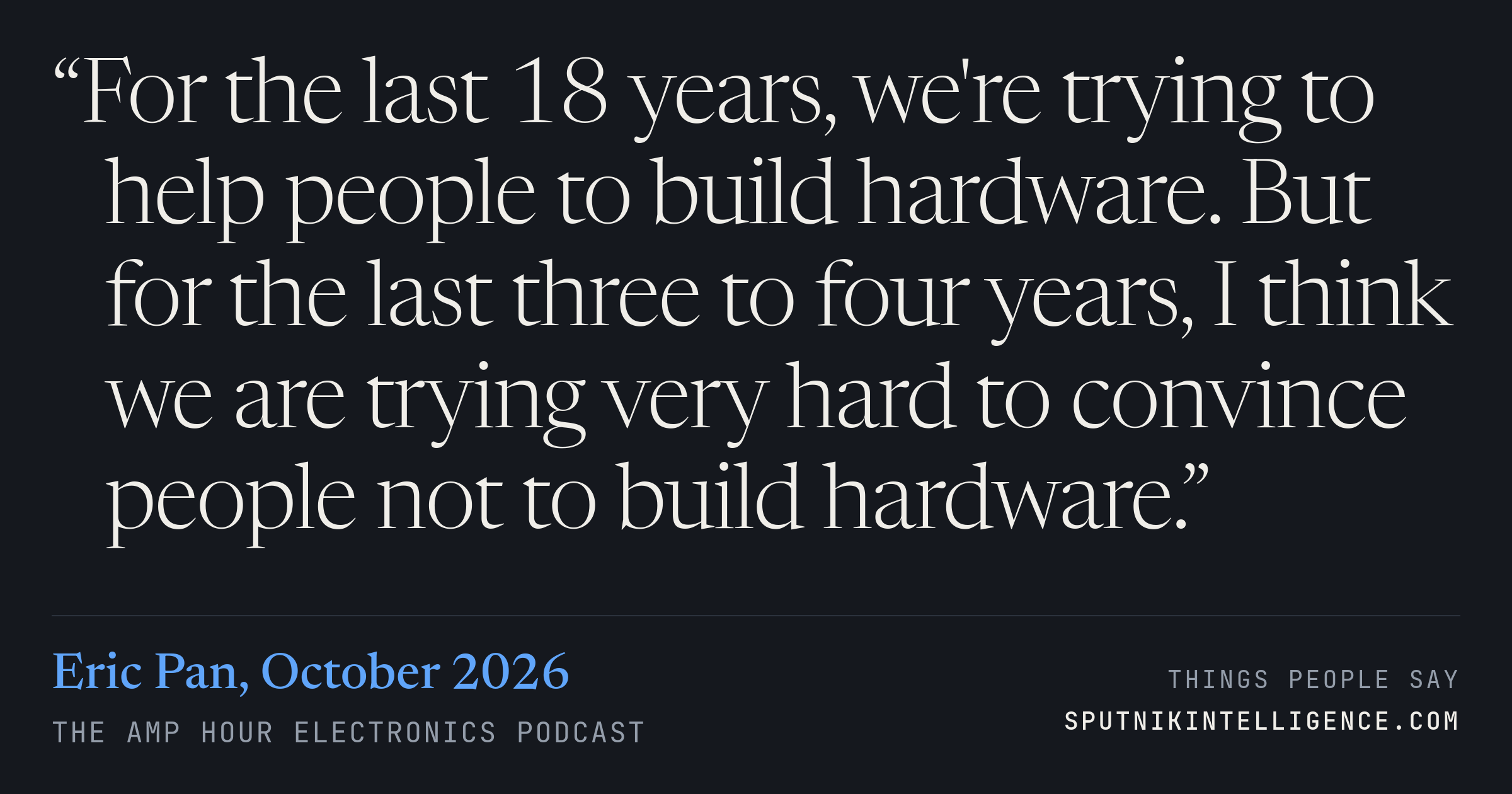
“For the last 18 years, we're trying to help people to build hardware. But for the last three to four years, I think we are trying very hard to convince people not to build hardware.” — Eric Pan, The Amp Hour Electronics Podcast

Pan runs a Shenzhen company that has long made electronics boards and parts for people building their own devices. His advice now is to start from hardware that already exists and add your own firmware, data and model. He says that is faster and more reliable than designing a new board.

The Amp Hour Electronics Podcast · 2026-10-07 Permalink → Listen →
The Amp Hour Electronics Podcast Around 37:47 into the episode
Eric Pan

It's two things: like, how do we use AI to build things? Like, for us people in Shenzhen, we don't use AI to build a PCB because we have professional engineers who have the AI is not ready to compete on the hardware button layer. But for the hardware teams in Shenzhen, they have benefited a lot, no matter on the coding or the design. So, before an engineer like me cannot build the embedded firmware so fast, but now I just wipe coding my firmware and I can build my website and can build a very good design, like designs, even in one person's company. So, this is like a very complementary to Shenzhen's advantages. And second is, how can we build things for AI? And it's just a chipset, right? It's just you squeeze a microcontroller or SPC into existing things and have either some machine learning models or it's HLM models into that, or it's a hybrid, or you have a cloud, OpenCloud, or Hermes living in your devices that can talk to the cloud and to learn and remember what you want. So, I think it's nothing in the way. It's more just philosophically, how do you see things? Are AI working with you, or you are building like physical agents that can work together by themselves and sometimes with you? So, people have different very diversified efforts. You

Chris Gammell

know, kind of the other side of the coin, I could see, obviously, Shenzhen just being the, you know, if I go and dream up any idea, even in my own lab here, just the likelihood of like something being developed quickly being put together just as I want it to be. It's like, yeah, I'm probably just going to send it over to Seed's service or send it over to JLC service and just be like, yep, and it's just going to come back and it's going to be good to go. So, I could actually see it having an acceleration effect as well in terms of just more people kind of getting into the ecosystem. So, what I'm really trying to say here is I have no idea where it's going to go. And yeah, I'm very curious to see how things develop on the ground in Genjen, you know, elsewhere. It's very interesting.

Eric Pan

Yeah, I think for the last 18 years, we're trying to help people to build hardware. But for the last three to four years, I think we are trying very hard to convince people not to build hardware. Interesting, which means like if you design something in North Korea and use GLC to deliver the boards, it might still be too slow. But you look at existing gadgets, look at existing hardware and customize it, or just put your firmware, put your data, your model into that to be part of. Your context, that's much faster and more reliable.

Chris Gammell

Yeah, so it's kind of like a zoom out effect of like, uh, so it's like going more holistic in terms of just being like a service provider of like, you know, put in file, get gadget back. It's like, no, no, let's let's look at the best solution that will actually allow you to go to market, go to get scale quickly, that sort of thing. So it's almost like an advisory role, that kind of piece of it.

Eric Pan

If I put into a picture, it's like Senzen is not the arena, actually. Senjen is like the supermarket. Imagine you're a chef, you go to the supermarket to get the best parts, but your battlefield is not in Senjin. Your arena is somewhere else. Maybe in your hometown that you need to fix some local challenges, maybe in your industry, which is not intronics, which might be agriculture, which might be like entricity. Now you use the resources in Senzen, but you cook a quarter zone that fit into your scenario. I think that might be a much better way. So it's Senzen is not competitive with everybody. But I think at least us, I think we are trying to enable people to innovate with Senjin.

Chris Gammell

That's good. I really like that. It's like, you know, you're talking to me and you're like, Chris, what value are you going to bring by growing a new varietal of like scallions, right? The world, like, yeah, they might be great scallions, but the world probably doesn't need that. But if I make something that has scallions that I can go and shop for and find the best ones at Chenzhen or elsewhere, piecing that all together, I could maybe kind of move up the stack and build all that stuff as well. Yeah, it is. I like that analogy quite a bit.

Speaker names from our own diarization · position estimated from where the line sits in the episode

Collections They Appear In