IA

Immad Akhund

Things Immad Says on Podcasts

Where to Find Them

Immad Akhund has been a guest on TBPN (3 times) , The Pitch (3 times) , The Full Ratchet (TFR): Venture Capital and Startup Investing Demystified (3 times) , Newcomer Pod (2 times) , The Twenty Minute VC (20VC): Venture Capital | Startup Funding | The Pitch (2 times) , My First Million (2 times) , The Room Podcast , Equity , Summation with Auren Hoffman , The Information's TITV , This Week in Startups , The Logan Bartlett Show , NEW ECONOMIES , In Depth and The Peel with Turner Novak .

Recently: “Immad Akhund on Building Mercury, AI Agents & Taking On Big Banks” on Newcomer Pod (October 2026); “Inside Mercury's Founding Story | Co-Founder & CEO Immad Akhund” on NEW ECONOMIES (June 2026); “SpaceX’s True Value Debate, Microsoft’s New Front in Agent Data Wars, Mercury CEO on $200M Raise” on The Information's TITV (May 2026); “Avi Patel on the startup that copied Kled and why he called out General Catalyst by name | E2291” on This Week in Startups (May 2026); “Google I/O Reactions, Large IPOs Incoming, Figma's AI Assistant | Dylan Field, Brian Chesky, Feross Aboukhadijeh, Tae Kim, Immad Akhund, Marcus Milione” on TBPN (May 2026); “#175 Above Health: The Allergy Clinic of the Future” on The Pitch (November 2025).

What They Said

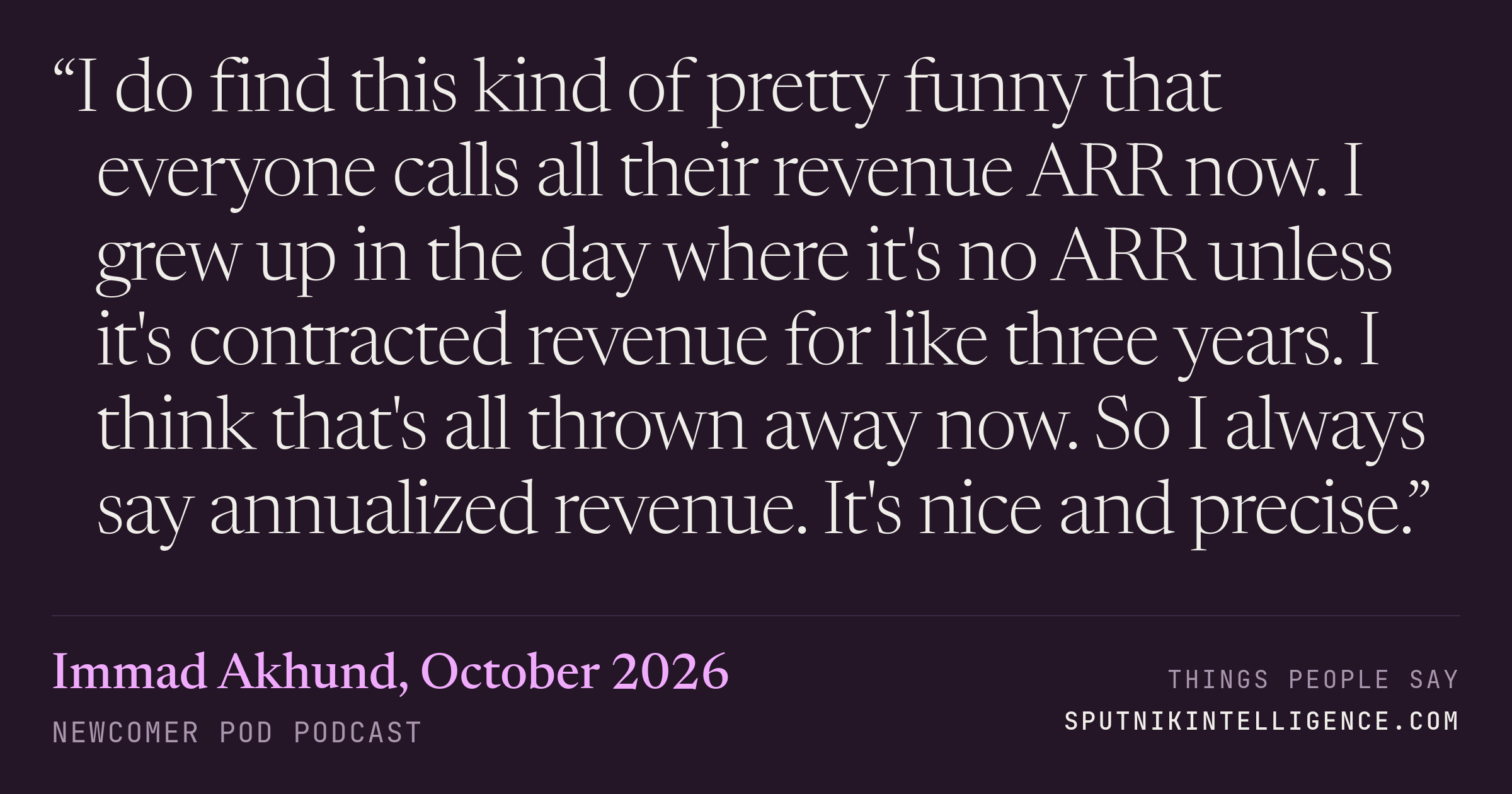
“I do find this kind of pretty funny that everyone calls all their revenue ARR now. I grew up in the day where it's no ARR unless it's contracted revenue for like three years. I think that's all thrown away now. So I always say annualized revenue. It's nice and precise.” — Immad Akhund, Newcomer Pod

Asked how recurring Mercury's revenue really is, Akhund explains that it comes from deposits and payment volume, and grows as customer businesses grow. He then mocks the current habit of calling any revenue "ARR", annual recurring revenue.

Newcomer Pod · 2026-10-19 Permalink → Listen →
Newcomer Pod Around 33:35 into the episode
Immad Akhund

…I think one thing before I started Mercury, AI I was like very curious about is like, you know, obviously because we serve small businesses, many of them fail. And that's actually our main churn. Like a main churn is people start a business and then they don't. See, this is what we need agents

Eric Newcomer

for. It's like, oh man, you're destroying your business. It's going to die if you keep doing this. What's the gave you? I guess nobody wants a bank that's so prescriptive. I mean, we

Immad Akhund

really do want to help people succeed, but also that's part of being a business, right? You take a risk and you want to start something and maybe it doesn't work out, right? Like I don't, I think like zero, 100% success would actually mean that we're not doing, we're not experimenting as like humanity. But so I wanted to say like, you know, every cohort, like every month, we get a new set of businesses and we kind of look at like, how do they grow over time, right? Which kind of ties to your question of like, you know, is this recurring? And we've generally found like every set of businesses fail, right? Whatever 20% or so fail within a year. But the ones that succeed kind of tend to scale both spend and deposits with us over time. So yeah, every month actually, every month becomes like an additive thing over time, which is, I guess, goes back to kind of, is this recurring or not? I do find this kind of pretty funny that everyone calls all their revenue ARR now. And like, you know, I grew up in the day where like, it's no ARR unless it's like…

Eric Newcomer

The credit card business, like how key is that? I mean, obviously, I don't know, RAMP is a juggernaut, has a huge valuation. I think, was it today valued at like $60 billion? You see RAMP as a direct competitor? How core is that to your business?

Immad Akhund

Yeah, we launched corporate credit cards kind of end of 2022. It's been growing really nicely. And most of our customers use the Mercury corporate card. Most of the time, we're not competing against RAMP. When we first started, we were really competing against SVB. That was our main competitor.…

Eric Newcomer

to acquire the customer at the banking stage. And then, yeah,
Speaker names from our own diarization · position estimated from where the line sits in the episode
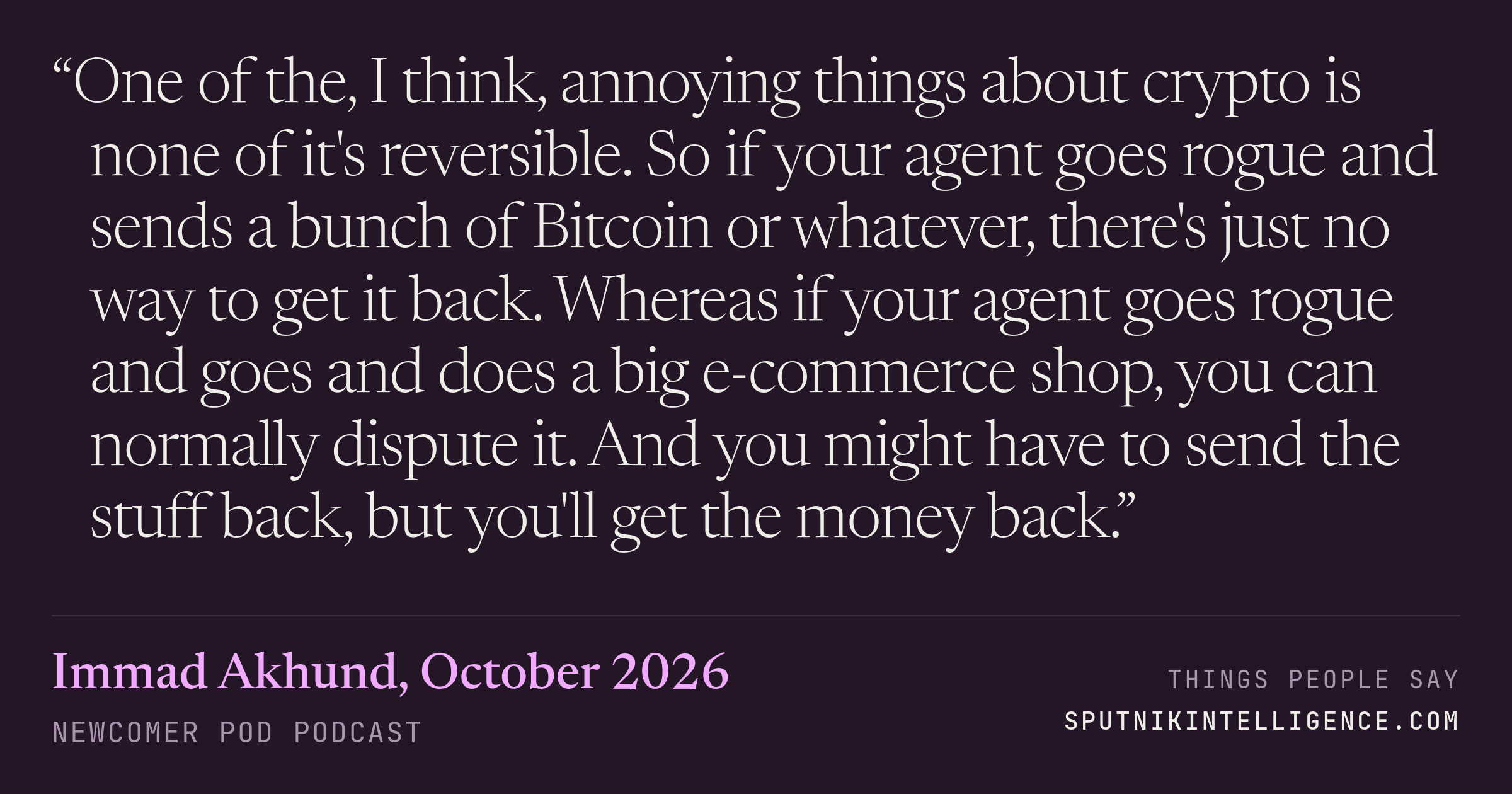
“One of the, I think, annoying things about crypto is none of it's reversible. So if your agent goes rogue and sends a bunch of Bitcoin or whatever, there's just no way to get it back. Whereas if your agent goes rogue and goes and does a big e-commerce shop, you can normally dispute it. And you might have to send the stuff back, but you'll get the money back.” — Immad Akhund, Newcomer Pod

Eric Newcomer asked whether a bank like Mercury worries about lawsuits once AI agents start spending people's money. Akhund compares it to the arrival of internet banking, and argues the fact that card and bank payments can be reversed is an underrated safety feature.

Newcomer Pod · 2026-10-19 Permalink → Listen →
Newcomer Pod Around 25:38 into the episode
Immad Akhund

I mean, if a person really wants to, like, I'm not here to like, yeah, we're trying to protect the customers. It's like, it's not, we're not here to police the customer. So if they're doing it, if they really want to get out of the way, I'm sure they can enable fully automated payments. I really.

Eric Newcomer

…like lawsuits every direction at some point. Somebody's going to spend money that they regret, even if it was their fault, and they're going to sue everybody involved and say an agent was involved. Like you should have stopped it, right? Like, do you worry about that as a company? Is that a risk?

Immad Akhund

Maybe, but I'm guessing the same thing happened when internet banking happened or whatever, right? It was like before it was like, oh, you had to go into a bank branch and you had to authorize this payment. And now you can be hacked on the internet. And yeah, there's laws in place. There's like things you can dispute. Actually, the banking system has dealt with this a lot, right? There's like, there's fraud and there's lots of fraud controls and things like that. Then there's like you doing something. And then, you know, when is it the merchant's fault? When is it your accountability? So there's a lot of actually rules already in place. So it depends on like the exact situation, probably. A lot of the benefit of banking is a lot of the stuff is reversible in a way that, you know, when people look, yeah, talk about crypto or whatever, like one of the, I think, annoying things about crypto is none of it's reversible. So, you know, if your agent goes rogue and sends a bunch of Bitcoin or whatever, there's just no way to get it back. Whereas if your agent goes rogue and like goes and does a big e-commerce shop, you can normally dispute it. And I…

Eric Newcomer

where it'll send emails that people didn't expect.

Immad Akhund

Yeah. But I mean, actually, right.

Eric Newcomer

But if you extend that out, it's like, oh, once payments, you know, are connected. I mean, I've

Speaker names from our own diarization · position estimated from where the line sits in the episode

Collections They Appear In