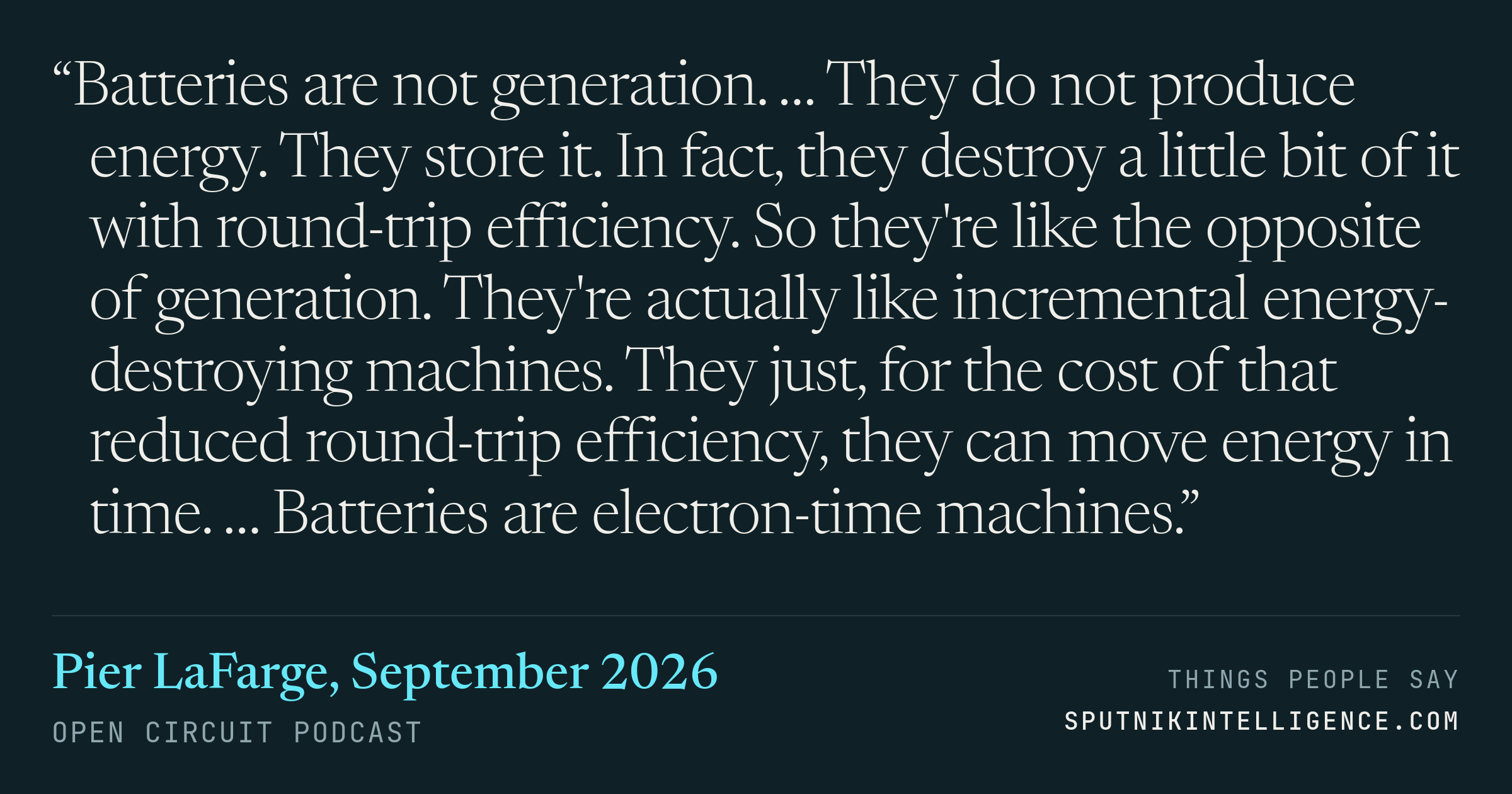
LaFarge is explaining his company's model of putting three-to-five-megawatt batteries at the edge of parking lots near grid constraints. He argues that batteries are valuable for raising grid utilization, by moving energy to where and when the grid needs it, and not as a source of power.
New Mexico is leading the energy conversation and the rest of the country should be watching. It's the nation's third largest energy producing state. New Mexico is putting its abundant sun, wind, and geothermal resources to work while becoming a powerhouse for advanced energy. Two national laboratories, major research institutions, growing investment in incentives, infrastructure, and workforce. The result, more energy production, more. Innovation, fewer emissions, and energy exported across the country. New Mexico is building the energy future right now. See what's happening at detectnm.com. That's detect nm as in newmexico.com.
Are you tired of overpaying for big name PR firms, but not really knowing what they're delivering? Is your comms team wasting time reviewing lengthy messaging briefs and decks instead of engaging journalists or producing content? Are you wondering why your competitors are getting press and you are not? FishTank PR is an award-winning climate and energy tech, renewables, and sustainability-focused PR firm dedicated to elevating the work of both early stage and established companies. Whether you need to position yourself as a thought leader in between project announcements or translate complex ideas and technologies into tangible, compelling stories that resonate with the media, Fishtank can help. Check out fishtankpr.com. Fish is spelled F-I-S-C-H fishtankPR.com or follow the link in the show notes. So, Pierre, let's talk about your approach to this. We have had discussions about the Capacity Connect program with Excel Energy to fund a couple hundred megawatts of distributed CNI batteries in Minnesota. This is something, this is the SparkFund model. So, I'm curious. I know you've been on lots of podcasts talking about this, and we've had discussions about it. So, let's kind of zip through it and just explain why strategically placing a one to three megawatt battery in like parking lots and other free space is a grid utilization strategy.
Well, look, grid utilization, regardless of what market model or regulatory model you use to pursue it, I think is a resource that can be harvested. You can go get it. And to do that, you need to shave the peaks on the grid, particularly in the distribution grid and transmission to pull the substations off transmission. On transmission, you need to smooth out the peaks to be able to deliver more energy. And then, if you can have demand show up in the right load pockets and help customers target EV fleets and compute and electrification in the right places, that picture together really lets you harvest utilization. So, one piece of that puzzle, right? There's sort of the flex piece and the demand piece to get it right. The reason you'd want to do both is that if you can sell more kilowatt hours faster than you grow the dollars that it costs to deliver that system, regardless of the regulatory model, it's all the same equation, right? How much is the grid cost divided by how many units of energy you sell over it? It's basically the price of power. And we have various regulatory ways of explaining that to ourselves and setting the prices, but it's all really just a division problem at the end of the day about throughput and dollars behind it. So, if utilization is a resource you can go harvest, and the reason you want to do it is that you can both sell more energy and make power cheaper every time you sell more energy. That's a really compelling way to run and grow a grid. And batteries are one critical piece, right? You have the flex side and the demand side. And the flex side, you want resources that can almost act as an extension of the wires themselves. Batteries are not generation. I think it's really important to say that, regardless of their regulatory treatment, they do not produce energy. They store it. In fact, they destroy a little bit of it with round-trip efficiency. So, they're like the opposite of generation. They're actually like incremental energy-destroying machines. They just, for the cost of that reduced round-trip efficiency, they can move energy in time. And I've said this before, right? Batteries are electron-time machines. And so, when you're talking about the best type of flexibility, it would be flexibility both in space and time. And the beauty of batteries is you can put them where the grid needs them most. So, you charge them up when there's plenty of energy on the grid. You dispatch them when it has constraints, both where the grid needs that relief of constraint and when it needs it, right? Because you're holding the electron safe until it needs to be dispatched. And running through that framework, you know, all of a sudden, the model that I think we're pursuing with Excel and others through distributed capacity procurements and a really very first principles approach to that. It's like, okay, if putting batteries near the grid constraints is to be able to smooth them to improve the grid, to improve utilization, then great. Just go put them at reasonable size where the grid needs them. That can be done with Resi batteries, right? You know, Caroline, you mentioned FacePower, Tesla, many, many players in that space are putting lots and lots of smaller batteries or all over the grid. SparkFund's model is to put kind of three to five megawatt batteries at the edge of a parking lot. They're bigger. So you get a little bit of that economy of scale, makes it cheaper to build per megawatt or per megawatt hour. And you put them working with the grid operator right where the grid has that constraint. And it also gives you an amazing opportunity for community wealth participation in infrastructure because by renting that parking lot, you pay a church or a school or a fire station a nice annuity for 20 years because we need to build infrastructure and they're in the right place. But we'll come back to that piece.
I personally like the three to five megawatt model, mainly because if you're going to Dork, geek out for a second, if you think about like rate classes for CNI customers residential customers, there's just more incentive. There's more incentive there. But, you know, Pierre, one of the things that, and maybe we can talk about this a little bit, but one of the things that has always been, I guess, part of my career, like it was this concept of decentralizing power, right? And I agree with you. We're going to have to, if we're taking on this AI infrastructure, like if our country's going to do it, you're not going to do it without building more power lines and without building more power plants. Full stop. So anyone who says that we don't need to is frankly kind of, I think, causing more confusion and is probably deleterious to the argument. But what I think is most interesting here is the, and we've talked about this a million times on the pod, Stephen, but like the data centers don't care where the power comes from. And I think that the other important part here is that the concept of being off-grid was like really ramped up for the data center community for about six months, in large part because Trump sort of said it. You know, he sort of endorsed this idea of like, just go build the microgrid data center and build data centers in space, which I stand by is still going to happen. But
Google just did some tests this week, right? I told
you, Jigger owes me so much money. So much money. Jigger, you're not on the pod. You owe me $10,000 for that bad money. So that's all going to happen. But I worked in the concept of decentralized power more in the developing world. And I'm going to come back to that for a second. But in a second. But what I think is interesting now is that in addition to the whole, we want in on the spending spree, and I'll call it that, you know, from the utilities, there's also a real political recognition that like, well, if we can't provide this and all these data centers go do this really irresponsible thing, we're stuck with the political consequences of that, right? So there's this interesting motivation going on where sort of behind the meter, you know, decentralized power provision for the data centers became this really difficult thing to do. You know, power plants are hard. And also they were doing it really irresponsibly. And so now it's sort of shifting back, like, oh, but we actually do want to be grid tied. We actually really want to be on the grid. Actually, the grid's really important. We want to do it. And it's opening up, okay, well, if you want to do it in three years, we can't get you three gigawatts, but we could probably get you 250 megawatts. What can you do with 250 megawatts? And so when we were building data centers 10 years ago, even five years ago, if we came to the table and said we needed 200 megawatts, which was the most we would ever say ever, the answer would be like no. But if we had come back and said, well, what we really need is 75 megawatts, the answer would have been yes. And so part of this is like the back and forth nuanced conversation of how do you incrementally build power on the distribution system to match the incremental load ramp of the utilities. And that can really only happen with distributed resources because you're not going to incrementally build a gas plant. You know, the economies of scale doesn't make sense. You're going to build it as big as you can and with as much robust resilience and with the cheapest output as possible. And that's what will get built in 2030. And that's what you'll run on. But in this like ramp rate, this is really the only way to build that like, you know, one-for-one block. So that's what I think is really important for people to understand in the nuance of this for why it's appealing to a data center ramp if we can get the structures right contractually.