Eörs Szathmáry

Things Eörs Says on Podcasts

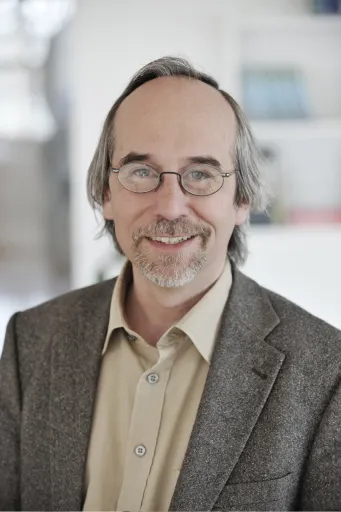
Eörs Szathmáry is a Hungarian theoretical evolutionary biologist. With the late John Maynard Smith, he developed the theory of major transitions in evolution, the framework for how life has repeatedly reorganized into higher levels of complexity across billions of years. His more recent work applies that framework to artificial intelligence: a 2026 PNAS paper he co-authored with Viktor Müller and Luc Steels argues AI may be approaching a major transition of its own, and that the real danger is not superintelligence or consciousness but evolvability. He directs the Parmenides Center for the Conceptual Foundations of Science in Munich and previously led Hungary's Centre for Ecological Research. He has appeared on The Trajectory podcast, discussing the chemistry of life's origins and what past evolutionary transitions suggest about the one AI may be entering.

Where to Find Them

Eörs Szathmáry has been a guest on The Trajectory .

Recently: “Eörs Szathmáry - Major Evolutionary Transitions and AGI's Impact (Stewarding the Flame, Episode 7)” on The Trajectory (September 2026).

What They Said

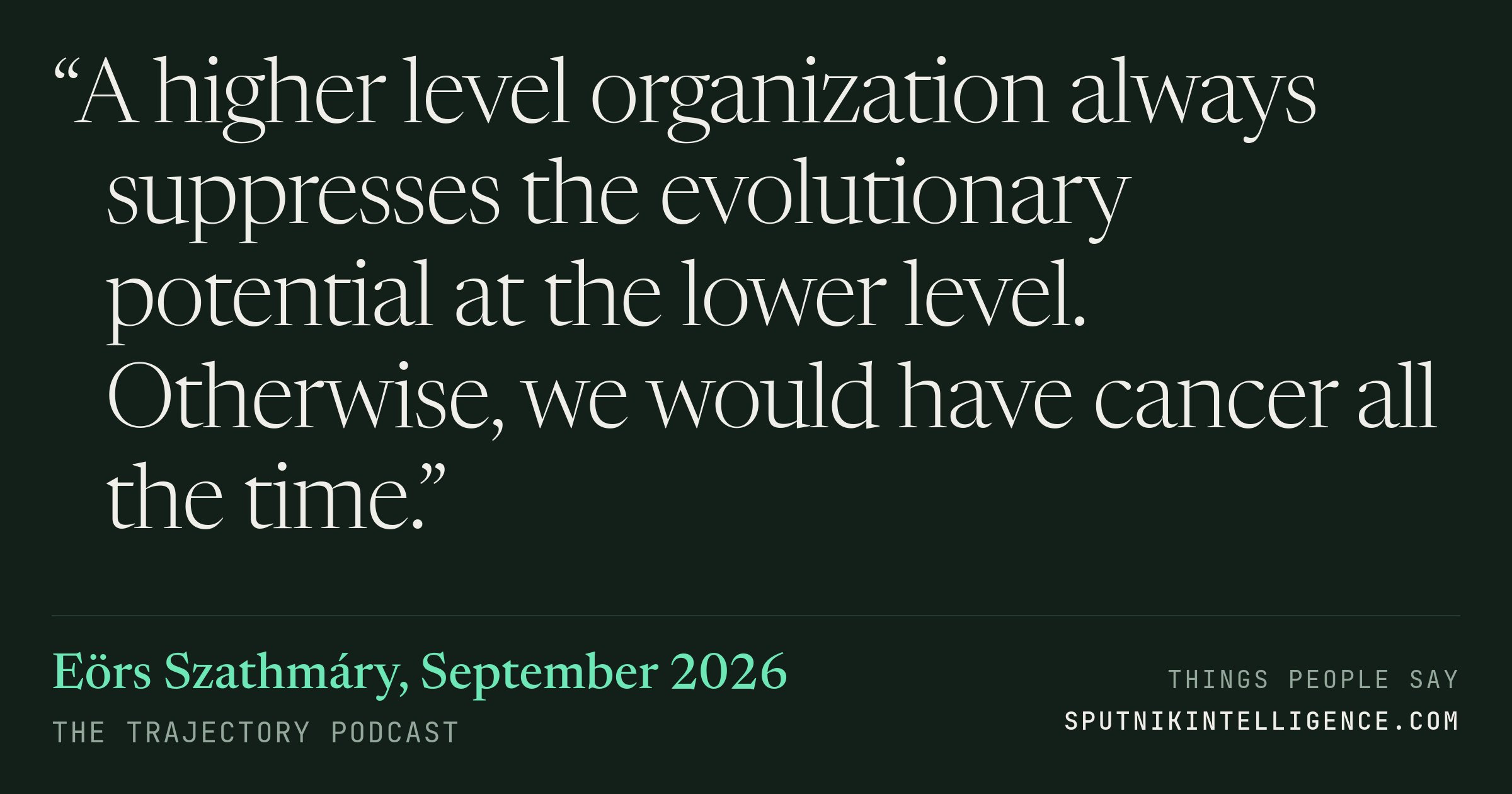
“A higher level organization always suppresses the evolutionary potential at the lower level. Otherwise, we would have cancer all the time.” — Eörs Szathmáry, The Trajectory

The host had been describing intergovernmental coordination as a brake on the AI arms race, and relaying the objection that such constraints are somehow against evolution. Szathmáry — an evolutionary biologist who has just argued that evolvability, not consciousness, is the real AI danger — answers with the biology. Every jump to a higher level of organisation works precisely by suppressing evolution at the level below it.

The Trajectory · 2026-09-11 Permalink → Listen →
The Trajectory Around 1:08:20 into the episode
Eörs Szathmáry

…know, the players, the human players, are not a good guarantee that such an agreement will ever come about. What I'm seeing is everybody's racing like crazy, right? Because we have to compete with the Chinese, we have to compete with the Americans. I mean, you know, this is how things can crash.

Daniel Faggella

…evil government thing that's going to be a tyrant. That's against evolution. I would say evolution. Expands its powers and then seems to find ways to bound them. Humans got big brains, but in order to participate in society, we have to stop being like murderous and inherently individually selfish.

Eörs Szathmáry

A higher level organization always suppresses the evolutionary potential at the lower level. Otherwise, we would have cancer all the time.

Daniel Faggella

Of course, of course. But then it opens up potential at the new vanguard, which is even greater. And so

Eörs Szathmáry

as Stu Kaufman would say, there are enabling constraints.

Daniel Faggella

Yes, yes, yes, yes. So Spinoza has this idea of potestas, which is different. That potentia is the expansion of powers. Potestas is the selective bounding of them. If done well, potestas increases the net potential of the system. And so enabling constraints is a beautiful way to put it. I'll have…

Speaker names from our own diarization · position estimated from where the line sits in the episode

Collections They Appear In