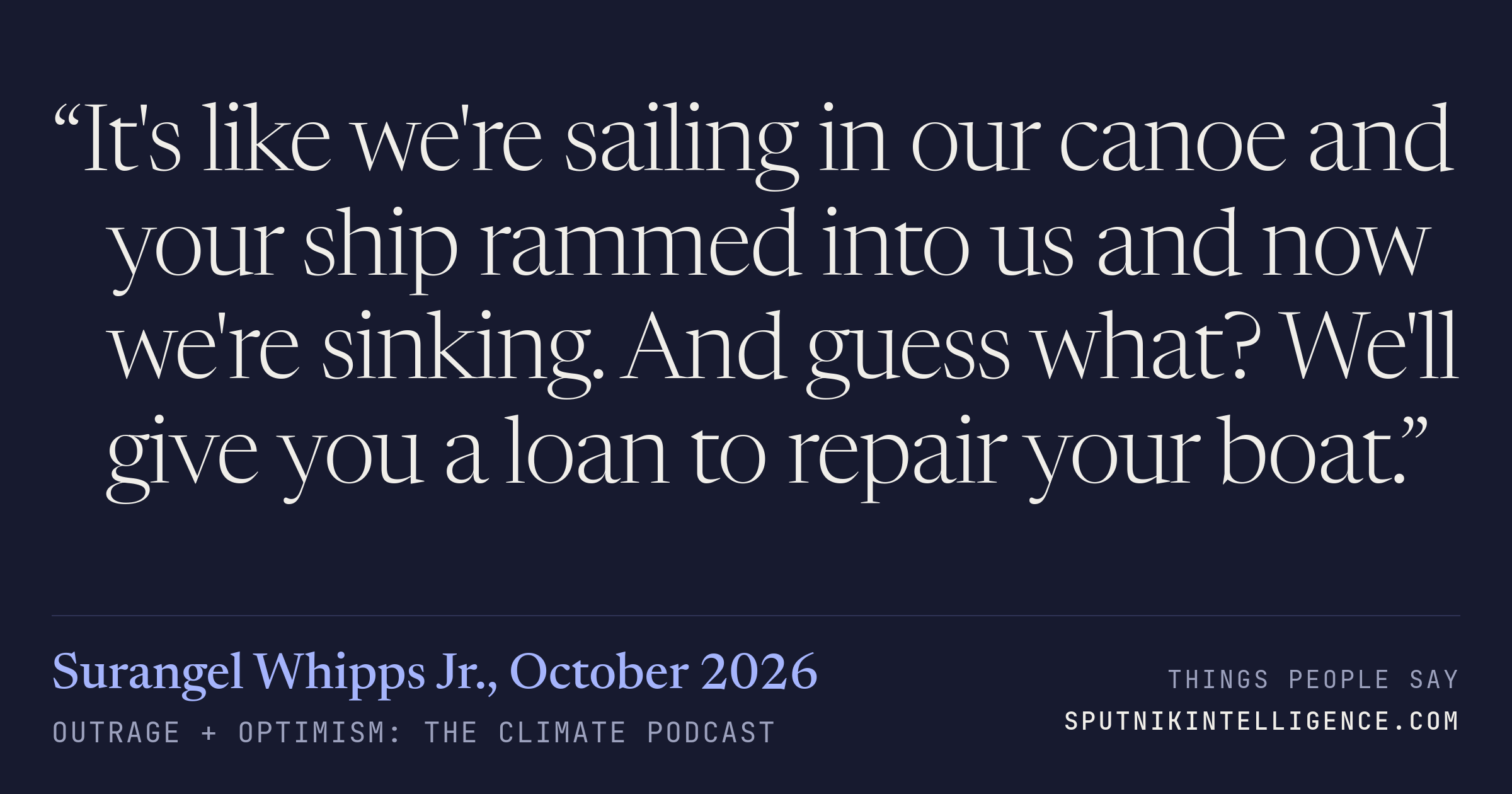
The president of Palau, who chairs the Pacific Islands Forum, on climate finance. He says Pacific leaders travel the world hearing promises of help with financing, and at the end of the day what is offered is loans. Christiana Figueres replies that it is "such a good way of putting it".
above pre-industrial level and thereby crossing what the world agreed during the Paris Agreement talks in 2015. A new UN report says humans must now limit the harm, the overshoot, to bring temperatures back down as quickly as possible.
That is dreadful news for the region that fought so hard for 1.5. Still, these nations are not giving up. At the start of September, leaders of the Pacific Islands Forum, the region's main political body with 18 members, met in Palau and recommitted to keeping 1.5 within reach. They called climate change for what it is, the single greatest threat to Pacific peoples. And the Pacific is once again at the center of climate diplomacy this month. As this episode goes out, the pre-COP is wrapping up in Fiji two days after leaders have gathered in Tuvalu. For decades, these nations have held the rest of the world to account. That job should never have been theirs alone. And the next few weeks are a chance for everyone else to show that they are listening. I had the opportunity to speak with Palau's President Whips a few weeks into Palau's chairmanship of the Pacific Islands Forum. I wanted to know whether these wins are reaching people on the ground in the Pacific and how he keeps young people in Palau from losing hope. Thank you so much for joining us here on Outrage and Optimism. We are very excited to speak to you for several reasons. The first is that you now chair the Pacific Islands Forum and you just had a leaders meeting at the end of August and first days of September. As you closed that meeting, you were saying that the real test is going to be what people see in their communities, not what gets announced in the room. What would that look like? How do we make a real difference at the community level?
So at the end of the day, it's not just about talking, but what can we do that really makes a meaningful difference? One of the things that we did different at this PIF is we had two segments, one that focused on oceans and then another one that focused on renewable energy and energy transition, which now the chair, we have a chair's outcome that we will carry those to pre-COP and also on to COP in Turkey. And it's so important that the Pacific voice is heard. And that's really what it means when we say we want those impacts reaching the people that are in need. So I'll just give you an example. You know, through these discussions that we've had over the years, GCCM, the Global Climate Mobility Initiative, came out with grants that could be helping people immediately to adapt. For example, you need a seawall. There's money on the ground to help those people build a seawall to protect that community from the impacts of sea level rise. So that's what people want to see. They want to see, you're going to these meetings. How in the end are we making a difference? Are you fighting for us to make sure that you lower carbon emissions? So therefore, it gives us hope our islands won't disappear. So it's tying what we do at these meetings, what we're sharing with our partners, getting our partners to commit, but not only commit, but to act responsibly and also provide the resources. I use the other example, which is the UNGA. You know, we often go around the world, we talk about, well, you've promised so much for financing. You're going to help us on this. But at the end of the day, you want to give us loans. And it's kind of interesting to me that first, it's like we're sailing in our canoe and your ship rammed into us and now we're sinking. And guess what? We'll give you a loan to repair your boat.
Such a good way of putting it, President Richard. Such a good thing.
That's the Pacific problem. And not only that, we'll make it so complicated that you can't actually get the help. So that's the reality that we face. But I have to say that we have made some progress, and that's getting the world together and fight for the protection of the oceans. The BBNJ treaty ratification earlier this year is just an example of how multilateralism works and how we together can do good for our planet. But it requires all of us working together.
Let me go into one of your two pillars from the forum, which is renewable energy. I seem to remember that some of the Pacific islands actually have to invest 20% of GDP into the import of fossil fuels, which is outrageous. That is part of the rising cost of fossil fuels, but also the very expensive transport all the way to the Pacific. All of these islands could actually graduate themselves from fossil fuels. So what is standing in the way?