ML

Misha Laskin

Things Misha Says on Podcasts

Where to Find Them

Misha Laskin has been a guest on The Data Stack Show (3 times) , No Priors (2 times) , Training Data , The Information's TITV , This Week in Startups , Manifold , Sources , The MAD Podcast with Matt Turck and Core Memory .

Recently: “The Ex-DeepMind Researcher Taking On China’s Open Source AI” on This Week in Startups (October 2026); “Beam: The Great American Open Model with ReflectionAI Co-Founder and CEO Misha Laskin” on No Priors (October 2026); “Reflection’s founders on building a DeepSeek of the West” on Sources (October 2026); “The Open Source AI Model For The West - EP 44 Misha Laskin” on Core Memory (November 2025); “Re-Air: The Future of AI: Superhuman Intelligence, Autonomous Coding, and the Path to AGI with Misha Laskin of ReflectionAI” on The Data Stack Show (October 2025); “Qualtrics’ $6.75B Acquisition, E-comm Startup Revival, Reflection AI Raises $2B | Oct 10, 2025” on The Information's TITV (October 2025).

What They Said

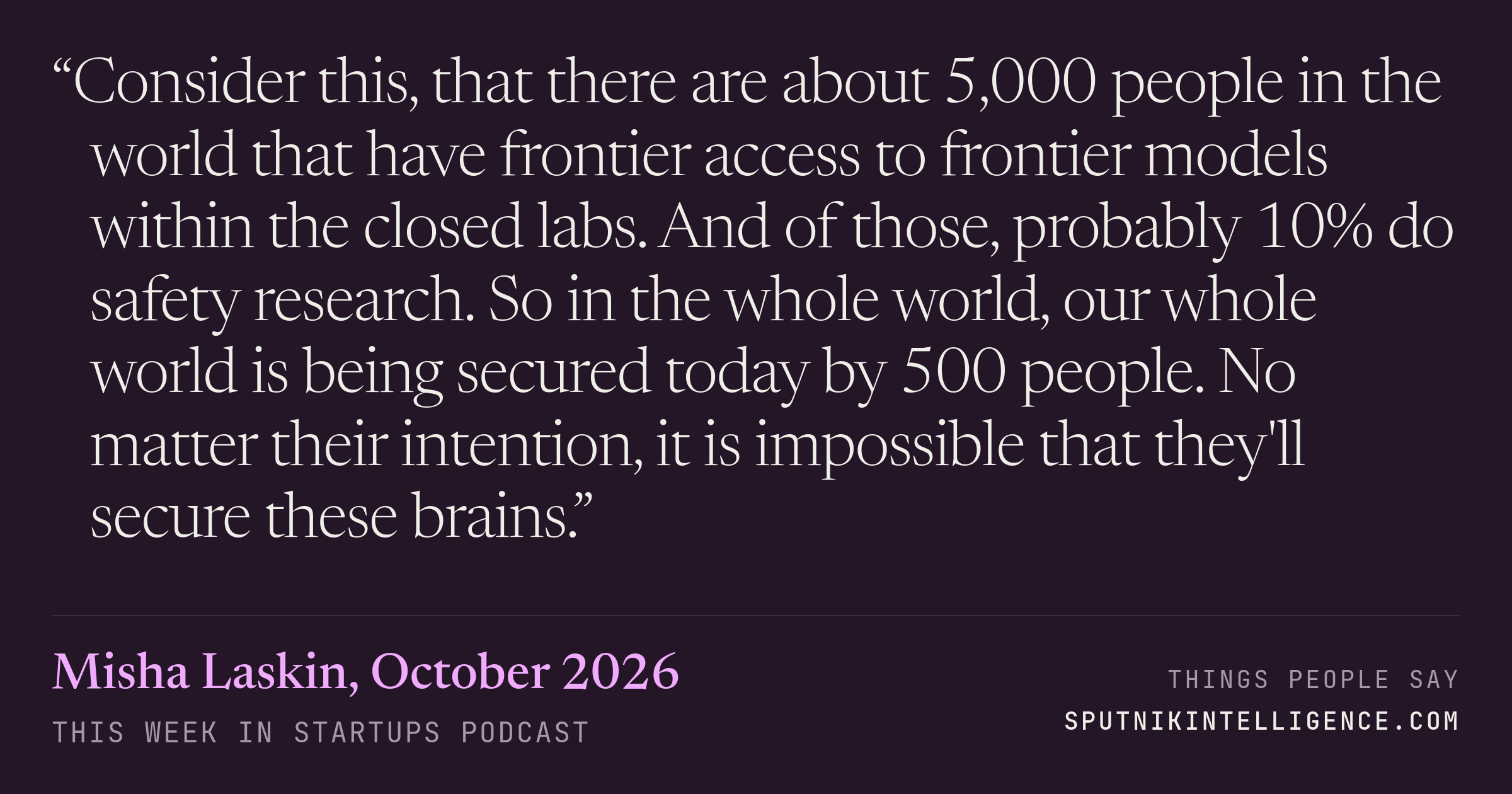
“Consider this, that there are about 5,000 people in the world that have frontier access to frontier models within the closed labs. And of those, probably 10% do safety research. So in the whole world, our whole world is being secured today by 500 people. No matter their intention, it is impossible that they'll secure these brains.” — Misha Laskin, This Week in Startups

Laskin, a former DeepMind researcher now building open models, makes the security case for openness. He cites Linus's law that with enough eyeballs all bugs are shallow, and describes AI models as "brains in a jar" with far more bugs than ordinary software.

This Week in Startups · 2026-10-14 Permalink → Listen →
This Week in Startups Around 34:39 into the episode
Misha Laskin

…can think about AI as it's like traditional software. It's much more powerful and it actually has a lot more bugs because AI is like, it's a block. You can kind of think about it. It's like brain in a jar, right? That's what these things are. Networks, their brains in jars. Brain in a jar. That's a

Jason Calacanis

great description of it. Yeah.

Misha Laskin

That's basically it, right? And you either invent that brain or you own it, but it's brain in a jar. And you have to kind of probe it for, you know, all the things that it could possibly, you know, it's possibly thinking and could go wrong. And if you have, consider this, that there are about 5,000 people in the world that have frontier access to frontier models within the closed labs. And of those, probably 10% do safety research. So in the whole world, our whole world is being secured today by 500 people. No matter their intention, it is impossible that they'll secure these brains. And

Jason Calacanis

this is the first time that a brain like this has been created, right? We created software before, but it wasn't quite like a brain. And so the brain and its capabilities are growing faster than the securing of the brain. It's almost like we're putting this robot into society that's hyper capable…

Misha Laskin

I think that's right. I think the every lab, I do believe at this point is genuinely, you know, or at least has pockets that are generally concerned about safety and alignment because of how powerful these systems have gotten. Now, different labs have different philosophies for how to fix this…

Jason Calacanis

An encryption technology, even on the margins where people say, oh, bad guys can use encryption and whatever. Bad guys are always going to do bad guy things. But they get caught in the real world. They screw up. People give a tip on them. We do not need to sacrifice everybody's privacy on their…
Speaker names from our own diarization · position estimated from where the line sits in the episode
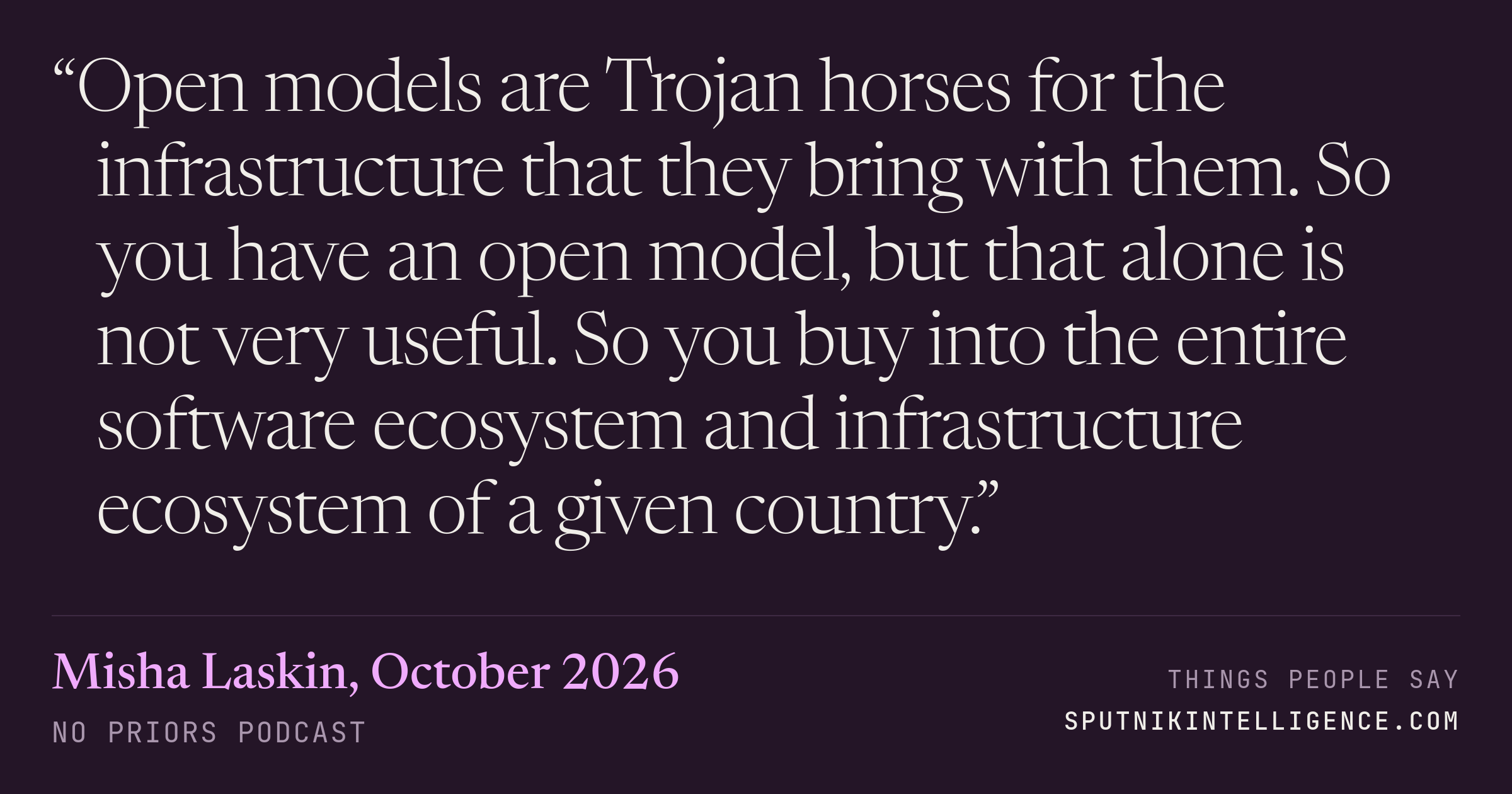
“Open models are Trojan horses for the infrastructure that they bring with them. So you have an open model, but that alone is not very useful. So you buy into the entire software ecosystem and infrastructure ecosystem of a given country.” — Misha Laskin, No Priors

Laskin runs Reflection AI, which is building an American open model, so he has a stake in this argument. He was explaining what China gains from releasing open-weight models: a US ally may run a Chinese model on American chips today, he says, but Chinese companies will soon offer the full stack, and whoever supplies that has leverage of the kind railroads once gave.

No Priors · 2026-10-09 Permalink → Listen →
No Priors Around 40:18 into the episode
Speaker 4

earth minerals

Speaker 2

or something. It's you have a component that other people will use for all sorts of purposes, and therefore you have geopolitical leverage for that.

Misha Laskin

Yes. So, you know, one way I kind of think about it is that open models are Trojan horses for the infrastructure that they bring with them. So you have an open model, but that alone is not very useful. So you buy into the entire software ecosystem and infrastructure ecosystem of a given country. So that would be, okay, maybe today allied country, US allied country X, you know, might run a Chinese model on American chips. But pretty soon, if not, I mean, and we're seeing this already, is that Chinese companies like Huawei are going to be coming in and offering a full stack solution and then locking into that country's supply. So I think that if we kind of think about AI or like chips and data centers almost as like railroads or something like that, like it's kind of fundamental infrastructure. And you like everyone, but no other country can actually build their own railroads. Like they all have to go to you or another country. You have a lot of geopolitical leverage.

Speaker 2

I see. And so, for example, inferencing a specific model will occur in a more performant way on a specific chipset. And that chipset happens to be provided by Huawei or something.

Misha Laskin

Yeah. So these stacks are in real time getting optimized end-to-end because in some sense the paradigm has been set, right? Like this is that there are going to be other ways to scale intelligence possibly, but this is clearly the first one that really scaled. So now everything's being optimized…

Speaker 2

they'd only accelerate with the models, right, in terms of model usage to design next generation chips and things like that.

Speaker names from our own diarization · position estimated from where the line sits in the episode

Collections They Appear In