The host suggested the last few years must be a bonanza for philosophers of mind. Gold agrees: the debates he studied as a grad student, about machine consciousness and whether it needs a biological substrate, felt like science fiction then and are now questions people have to make real decisions about.
I have that view too. I mean, I'm certainly frightened about what could happen with AI for all sorts of reasons, though. I think, of course, mostly because of bad or foolish people, not because of what's intrinsic to AI. But I'm certainly afraid of it. But I think you're absolutely right that whatever happens, we're going to learn a hell of a lot because AI is forcing us to consider questions that we've never considered before. Or if we've considered them, we've only considered them in a way that was hypothetical. Philosophy, unlike science, doesn't set a problem for itself that eventually it solves, or doesn't set a problem for itself that eventually it replaces with new problems that it solves. Philosophy tends to kind of take up a problem and debate it for a long time, and then it sort of fades away. Or it gets stale. And then if you're very, very lucky, you're living in a moment where science discovers something new. And what it discovers challenges a whole lot of philosophical views. And then suddenly, everything you learned by working through the earlier problem that went stale suddenly becomes fresh again. I mean, the classic example, of course, is Immanuel Kant's work, which on one reading is a response to Newton. So Kant, arguably after Aristotle, the most important philosopher ever to have lived in the Western world. And on one reading, his metaphysics is an attempt to say that Newton is right. You can't reject Newton. That's real science. But on the other hand, human beings can still be said to be free and so on. And yeah, that's a tangent. But that's a wonderful example of science suddenly animating philosophy and giving it a kind of a new impetus and a freshness. And I think that AI is clearly already doing that to. Philosophy of mind and maybe even ethics. And so a lot of things are going to be unveiled. I think there's just no question about that. And if we can also get together and keep some of the bad actors from getting their hands on the powerful stuff, then I think things will work out just fine.
Yeah, I guess through that lens, this moment in time, the last five years or so, must really be just like a philosopher of the mind's bonanza.
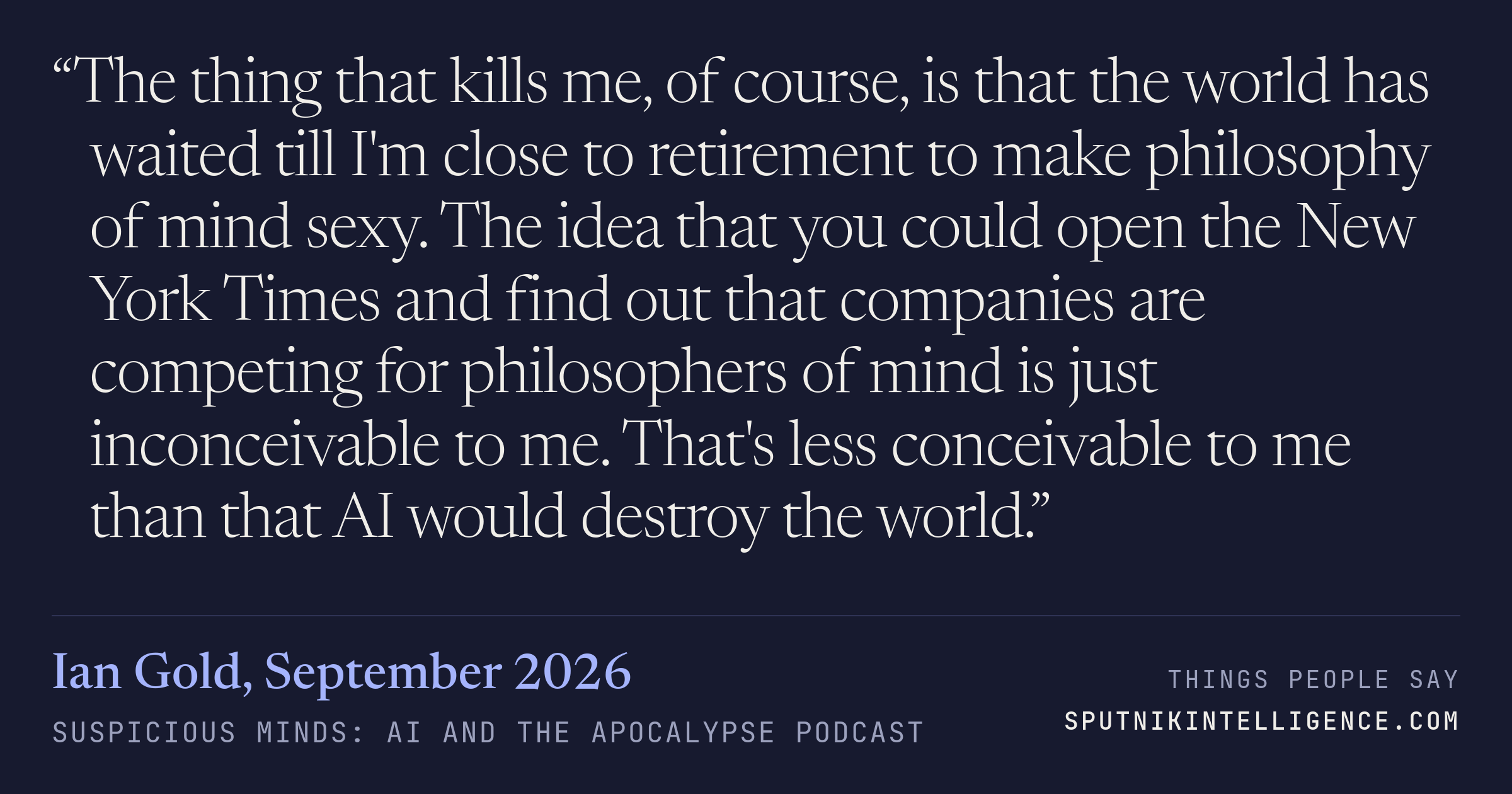
Oh, in every way. So intellectually, I mean, the thing that kills me, of course, is that the world has waited till I'm close to retirement to make philosophy of mind sexy. The idea that you could open the New York Times and find out that companies are competing for philosophers of mind is just inconceivable to me. That's less conceivable to me than that AI would destroy the world. I was brought up as a grad student on things like Cyril's Chinese room argument and those early debates about what strong AI would look like and whether consciousness depended on having a biological substrate and whether functionalism made room for consciousness and so on. To see all of those debates that all seem just like science fiction. I mean, they were science fiction. And I never expected them to ever actually manifest in real things that we had to make decisions. But to see that now become a real thing where we have to start addressing these questions is, for someone like me, just astonishing. Absolutely astonishing.
I agree. This is astonishing. It's also right to be skeptical, critical, maybe even angry about what's happening behind the closed doors of the frontier AI labs. All of these responses contain a truth, and this episode lives at their intersection. But before we get too deep into it, here's a quick recap of the very basics of the last two episodes in our consciousness arc. Neuropsychoanalysis pioneer Mark Solms told us what he thinks consciousness is. Feeling, an extended form of homeostasis. Then he told us that he's building it. And he says his digital agent has already passed the test that a room full of researchers who study non-human consciousness decided is the most likely to determine if consciousness is present in a given creature or entity. Okay, that's a mouthful, but it's also really, really important. If this has happened, this changes everything. But it's not that simple. Philosopher Marcus Arvan then told us the universe won't allow artificially engineered consciousness of this sort, that consciousness is analog and a digital machine simply can't be conscious. And Ian Gold told us to wake him up in 500 years to talk about conscious robots. What's so fascinating about the nature of consciousness is that at least right now, none of these brilliant thinkers can prove the other one wrong. In this episode, we're getting to the question we've been building to this entire time. Maybe the question we should be asking is not if Mark Solms can engineer artificial consciousness, but should he? I want to take a look at the words Mark Solms for what he's doing. Engineering artificial consciousness. I've been struggling with this middle word for a while, artificial. If the substrate doesn't matter, then consciousness is consciousness. And the word artificial is doing something other than describing something. It's an attempt to comfort us. The word artificial is recognizing this engineered consciousness as human-derived, unnatural. Personally, I almost feel like it's a way of saying less than. The same with artificial intelligence. Isn't intelligence intelligence, regardless of who makes it? Do we consider a beaver's dam unnatural, artificial, or part of nature? When does something derived from natural beings achieve natural status? Or when is it considered artificial? A lot of people will disagree with me here and think I'm being silly because there are really well-established definitions for things like artificial and natural. But I think there's something else going on here and I'm not quite willing to let it go. Psychoanalyst Dr. Amy Levy chairs the American Psychoanalytic Association's Commission on Artificial Intelligence. And she's the person who first introduced me to Mark Solms work and introduced me to Mark.
I think you're probing something that's really rich because there's always this judgment in how we name things. Like we don't call our home an artificial dwelling. You know, we call it a home, you know, because it feels safe. I think you're right that artificial is a term that's being used to mark something as alien, as foreign, as, you know, keep your guard up. This is not us, even if it comes from us. But some things that come from us don't have to bear it. That label. And why is that? Why are some of our creations, why do they feel less threatening than others? I've been having the same thought about tool. You know, people are constantly leaning on, oh, well, you know, my use of AI is benign because I just use it as a tool. And I've been thinking, well, where do you draw the line? What is a tool, actually? You know, there was a time when people had children because they helped with labor fields and home construction or whatever. I mean, does that make a child a tool? If a tool is something that we create to help us, there's a whole range of phenomena that we could call tools. So where do we draw that line? And then what are we saying when we apply that term to something? It seems like it's a way of asserting that we have mastery over it and that it is beneath us. And I think Art Mitchell has the same sort of quality.
This brings us to the question: even if it is artificial, should Mark be engineering consciousness in the first place? Because if he succeeds, he will have made something that can suffer. Before the philosophers, I want to talk to a clinician, Dr. Joel Gold, a psychiatrist and psychoanalyst in New York. He's Ian Gold brother and the other author of Suspicious Minds. Joel and Mark work in roughly the same tradition, and Joel spends the majority of his time treating people who are in one way or another suffering. Before discussing the ethics of Solm's current project of creating consciousness, it may be helpful to more broadly situate his body of work. Dr. Gold had useful context for Solm's enormous influence in merging the fields of neurology and psychoanalysis.