TG

Tim Gould

Things Tim Says on Podcasts

Where to Find Them

Tim Gould has been a guest on Columbia Energy Exchange (2 times) , Bloomberg Surveillance , The Climate Question , Big Boss Interview and Energy Evolution .

Recently: “Tim Gould on the IEA's World Energy Outlook in a Year of Energy Shocks” on Columbia Energy Exchange (November 2026); “World Energy Outlook 2025: Navigating Divergent Futures” on Columbia Energy Exchange (November 2025); “Critical minerals and renewables: A new era of energy security” on Energy Evolution (May 2025); “Are we spending enough on renewable energy?” on The Climate Question (June 2024); “Surveillance: Recession Risk with Dudley (Podcast)” on Bloomberg Surveillance (June 2022); “Review of the year - 2021” on Big Boss Interview (December 2021).

What They Said

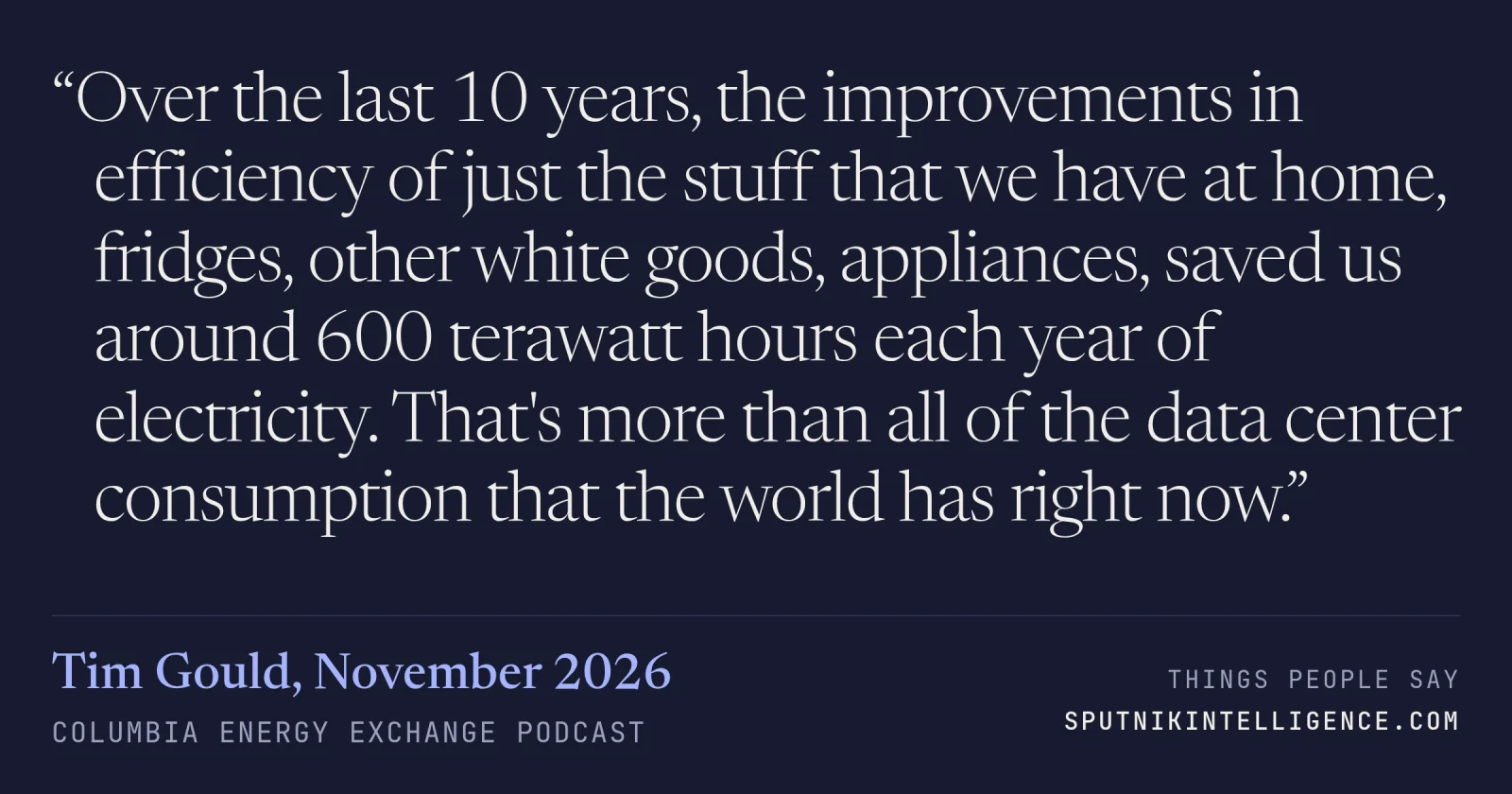
“Over the last 10 years, the improvements in efficiency of just the stuff that we have at home, fridges, other white goods, appliances, saved us around 600 terawatt hours each year of electricity. That's more than all of the data center consumption that the world has right now.” — Tim Gould, Columbia Energy Exchange

Asked about energy efficiency, which the host called the forgotten fuel, the IEA's Tim Gould puts appliance efficiency gains next to today's data center load.

Columbia Energy Exchange · 2026-11-24 Permalink → Listen →
Columbia Energy Exchange Around 54:21 into the episode
Tim Gould

…ahead. I mean, of course, there's open questions there about building out the infrastructure and getting it to work effectively. But that path is in a way reinforced by the crisis, by the worries about energy security. You can't yet say the same thing about the outlook for low-emissions fuels.

Jason Bordoff

…people forget about it, but at least we're not forgetting about it. We're mentioning it and asking about it. Energy efficiency, as you know, is often the sort of forgotten fuel. Talk a little bit about what the WIO shows can be done. What do you project will be done to use energy more efficiently?

Tim Gould

So, we will continue to bang this drum for as long as we can that there is a huge potential still to use energy more efficiently. Electrification, as you pointed out just now, is a part of that because electrification is inherently more efficient than fuel consumption as a way of delivering. energy services. But just to give you an illustration of what we can do with a greater focus on efficiency. So over the last 10 years, the improvements in efficiency, just of the stuff that we have at home, fridges, other white goods, appliances, that saved us around 600 terawatt hours each year of electricity. That's more than all of the data center consumption that the world has right now. So it's a really important untapped resource. And there's much more that we could be doing cost effectively in the future as well. In our view, we're going to see a somewhat artificial pickup in the energy sort of improvement in the energy intensity of the global economy this year because essentially the economy has continued to expand, but overall energy demand is likely to be flat.…

Jason Bordoff

And in closing, I know the IA is cautious about being too prescriptive with policy advice, but you talk to policymakers a lot. We have 20 or 30 people about to run for president in this country. We are a policy center. So what would you tell policymakers to keep in mind as they think about good…

Tim Gould

It's a complex system. And if anyone comes to you saying that there's a single answer to affordability or security or decarbonization, be skeptical. Because I think one of the lessons of recent years is that you have to think about the interrelationship of lots of different moving parts. So if…

Jason Bordoff

It's a complex system. It is a complex time, politically, geopolitically, technologically, AI revolution. And the work you and your colleagues do for those of us who are trying to understand the energy system is enormously helpful. So thanks, Tim, to you and Laura Cozy and Fatih and the whole team…
Speaker names come from our own diarization. The position is estimated from where the line sits in the episode.
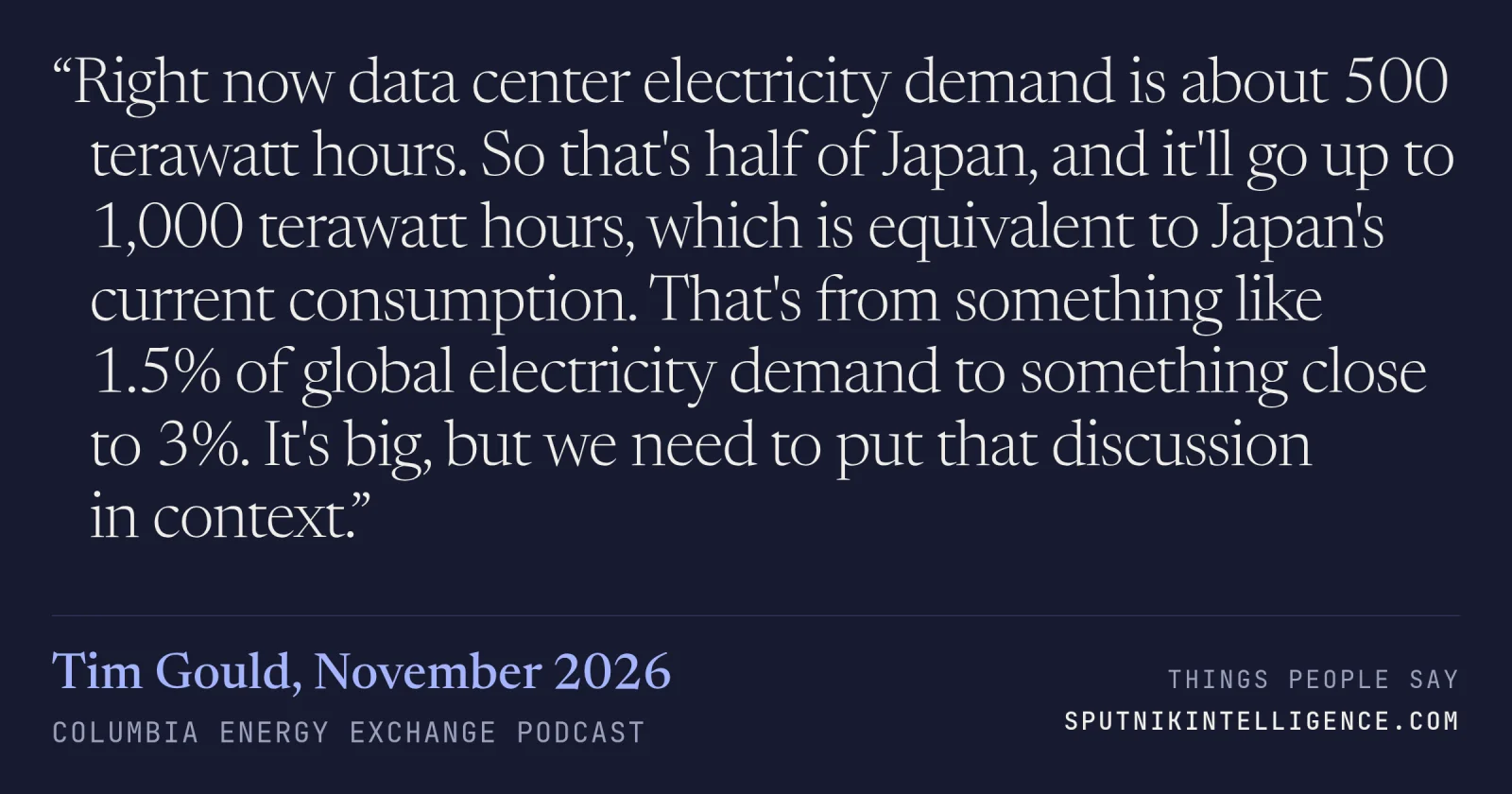
“Right now data center electricity demand is about 500 terawatt hours. So that's half of Japan, and it'll go up to 1,000 terawatt hours, which is equivalent to Japan's current consumption. That's from something like 1.5% of global electricity demand to something close to 3%. It's big, but we need to put that discussion in context.” — Tim Gould, Columbia Energy Exchange

Tim Gould of the IEA notes that data centers drive a big share of US demand growth. Globally, though, their share of electricity stays small.

Columbia Energy Exchange · 2026-11-24 Permalink → Listen →
Columbia Energy Exchange Around 43:49 into the episode
Tim Gould

…overall electricity demand, but it's something like 30% of peak electricity demand. And so, you know, if you have heat waves, if you have very hot periods in a country, and that can lead to enormous strains on the system. So you need to be building in some additional resilience to cope with that.

Jason Bordoff

So big discussion, say, here in the US about AI and data centers, but globally, that is not. There are many other drivers that are bigger sources of growth and electricity demand than the AI revolution, it sounds like.

Tim Gould

I mean, it's very big in certain countries and the US is, of course, one of them, data center electricity demand, in our view, that's slightly over half of the growth in electricity demand in the US to 2030. And within the US, as you know very well, these data centers tend to cluster, so they have very strong local effects. But 80% of the data centers that we think are going to be built between now and 2030 are either in the US or in China or in Europe. So we shouldn't generalize too much from the discussions that are rightly being had in some of those jurisdictions to the world. Putting a couple of numbers on it, right now, data center electricity demand is about 500 terawatt hours. So that's half of Japan, and it'll go up to 1,000 terawatt hours, which is equivalent to Japan's current consumption. That's from something like 1.5% of global electricity demand to something close to 3%. It's big, but it's not, you know, we need to put that discussion in context.

Jason Bordoff

And the IEA sees most of that growth, am I right, in power demand being met by renewables? Is that energy and enhanced energy security concerns might bolster the case for renewables? How should we think about whether the electricity system can handle it? You know, there's often language in the Wii…

Tim Gould

I think the, I mean, that cuts both ways. And if you start from the data center example, in our view, about half of the additional data center demand is going to come from renewables. A big additional chunk is going to come from natural gas. But if you need to put in place new generation quickly…

Jason Bordoff

Jr.: For the last more than a decade, one of the biggest factors shaping the global energy outlook has been this shale revolution, growth from 5 million barrels a day to nearly 15 in the United States, just stunning year-on-year growth. Those days may be close to over, most projections show. How…

Speaker names come from our own diarization. The position is estimated from where the line sits in the episode.

Collections They Appear In