Thornton runs a defense manufacturing startup. The host asks how the Pentagon moved so quickly away from contracts where a supplier's profit rose with its costs. Thornton's view is that the old contractors behaved exactly as those incentives told them to, and that fixed-price deals produce cheaper and better weapons.
…actually get to a spot where we have significantly greater financial efficiency. But asymmetry, actually, in context, what we need to be building as a company and what we need to be buying as a country means the ability to punch above our weight class with our industrial base relative to China.
…overall profit would go up as they spent more and more money on the product. So it was just complete adverse incentive. And today you have these companies like Mock with this asymmetric warfare with very cost-effective weapons that are being sold to the government. How did that change so quickly?
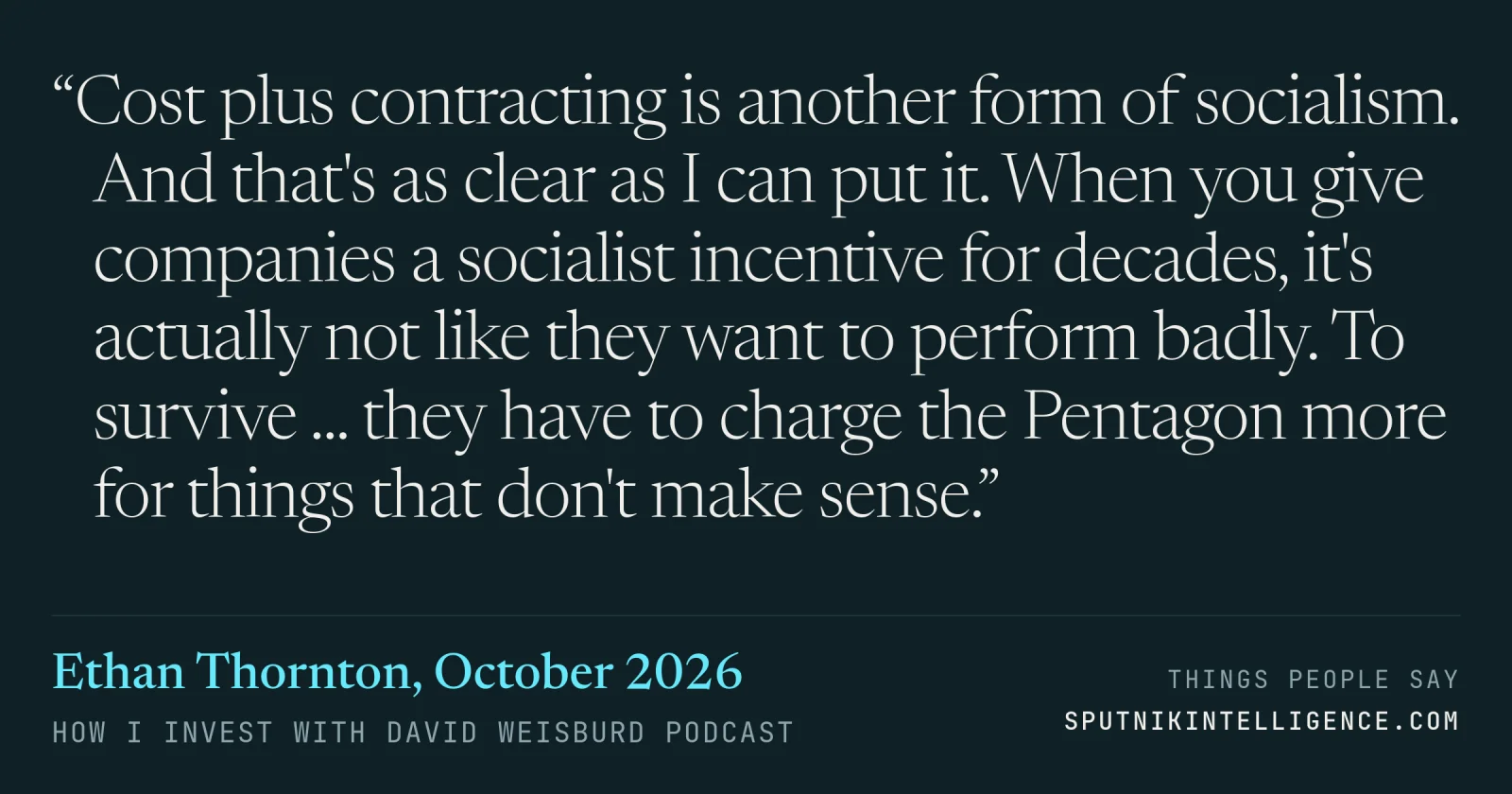
100%. Look, cost plus. Contracting is another form of socialism. And that's as clear as I can put it. When you give companies a socialist incentive for decades, it's actually not like they want to perform badly. To survive, they actually have, they have to charge the Pentagon more for things that don't make sense. I love looking at incentives to understand outcomes. And when you look at the incentives of COX plus contracting, it's actually not surprising how we got here. It's uncomfortable to say you need to be deeply capitalistic to ship great technology. But the thing America continues to do incredibly well is to find the next stage of tech. And 40 years ago, we did have a bigger industrial base than…
You mentioned China. We're in this Cold War with China. It may turn into a hot war. I think there's a 12% chance that China invades Taiwan one way or another by the end of next year. Where are we in relationship with China? And how do you even quantify the relative military strength of the two…
For sure. It's actually kind of a fool's errand, I think, to deeply try and predict military strength or when China will invade Taiwan. I'm curious where you got that 12%.
Polymarket.