SG

Susanna Gallani

Things Susanna Says on Podcasts

Holds the Tai Family Associate Professorship in the Accounting and Management unit at Harvard Business School. Her research and case writing focus on incentive design, performance measurement, and motivation systems, with a concentration on healthcare organizations; she co-teaches the MBA course Transforming Health Care Delivery. Appears as a guest on Cold Call, HBR's podcast built around HBS case studies, to discuss cases she has written. These include Lanco Medical Group, a Latin American healthcare distributor, on employee motivation and incentive design as it scales, and a separate case on Mass General Brigham's rollout of an AI clinical scribe, covering adoption timing and physician trust. She also writes for practitioner outlets including Harvard Business Review and Forbes.

Where to Find Them

Susanna Gallani has been a guest on Cold Call (4 times) .

Recently: “Can an AI-Powered Scribe Curb Physician Burnout?” on Cold Call (August 2026); “How Lanco Medical Group Fosters Workforce Happiness to Motivate Employees and Grow Fast” on Cold Call (March 2025); “Can the Robin Hood Army Grow with Zero Financial Resources?” on Cold Call (November 2019); “Cost-cutting Leads to Turbulence in the Airline Industry” on Cold Call (March 2017).

What They Said

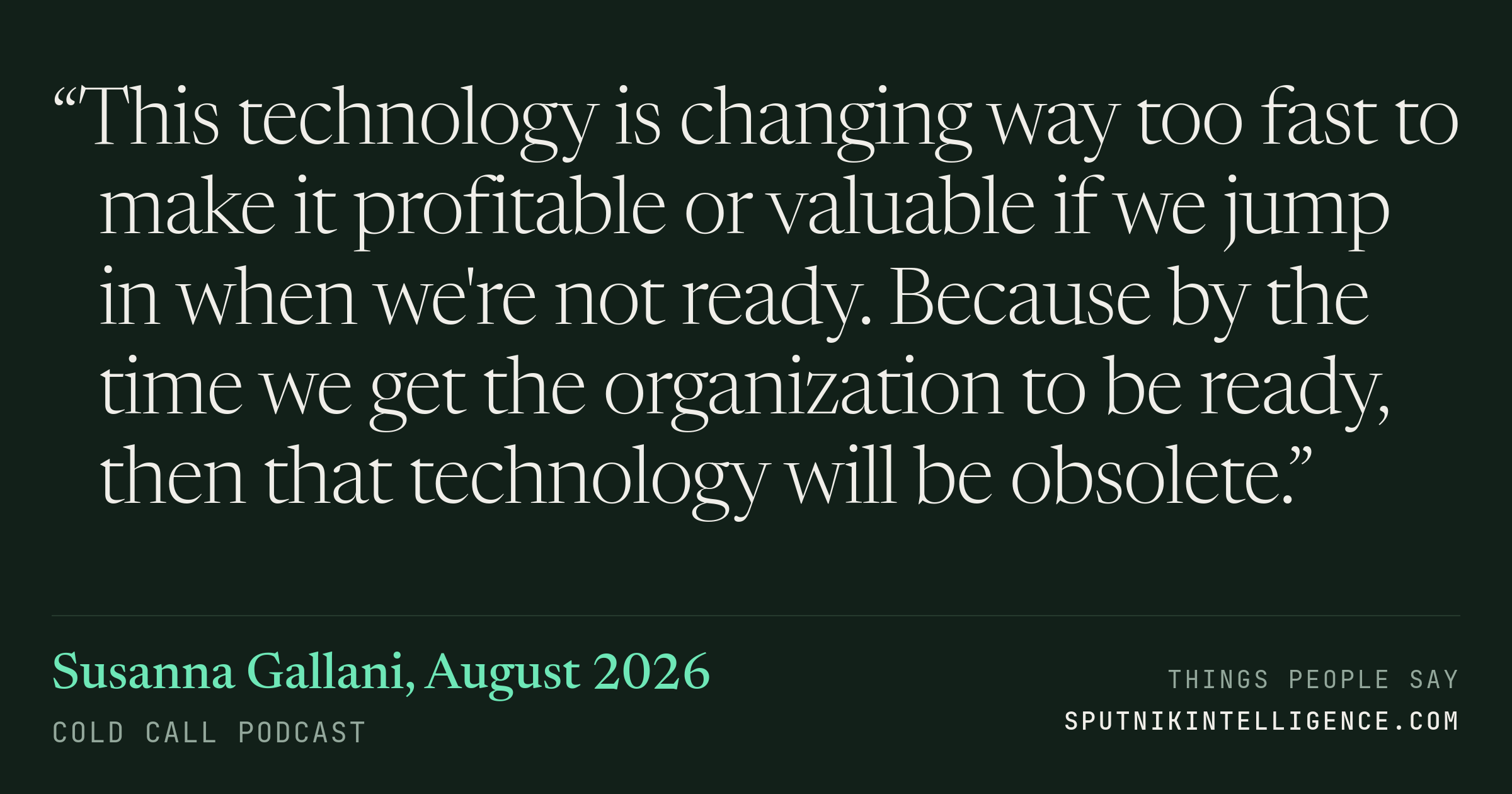
“This technology is changing way too fast to make it profitable or valuable if we jump in when we're not ready. Because by the time we get the organization to be ready, then that technology will be obsolete.” — Susanna Gallani, Cold Call

Susanna Gallani on the timing trap organizations face when adopting AI tools like Mass General Brigham's AI scribe: preparing too cautiously can mean the technology has already moved on by the time you're ready.

Cold Call · 2026-08-18 Permalink → Listen →
Cold Call Around 21:41 into the episode
Susanna Gallani

Yeah, for sure. The fact that this is happening in healthcare is just a context, right? It is, as you were mentioning, happening in many other industries. So, it's not specific to healthcare. Obviously, in healthcare, there is maybe a specific type of risk because we're talking about healthcare data or healthcare information, which is a little bit different than maybe your purchasing information, which it still has to be treated with respect and the appropriate safety precautions. But I think healthcare is one level deeper than that.

Brian Kenny

So,

Susanna Gallani

in terms of generalizable lessons, well, one thing that is clear to me is that we don't have to jump into this all at once, and especially when we're not ready. This technology is changing way too fast to make it profitable or valuable if we jump in when we're not ready. Because by the time we get the organization to be ready, then that technology will be obsolete. So, one of the things that they are pondering at Mass General Brigham, but I'm sure in other organizations too, is when is the right time to introduce this technology and for whom? I mentioned the trainees before, right? So, this, again, it's a problem that we see in other industries as well. I actually had a recent conversation with a legal firm in England that is thinking about introducing AI for their work. But the problem they share with Mass General Brigham is: what are you going to do with the trainees when you have a junior partner or a junior or an associate in a law firm, as well as a resident at Mass General? Are you going to teach them to use AI or are you going to be AI independent? Should that technology go away or not work? Or what are the opportunities that we're missing in not training our trainees to use AI? But at the same time, what opportunities are we missing if we train them just to use AI? So, either way, you have to consider the pros and cons of either choice.

Brian Kenny

Right, and we know that one of the ways that AI learns is by consuming mass amounts of information. So, it almost seems like when you scale this up, you really do need to get a high percentage of adoption, or you're not going to get the full benefit of what the AI is capable of doing. It's not going to learn as much as it could and not as fast. So, it's pretty complicated to think about all the implications of that. This has been a great conversation, always is when you're on the show. So, thank you for being here. Just one last question would be: if you think about maybe one thing that our listeners should take away from this case, what would it be?

Susanna Gallani

I go back to the point I made earlier, which is think about the human that is using the technology and use the technology to solve a problem that the human has before thinking that it's just going to be great. We have to really be specific of what problem we're trying to solve. And I think that Mass General Brigham did a great job in really pinpointing what was the purpose of that implementation. It was not just about certainly they are not unhappy to improve productivity, but the purpose, the driver of the decision was we have to reduce burnout. And that was their priority.

Brian Kenny

Yeah, that's great. Susanna, thank you for joining me on Cold Call.
Speaker names from our own diarization · position estimated from where the line sits in the episode
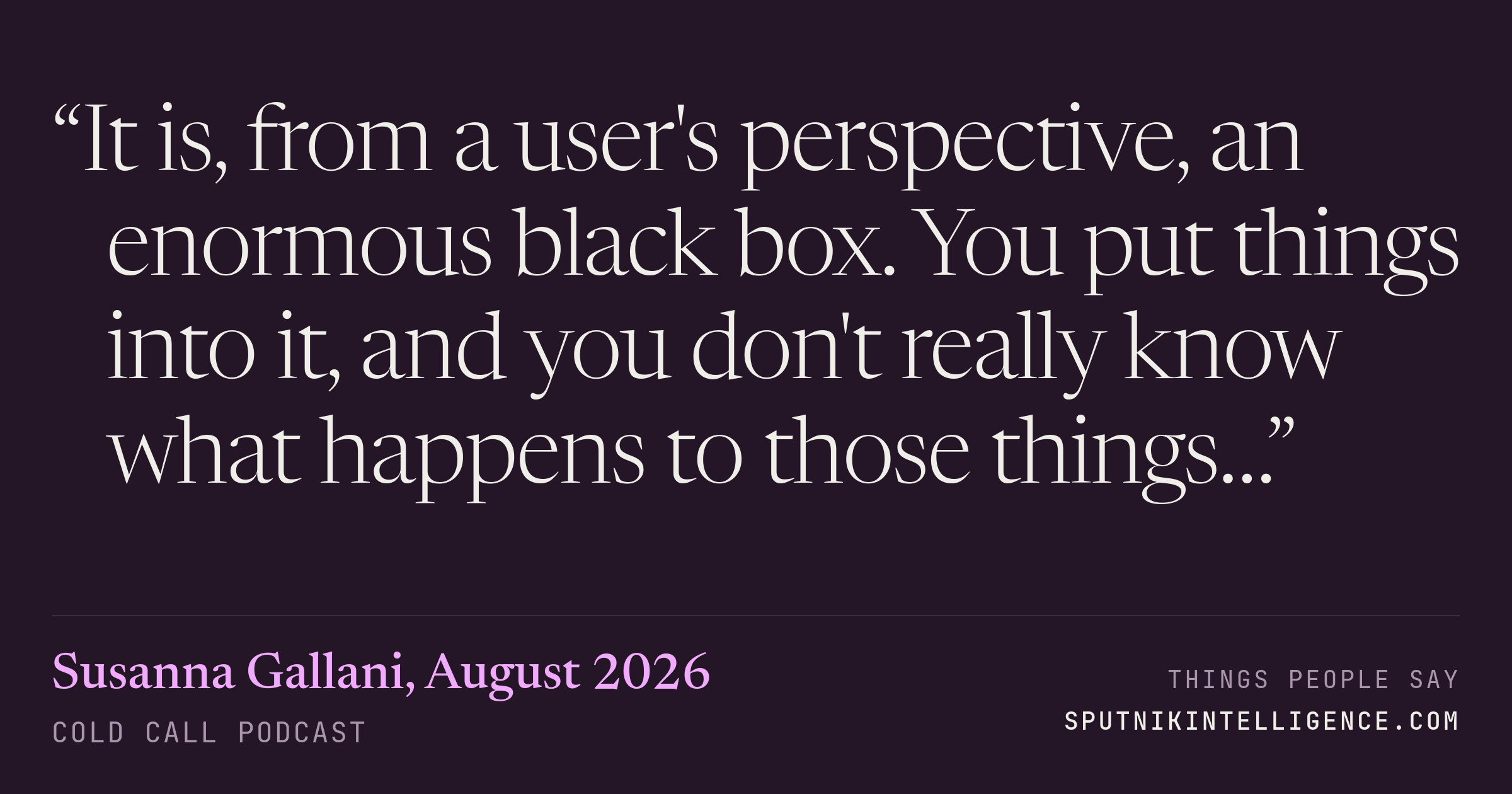
“It is, from a user's perspective, an enormous black box. You put things into it, and you don't really know what happens to those things…” — Susanna Gallani, Cold Call

HBS professor Susanna Gallani, discussing why physicians and patients hesitate to trust an AI scribe that records and transcribes clinical visits. Her point is that opacity, not the technology's usefulness, is what undermines adoption.

Cold Call · 2026-08-18 Permalink → Listen →
Cold Call Around 17:45 into the episode
Susanna Gallani

so imagine anything you want to do with clinical data, whether it's research, whether it's improving care, you want to have enough adoption, enough mass to have that mass of data so that it's consistent across an organization. That would make sense. Well, when they open it up for a larger group, which they still haven't rolled it out to everyone, but they are progressively getting there. One of the largest groups, which is the group that historically has the highest level of burnout, this primary care. Once they open it up to that group, it was opt-in. But for those people that chose to use the license, many of them, a significant amount, did not pursue it. So they had the license, they just didn't do it. And in fact, there was a rule that if you didn't use it for three months, they would ask you why and potentially take it away. Because it has a cost. There is a monthly fee for this licenses, which is person by person.

Brian Kenny

Yeah. Yeah. I mean, we're finding that the human side of AI, getting people to adopt the tools and to use them, is highly variable, right? Some people are comfortable doing it. They think, oh, this is great. This is going to make my life easier. Other people are thinking, this is something new I have to do. I have to learn how to use this. And what if it breaks? Or what if I don't do it right? What would you say to people who are listening who are maybe going through the same kind of a process in their own organization? What are the sorts of things that you have to be thoughtful about as you're trying to scale up this kind of platform?

Susanna Gallani

The first thing is trust, right? We talked about it. It's really difficult for people to just embrace this when this technology changes daily. It is, from a user's perspective, an enormous black box. You put things into it, and you don't really know what happens to those things, things being information, sometimes sensitive, sometimes personal. And so having this expectation that everybody will jump at the opportunity to use it is probably misguided. So understanding what do you need to do to make it so that people trust what you're going to do with that technology. Generally speaking, security of that technology, it is a black box for the leadership too. It's not that we understand this infinitely well. Remote learning,

Brian Kenny

yeah.

Susanna Gallani

Yes, and it's changing so much that we tend to understand less and less instead of more and more in certain ways, right, of what it does and what it's capable of doing. So the first thing would be trust. The second thing would be use it to bring up the humanity of the workers and not to replace them because there's a huge fear. Now, this is less prominent in healthcare, I will say, than other industries, but we all are thinking about: is this thing going to take my job, right? So understanding that that is a concern that people have, even if it is, you know, buried in the back of your psychology, but especially if you're bringing this technology in to help people make it help people

Brian Kenny

instead

Speaker names from our own diarization · position estimated from where the line sits in the episode