Agrawal, Twitter's former CEO, now runs Parallel, a web search company built for agents rather than people. Harry Stebbings asked what the original insight was. He goes on to argue that search compute has to get 10 to 100 times more efficient, and that the current market price of web search is 'totally off'.
Parallel is the Google for agents. So agents need to search the web to do anything they do for you, whether it's a personal agent or an agent built for work. Just like humans need to go on a browser, search Google, oftentimes during work or for whatever you're doing in life, your agent needs to do the same. Turns out agents are different from humans in the way you build web search for agents of different. Parallel is about building the technology for agents to search the web and then the business models to make that sustainable.
Was that the original insight that you had?
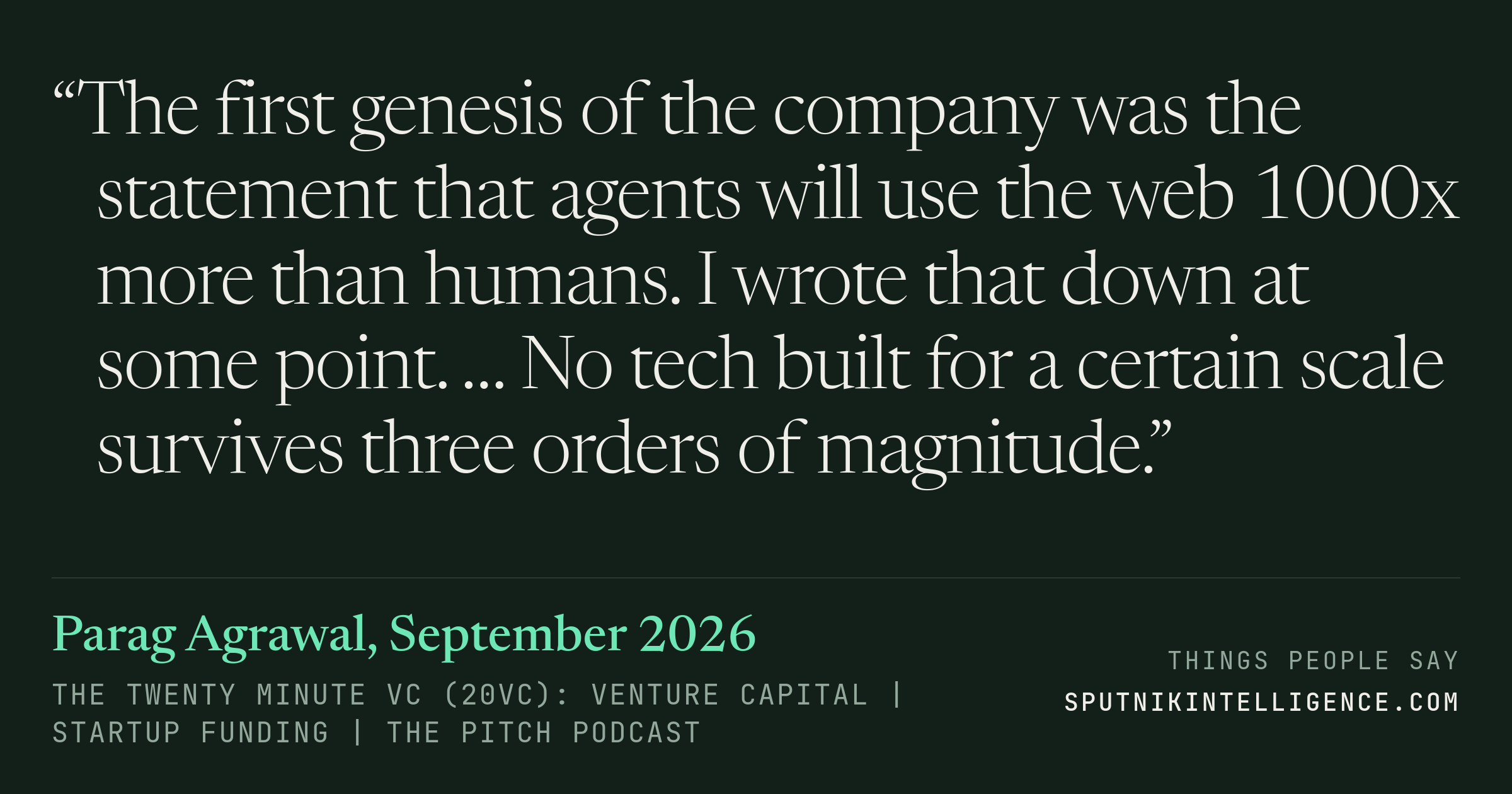
Yeah, literally the first genesis of the company was the statement that agents will use the web 1000x more than humans. I wrote that down at some point. Hence, new tech is needed and new business models are needed. Thousandx gives you a sense of scale. It changes how you think about building the tech underneath because like no tech built for a certain scale survives three orders of magnitude. And then when you need new business models alongside new technology, a problem becomes really interesting.
How does the world of agents change web search in terms of the technology required?
There are many, many layers to the answer, but let's start at the first thing we mentioned, which is scale, right? Now if you think about, let's say agents actually do end up searching the web a thousandx more. If we spend the amount of compute we currently spend per web search, that's too much compute for web search. So you now need to make it way more efficient by perhaps, I think, 10 to 100x. For it to make sense.
Yeah. If you're doing a thousand eggs, yeah.