BM

Bob Michele

Things Bob Says on Podcasts

Where to Find Them

Bob Michele has been a guest on Bloomberg Surveillance (42 times) , Wall Street Week (5 times) , Closing Bell (5 times) , Bloomberg Intelligence (2 times) , Masters in Business , Squawk Box Europe Express and Equity Mates Investing Podcast .

Recently: “Financing In The AI Boom: Masters in Business with Bob Michele” on Masters in Business (October 2026); “Bloomberg Surveillance TV: September 28th, 2026” on Bloomberg Surveillance (September 2026); “Today's Fed decision with first hike in three years priced in” on Squawk Box Europe Express (September 2026); “Closing Bell Overtime: Markets Close Out Wild August 8/31/26” on Closing Bell (August 2026); “The US Macroeconomic Picture” on Bloomberg Surveillance (June 2026); “Closing Bell Overtime: Markets Search for New Leaders as Big Tech Stalls and Intel Surges 6/18/26” on Closing Bell (June 2026).

What They Said

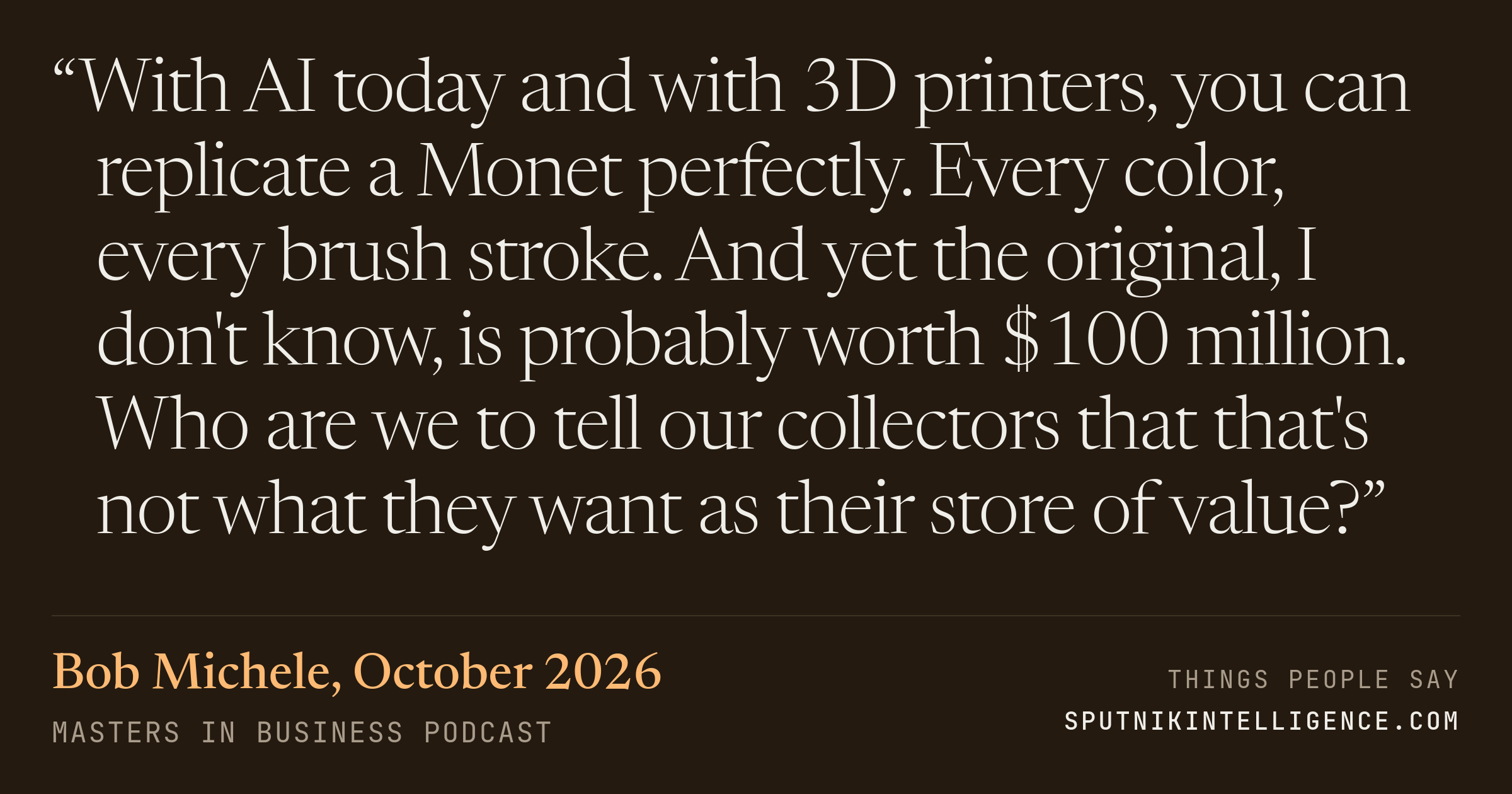
“With AI today and with 3D printers, you can replicate a Monet perfectly. Every color, every brush stroke. And yet the original, I don't know, is probably worth $100 million. Who are we to tell our collectors that that's not what they want as their store of value?” — Bob Michele, Masters in Business

Asked whether Bitcoin could challenge the dollar, Michele says he has always seen it as a store of value. When clients tell him it represents nothing, he answers with fine art: something can be worth a fortune even when it can be copied perfectly.

Masters in Business · 2026-10-16 Permalink → Listen →
Masters in Business Around 19:27 into the episode
Bob Michele

…and deliver on their primary objective, which is price stability, inflation. Gold's more a reflection of the outcome of their policies than allowing them to alter their policies. So today we sit here and really the dollar is the only reserve currency out there. Nobody wants to fight it for now.

Barry Ritholtz

…yellow metal we scrape out of the ground each year, but hold that aside You didn't mention Bitcoin or any of the crypto currencies is that is that a fantasy that some people hold that we can replace the US dollar with either central bank issued currencies or Crypto currencies or perhaps Bitcoin.

Bob Michele

I know bitcoins been controversial. I know a lot of the controversy about has to do with what does it actually represent. I'm going to talk to that. And I know a lot of it is concerned that if it's untracked, unregulated, it gets used for criminal enterprise. And yes, of course, that's a concern. Let me go back to store of value. From the time it was created, I stepped back and thought, I can see this as a store of value. I can see the millennial generation and surrounding cohorts coming along, and this is something they would like to have as a store of value. What does it represent? A mathematical formula? Okay, I have a math background. I kind of get that. I'm okay with that. When I get into debates with clients about, but you own nothing, and it just goes on and on, I bring up fine art. And I bring up the thought that, look at some of the fine art. A few months ago, a Jackson Pollock painting sold at Christie's for close to $ 200 million. And I went to see it because I wanted to see it. It was beautiful. It was like squiggly lines. Probably…

Barry Ritholtz

An alternative to fiat currency. Could that ever be an alternative to the dollar?

Bob Michele

I'm not sure. I think you would need central banks to come in. You would need treasuries to come in. I think there's a big difference between and the confusion between crypto and a stable coin and what can be tracked and regulated and what has the full faith and credit of the u.s behind it and is…

Barry Ritholtz

So I'm glad you brought up stable coins. And I don't want to spend too much time talking about currencies, but I've always thought of the dollar more as a medium of exchange than a store of value, if only because we tend to have inflation at 2%, 3% or higher over longer periods of time. And I could…
Speaker names from our own diarization · position estimated from where the line sits in the episode
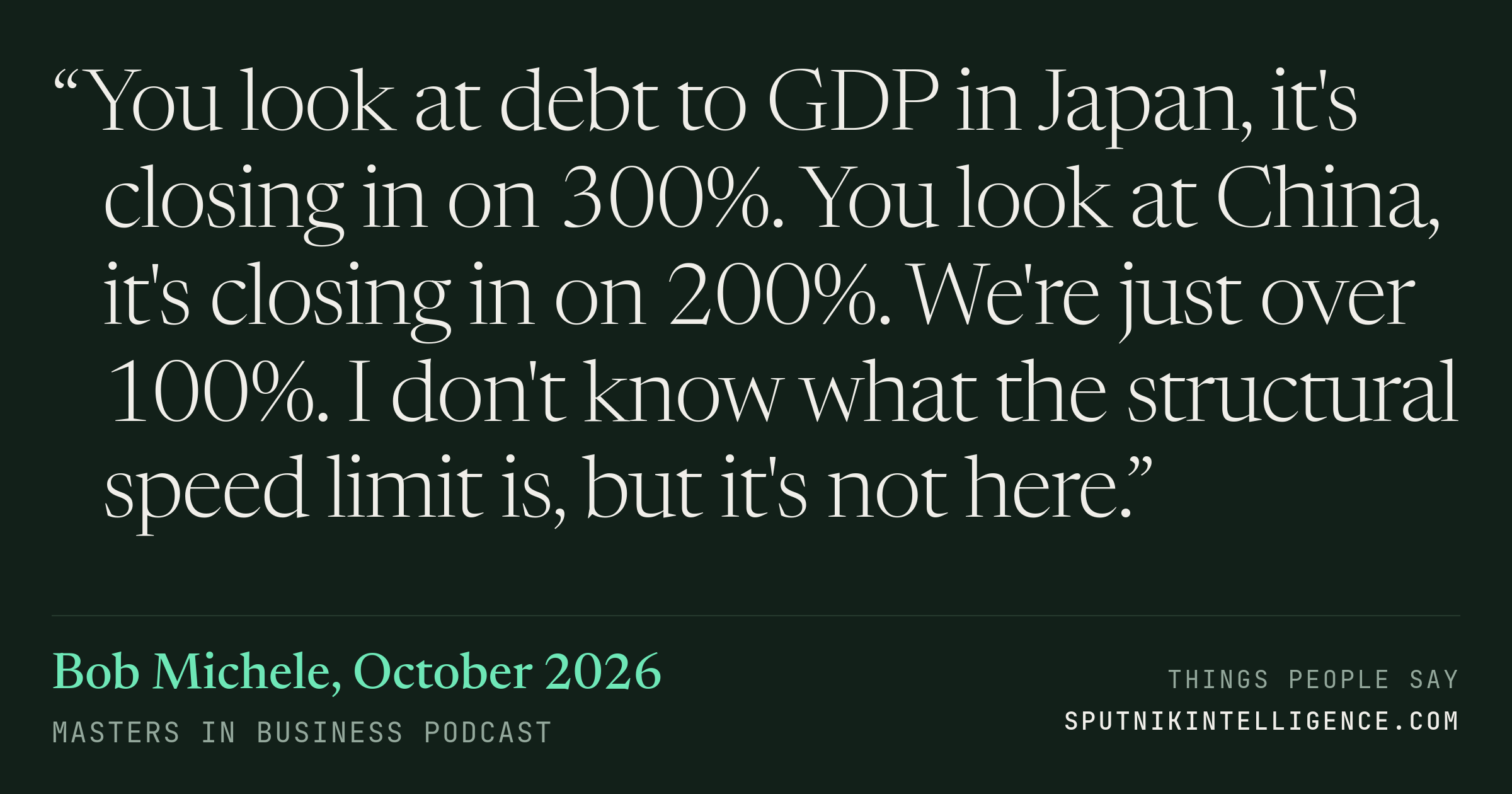
“You look at debt to GDP in Japan, it's closing in on 300%. You look at China, it's closing in on 200%. We're just over 100%. I don't know what the structural speed limit is, but it's not here.” — Bob Michele, Masters in Business

Barry Ritholtz asked how much deficits are driving bond yields higher. Michele says he is "over" the righteous indignation about government debt. He argues that debt service of roughly 3.5% of GDP is still reasonable, even if governments have lost their discipline.

Masters in Business · 2026-10-16 Permalink → Listen →
Masters in Business Around 35:57 into the episode
Bob Michele

…America, will source and originate loans. We'll have a look at them and do a fiduciary look. If they make sense for some of our client base, then we'll put it into our portfolios. The convergence between public and private is happening everywhere. I think it's healthy for the bond markets.

Barry Ritholtz

So let's talk about a few other things besides inflation that are driving yields higher. How do you look at the current set of deficits? How significant has that been to what's going on in bond markets? And is that a key factor with yield or is that just one of many factors?

Bob Michele

…go here and sell. Do we need to go out for dinner? No, probably not. We can eat at home. Everyone is doing that, yet we look at governments and they don't seem to have that discipline anymore. And it's not just the U.S. We're learning it's happening in France. We're learning that it's about to happen in Germany. Has it gone on in Japan and China for a while? It has. I'm over it. I'm over it. You look at debt to GDP in Japan, it's closing in on 300%. You look at China, it's closing in on 200%. We're just over 100%. I don't know what the structural speed limit is, but it's not here. Perhaps a more interesting measure is to look at debt service to GDP. Where does that become a problem? Where does it look stretched? Maybe the total amount of debt service payments to GDP at close to 5% is a historic high level for the US. But we're in the mid threes right now. To me, that's still pretty reasonable. So there was a lot of low coupon financing that's gone on at the government…

Barry Ritholtz

And if memory serves, I'm doing this off the top of my head, 10% is where countries really run into trouble. If their debt service is 10%, of their gdp that's really problematic.

Bob Michele

Yeah and and then you're hunting the math on how much debt the u s would have to issue to get there i don't even know if we could spend it all you're not given five thousand dollar checks terry what i don't maybe you're given five million dollar checks to everyone.

Barry Ritholtz

That would be inflationary we would have to worry about that so so there has been some hesitancy uh... when we look at these treasury auctions from foreign buyers I know you've pushed back on the sell America narrative. What are your thoughts on how attractive U.S. treasuries are today around the…

Speaker names from our own diarization · position estimated from where the line sits in the episode