
Shreya Shankar

Things Shreya Says on Podcasts

Where to Find Them

Shreya Shankar writes Vanishing Gradients , writes The Growth Podcast , writes ThursdAI - The top AI news from the past week , writes Lenny's Podcast: Product | Career | Growth , writes Lenny's Newsletter and writes Product Growth . They have also been a guest on MLOps.community , Gradient Dissent: Conversations on AI , The Data Exchange with Ben Lorica , The Gradient , Latent Space , The Analytics Engineering Podcast and The TWIML AI Podcast . They also write for Shreya Shankar on Substack.

Recently: “Can data agents do real analysis?” on The Analytics Engineering Podcast (October 2026); “Advanced evals: How to find (and fix) hidden AI failures in your product” on Lenny's Podcast: Product | Career | Growth (September 2026); “Advanced evals: How to find (and fix) hidden AI failures in your product” on Lenny's Newsletter (September 2026); “How to Do AI Evals Step-by-Step with Real Production Data | Tutorial by Hamel Husain and Shreya Shankar” on The Growth Podcast (January 2026); “LLM Judges and AI Agents at Scale” on Vanishing Gradients (October 2025); “Why AI evals are the hottest new skill for product builders | Hamel Husain & Shreya Shankar (creators of the #1 eval course)” on Lenny's Podcast: Product | Career | Growth (September 2025).

What They Said

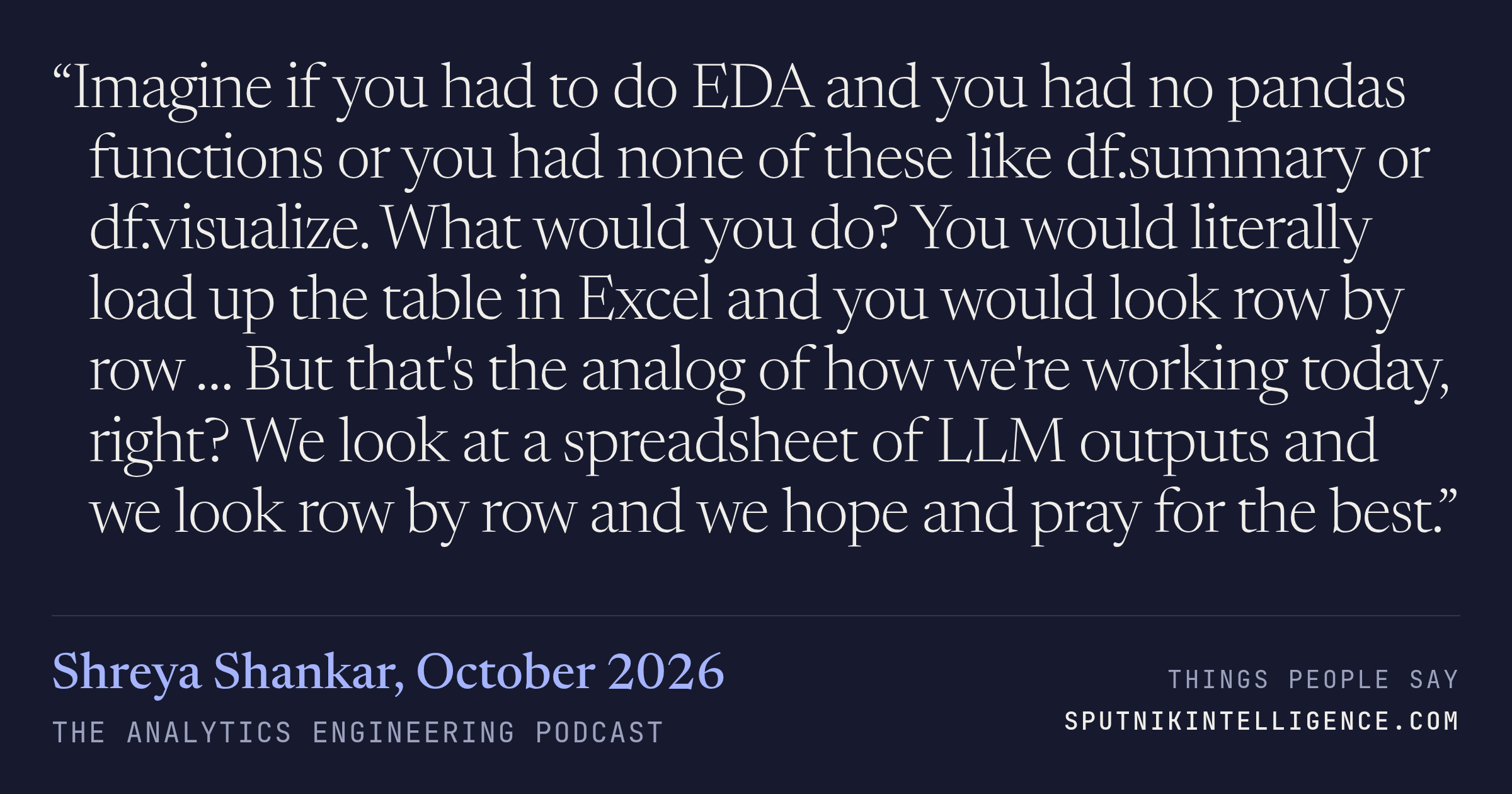
“Imagine if you had to do EDA and you had no pandas functions or you had none of these like df.summary or df.visualize. What would you do? You would literally load up the table in Excel and you would look row by row … But that's the analog of how we're working today, right? We look at a spreadsheet of LLM outputs and we look row by row and we hope and pray for the best.” — Shreya Shankar, The Analytics Engineering Podcast

Asked how practitioners should evaluate AI agents, Shankar says exploratory data analysis doesn't carry over to unstructured agent outputs yet. For now, reading outputs one at a time is all anyone has.

The Analytics Engineering Podcast · 2026-10-23 Permalink → Listen →
The Analytics Engineering Podcast Around 46:23 into the episode
Shreya Shankar

Yes.

Tristan Handy

This is, you know, to a large extent, like the data engineer, analytics engineer toolkit is just as relevant pre-agents as post-agents. But this is a brand new thing. Do you have recommendations for practitioners on practically how to go about doing this well?

Shreya Shankar

…my outlines? You can define this in your favorite database framework, data framework, but you cannot define this on your AI agent outputs. So we don't have the tools yet to accelerate all of these patterns that we know of how to work with data. And I think that's where people get stuck because now that's like they do have to invent from first principles of like, how do I look at this data? Like imagine if you had to do EDA and you had no pandas functions or you had none of these like df.summary or df.visualize. What would you do? You would literally load up the table in Excel and you would look row by row and you would be like, I don't know what I'm doing. Right. But that's the analog of how we're working today, right? We look at a spreadsheet of LLM outputs and we look row by row and we hope and pray for the best. We try to define some rubric and we're like, okay, maybe I'll run this rubric at scale on the outputs with another LLM judge and then look at that results in a spreadsheet. And like…

Tristan Handy

I love that. It's an indication of just where we are in figuring out the new rules of the road, which is fun for me. I like transition points because it means that there's stuff to learn. And that's when it gets interesting. Speaking of which, last question for you. Wait, you're headed to or you're…

Shreya Shankar

I am headed to. So when do you start? 2027.

Tristan Handy

We talked a lot about the research that you've done. What's top of mind? What are you going to be, what are you going to get up to?
Speaker names from our own diarization · position estimated from where the line sits in the episode
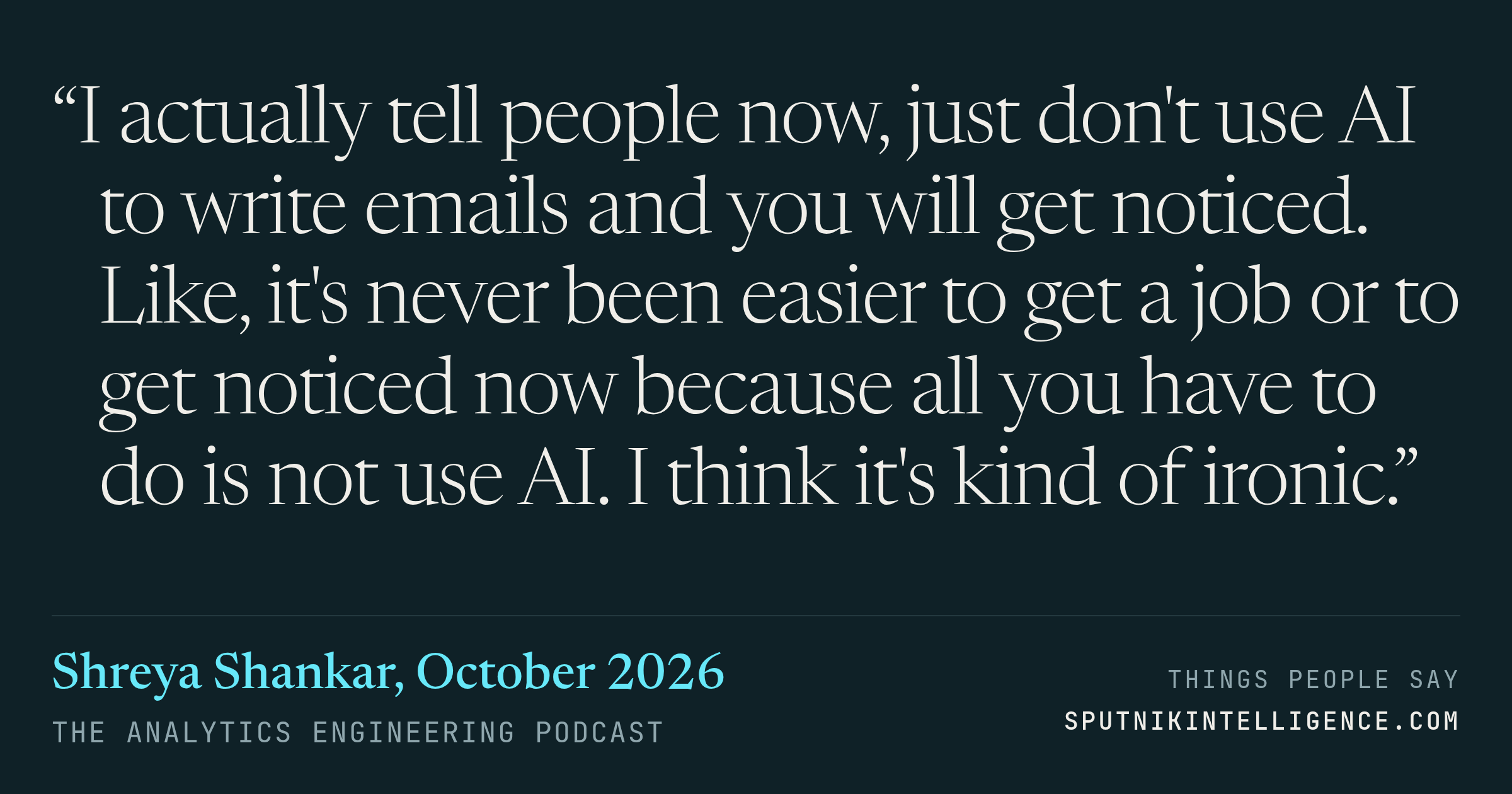
“I actually tell people now, just don't use AI to write emails and you will get noticed. Like, it's never been easier to get a job or to get noticed now because all you have to do is not use AI. I think it's kind of ironic.” — Shreya Shankar, The Analytics Engineering Podcast

Shankar and Tristan Handy discuss the flood of highly personalized, AI-written cold email, which spam filters struggle to tell apart from a real person writing.

The Analytics Engineering Podcast · 2026-10-23 Permalink → Listen →
The Analytics Engineering Podcast Around 03:52 into the episode
Shreya Shankar

…like making this instruction a good prompt injection. Like I think that the AI agents ignore it. But my guess is that because I have this instruction, the AI agents that are just trying to find professors and mass are probably not crafting an email for me. And I'm very, very happy with that. So

Tristan Handy

…is like highly personalized, clearly the result of like, you know, agentic context development on you personally before sending. Like, it's, I don't know how kind of traditional anti-spam techniques would combat that. It's not that different from like an actual human sending you an actual email.

Shreya Shankar

Right. I think it's super fascinating. I actually tell people now, like, just don't use AI to write emails and you will get noticed. Like, it's, it's never been easier to get a job or to get noticed now because all you have to do is not use AI. I think it's kind of ironic.

Tristan Handy

So you mentioned your brand new CMU job. Maybe you could just spend a few minutes talking about your history and how you got to where you're at.

Shreya Shankar

Yeah. So I went to college. I majored in computer science. I did my undergrad at Stanford. I did this during the time of the deep learning boom. So 2016 era, like it was right before Transformers, but everyone was like, you know, Gantt, adversarial image classification. I don't know, like this was…

Tristan Handy

Did you go to Neurops?

Speaker names from our own diarization · position estimated from where the line sits in the episode

Collections They Appear In