JD

Jeff Dorman

Things Jeff Says on Podcasts

Where to Find Them

Jeff Dorman writes Markets Outlook . They have also been a guest on Unchained (4 times) , The Wolf Of All Streets (2 times) , Raoul Pal: The Journey Man (2 times) , CoinDesk Podcast Network (2 times) , The Milk Road Show (2 times) , Bloomberg Intelligence , WSJ's Take On the Week , Inflection Point and Bankless .

Recently: “Is Ethereum's $240 Billion Market Cap Justified With Only $6 Million in Monthly Fees?” on Unchained (November 2026); “Strategy is Trapped & in Crisis — "It's Basically a Hedge Fund Now" | Jeff Dorman & Matt Walsh” on Bankless (July 2026); “Why MSTR Should Have Sold $2 Billion Instead of $2 Million of Bitcoin” on Unchained (June 2026); “Stop Watching Bitcoin: The 3 Biggest Opportunities in Crypto Right Now w/ Jeff Dorman” on The Milk Road Show (February 2026); “Are We Back in a Bull Market… or Getting Baited? w/ Jeff Dorman” on The Milk Road Show (May 2025); “Crypto Sentiment Is Down Bad. But Is It Time to Go All In? - Ep. 784” on Unchained (February 2025).

What They Said

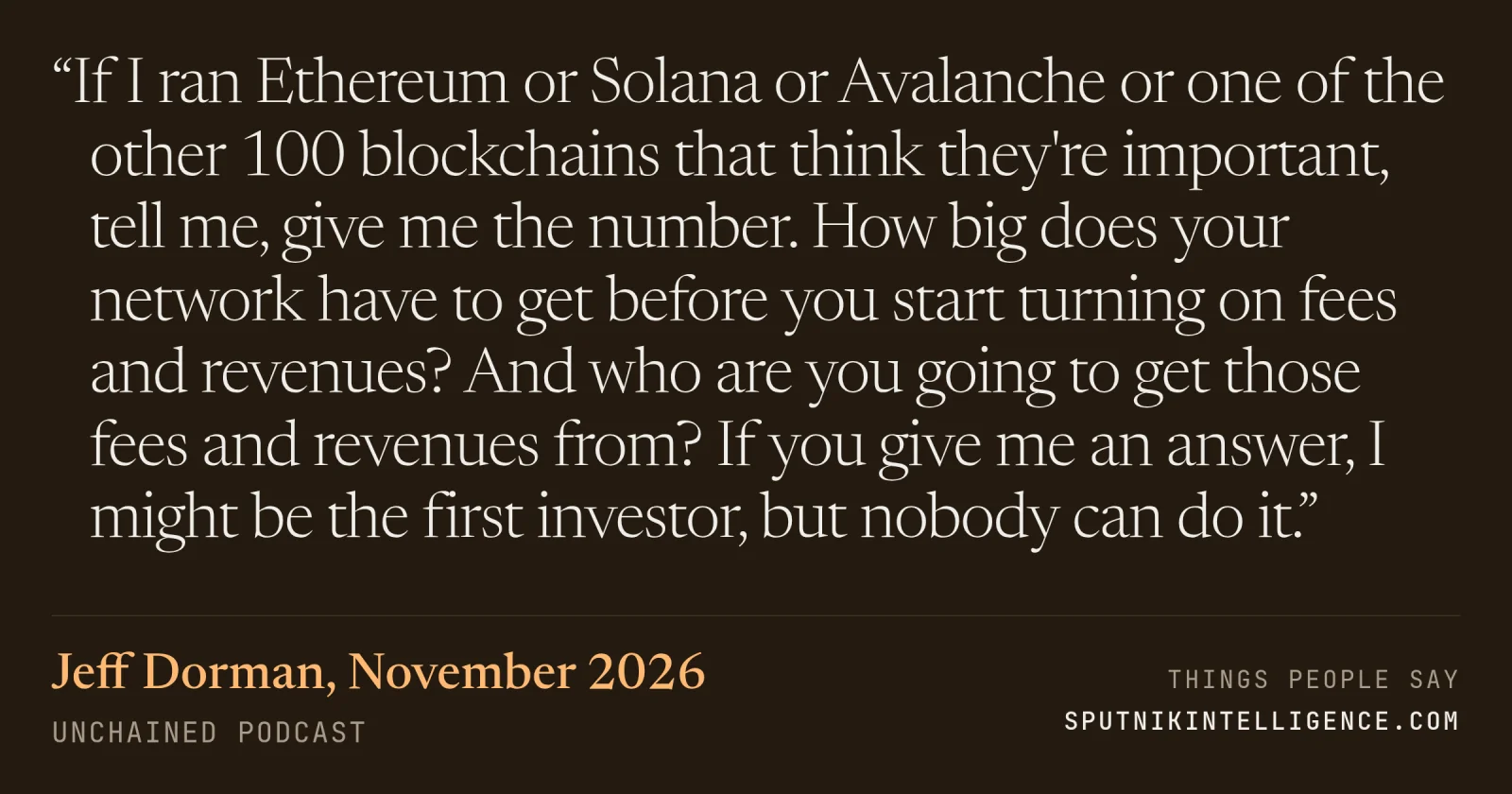
“If I ran Ethereum or Solana or Avalanche or one of the other 100 blockchains that think they're important, tell me, give me the number. How big does your network have to get before you start turning on fees and revenues? And who are you going to get those fees and revenues from? If you give me an answer, I might be the first investor, but nobody can do it.” — Jeff Dorman, Unchained

Asked about the argument that chains have to subsidize usage now and charge later, Dorman says the strategy is fine but no one can put a number on the path, unlike early Facebook.

Unchained · 2026-11-13 Permalink → Listen →
Unchained Around 30:35 into the episode
Jeff Dorman

…because they have the same market, you know, higher market caps. Like they're just not the same, right? Bitcoin is this one in a billion anomaly that no one will ever replicate again. And the rest of them are commodity businesses that are all competing for the same businesses to be built upon them.

Laura Shin

And what do you think of the argument that in order to grow, you kind of need to subsidize a certain period to get adoption? And then after that, you can start ramping up fees. Like, do you think that any of the chains are in that phase and should use that strategy?

Jeff Dorman

I think that strategy makes all the sense in the world. But again, it comes back to if that is the strategy, why can't anybody quantify that? right like nobody thought facebook was going to be worth a ton of money without ever generating revenue the people who were bullish on facebook and by the way facebook was pretty polarizing 15 years ago as well people were like well these these don't guys don't make any money all they are is this you know platform that everyone's coming on and using for free and the visionaries who actually believed in facebook the stock said well that's short-sighted they're just trying to grow the biggest network in the world and then eventually they'll turn on the fees okay well there were a lot of analysts out back then who were quantifying that they you know you can use metcath law or whatever nonsense you want to talk about a value of a network but eventually it comes back to if you actually grow that network to a size that matters then you start collecting fees from the people using it right and facebook obviously has turned that on as have other social networks and other technology platforms but again it…

Laura Shin

yeah no i mean it is a good question it's just that i think the analysis would require variables that are kind of constantly changing and so that's probably why you're not getting a good answer is because any analysis would be fixed at a certain point in time and then the circumstances would change…

Jeff Dorman

description there is the definition of hope with no valuation i mean that's basically what that's you know that you can't you can't underwrite that thesis you're on your bait you're underwriting the thesis of i think one day things might be good is basically what you say because you can't quantify…

Laura Shin

yeah yeah i i guess like the only other thought that i'm having too is that i i think like i could i could imagine some ethereum people resisting what you're saying because it is at least to to my mind and i think you admit it as well that some of your ideas would be very centralizing and because…

Speaker names come from our own diarization. The position is estimated from where the line sits in the episode.
“Bitcoin would be an incredibly boring country since you can't do anything with it. You don't spend it. You don't use it. It's literally a country of just rocks.” — Jeff Dorman, Unchained

Laura Shin suggested that only Bitcoin and Ethereum could become real "crypto countries." Dorman pushes back on the Bitcoin half of that idea.

Unchained · 2026-11-13 Permalink → Listen →
Unchained Around 17:59 into the episode
Jeff Dorman

…closed ecosystem where every all the activity is happening in one place. As a result, you're constantly kind of fluidly moving back and forth. And if you're not creating any value within the ecosystem, I just don't understand how the native currency can be viewed as anything other than a business.

Laura Shin

…and like, I know I'm going to get a lot of hate for saying these things, but probably the only two networks in crypto that could legitimately become countries are Bitcoin and Ethereum, right? Like, just, am I wrong in thinking that? Like, I don't know why you're, it seems like you're saying that.

Jeff Dorman

Bitcoin would be an incredibly boring country since you can't do anything with it. You don't spend it. You don't use it. It's, it's, it's literally a country of just rocks, but sure.

Laura Shin

But, but, so, but it seems like you were arguing the opposite of what I just said.

Jeff Dorman

Well, yeah. I, so, first of all, if you go back to the Joe Lubin tweet that I think is what triggered you asking me to be on the show and my response to it, I don't disagree with anything that Joe Lubin said about Ethereum the protocol. Ethereum, the protocol is fantastic. Like you said, it's the…

Laura Shin

So what do you think is the best way for Ethereum to go? Like, do you think that they can become a store of value asset? Do you agree with Vitalik's take there, or do you think that's misguided?

Speaker names come from our own diarization. The position is estimated from where the line sits in the episode.
“If I'm on DeFi Llama right now and I look at 30-day revenue, Ethereum is not even in the top 50, or it's barely in the top 50. It did $6 million of revenue in the last 30 days. So let's give them the benefit of the doubt and say that this was a pretty bad month and let's double that to 10 million. Now you're talking $120 million per year of revenue for Ethereum. Let's slap a very generous 20 times multiple on that. You're only looking at a couple of billion dollars of financial value there.” — Jeff Dorman, Unchained

Asked whether Ethereum's utility is really that small, Dorman runs the revenue math from public fee data to show how little of the market cap rests on fees.

Unchained · 2026-11-13 Permalink → Listen →
Unchained Around 09:00 into the episode
Jeff Dorman

Yeah, right. The idea of it's a cool factor. It's something that you just sort of want to own. You speak it into existence. So, you know,

Laura Shin

you think that even for Ethereum, it's there, like the utility is minimal.

Jeff Dorman

Well, yeah, I mean, let's do the math per second, right? If I'm on DeFi Llama right now and I look at 30-day revenue, Ethereum is not even in the top 50, or it's barely in the top 50. It did $6 million of revenue in the last 30 days. So let's, you know, let's give them the benefit of the doubt and say that this was a pretty bad month and let's double that to 10 million, right? Now you're talking $120 million per year of revenue for Ethereum. Let's slap a very generous 20 times multiple on that. You're only looking at a couple of billion dollars of financial value there. And

Laura Shin

you wouldn't count like securing the layer twos. You wouldn't sort of like have some sort of inclusive way of measuring, even if it's some fraction of that activity, you wouldn't include that.

Jeff Dorman

Well, even if you did, I mean, how much is that really worth? Right. I mean, there's a billion chains. There's virtually no cost to move in between chains. You know, as an economist, you would call that perfect substitutes. I don't know. I wouldn't put a huge value on that. But then on the utility…

Laura Shin

But you, so is Ethereum an outlier amongst crypto tokens in that respect? Or is it just one of many crypto tokens where the analysis would be pretty much the same?

Speaker names come from our own diarization. The position is estimated from where the line sits in the episode.
“Ethereum has the L1, but all of the actual revenue and businesses that are built upon it are going elsewhere. The DEX revenues don't go to Ethereum. It goes to Uniswap and Arrow. The stablecoin fees don't go to Ethereum. It goes to USDC, Circle, or Tether. And as a result, unless they start taxing those businesses, I just don't understand how you can put a high valuation on the L1 just for hosting when there's 100 other blockchains out there that can host just as easily.” — Jeff Dorman, Unchained

Dorman had just contrasted Ethereum with a chain that owns its own exchange and stablecoin distribution. This is his summary of why the ETH token doesn't capture the value of what is built on it.

Unchained · 2026-11-13 Permalink → Listen →
Unchained Around 19:48 into the episode
Jeff Dorman

Bitcoin would be an incredibly boring country since you can't do anything with it. You don't spend it. You don't use it. It's, it's, it's literally a country of just rocks, but sure.

Laura Shin

But, but, so, but it seems like you were arguing the opposite of what I just said.

Jeff Dorman

Well, yeah. I, so, first of all, if you go back to the Joe Lubin tweet that I think is what triggered you asking me to be on the show and my response to it, I don't disagree with anything that Joe Lubin said about Ethereum the protocol. Ethereum, the protocol is fantastic. Like you said, it's the leader in every category. But the problem is everyone continues to try to equate the strength of the protocol with the token. And like I said, there's just no real tangible ties to the token price based on how cool the platform is. And I'll go even further there: we've had a ton of experiments over the last 15 years in crypto, most of which have failed, right? You know, social trading has failed miserably, gaming, NFTs, all this stuff has failed. The only three things that are clearly up into the right and without a doubt growing are stable coins and payments, like undeniably, right? Even with the recent blip post-the-Binance hack where stablecoin AUM has fallen 15 billion over a longer time horizon, like AUM of stablecoins is growing and payments and transactions are definitely growing, right? Like, you know, all of Wall Street is now in this. All the banks are looking at this. Like, stablecoins and payments are not going away. That's, that's use case number…

Laura Shin

So what do you think is the best way for Ethereum to go? Like, do you think that they can become a store of value asset? Do you agree with Vitalik's take there, or do you think that's misguided?

Jeff Dorman

I think it's really misguided, right? I mean, again, like a store of value, you're saying you're a currency, right? And I think everybody in crypto, it's almost like, you know, Bitcoin was effectively like an immaculate conception, right? It was a one in a billion long shot that it actually worked.…

Laura Shin

Well, so the one thing is that when I was reading his tweet, it seemed like essentially because of crops that being a store of value for ETH was the most aligned. And that made sense to me because it sort of felt like it was of a piece. You know, if you think of crops as being very cypherpunk, then…

Speaker names come from our own diarization. The position is estimated from where the line sits in the episode.
“I wouldn't say all crypto tokens are overvalued. I would say all layer one smart contract platform tokens are overvalued. There's plenty of incredibly undervalued crypto tokens at the application layer that are generating a ton of revenue and fees relative to the actual market caps. … That value does not accrue to the layer one protocol. It accrues to the applications built upon these protocols.” — Jeff Dorman, Unchained

Asked whether his Ethereum critique applies to every token, Dorman draws the line between layer-one chains and the apps built on them. He calls the old "fat protocol" thesis wrong.

Unchained · 2026-11-13 Permalink → Listen →
Unchained Around 14:24 into the episode
Jeff Dorman

…average, people own about 0.02 Sol. So you're talking 2 million Sol at most that is actually owned for the purposes of gas and actually using it. Again, at $100 Sol, you're talking $200 million worth. It just doesn't get you anywhere close to the $50 billion that people think this network is worth.

Laura Shin

And so essentially, you're saying that pretty much all crypto tokens are overvalued. Is that, I mean, it almost feels like it's not super particular to Ethereum, right?

Jeff Dorman

No, I wouldn't say that. I wouldn't say all crypto tokens are overvalued. I would say all layer one smart contract platform tokens are overvalued. There's plenty of incredibly undervalued crypto tokens at the application layer that are generating a ton of revenue and fees relative to the actual market caps. Again, going back to DeFi Llama, Hyperliquid is doing 70 to 100 million per month, right? You slap a 25 times, 20 times multiple on that. Now you do have a $20 to $25 billion token. Same with PumpFund. Pump funded 50 million. You annualize that, that's 600. And that's in the depths of very little activity happening on chain. They're still doing $600 million a year of revenue. And you have a…

Laura Shin

Huh. All right. So in a moment, we're going to talk a little bit more about how value accrues to layer ones. But first, we'll take a quick word from the sponsors who make the show possible. What if your crypto could do more than just sit in your wallet? Nexo is a digital assets wealth platform…

Jeff Dorman

Well, I mean, he's not wrong. If you start to only focus on fee generation, then yeah, you basically become a stock, right? And I'm not arguing that that's all a blockchain should do is focus on fee generation. But the flip side is also true that if you don't care about fee generation and you only…

Laura Shin

So I guess what I don't fully understand is like Ethereum probably has the largest ecosystem in crypto, even more so than Bitcoin, which has a bigger market cap. But in terms of the sheer amount of activity of all sorts, it's for sure Ethereum. Like if we're going to pick one place where, like, if…

Speaker names come from our own diarization. The position is estimated from where the line sits in the episode.
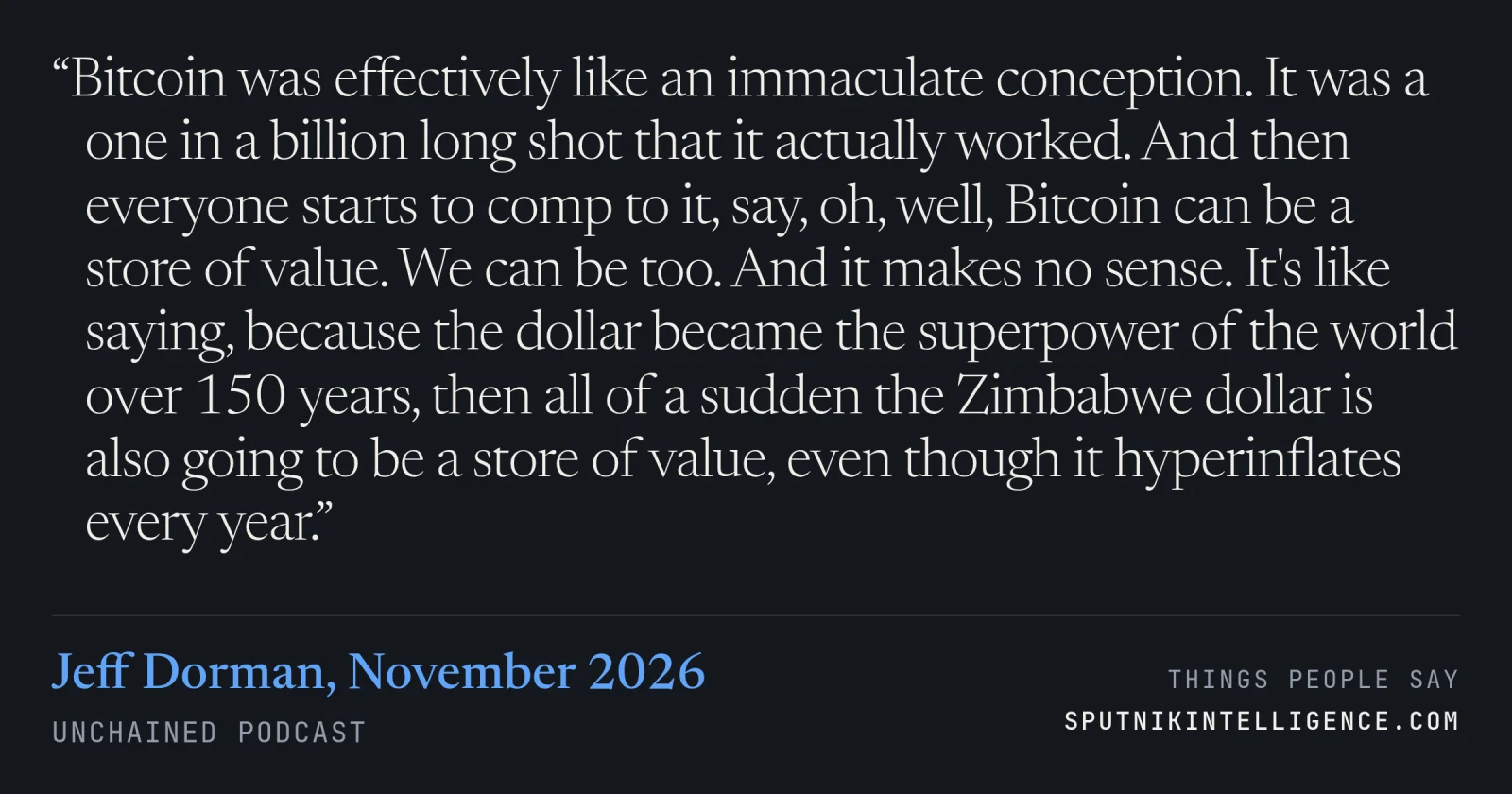
“Bitcoin was effectively like an immaculate conception. It was a one in a billion long shot that it actually worked. And then everyone starts to comp to it, say, oh, well, Bitcoin can be a store of value. We can be too. And it makes no sense. It's like saying, because the dollar became the superpower of the world over 150 years, then all of a sudden the Zimbabwe dollar is also going to be a store of value, even though it hyperinflates every year.” — Jeff Dorman, Unchained

Laura Shin asked whether Ethereum can become a store of value, as Vitalik Buterin argued that week. Dorman calls the pivot misguided and argues Bitcoin's success can't simply be copied by other tokens.

Unchained · 2026-11-13 Permalink → Listen →
Unchained Around 21:36 into the episode
Jeff Dorman

…fees don't go to Ethereum. It goes to USDC, Circle, or Tether. And as a result, like I said, unless they start taxing those businesses, I just don't understand how you can put a high valuation on the L1 just for hosting when there's 100 other blockchains out there that can host just as easily.

Laura Shin

So what do you think is the best way for Ethereum to go? Like, do you think that they can become a store of value asset? Do you agree with Vitalik's take there, or do you think that's misguided?

Jeff Dorman

I think it's really misguided, right? I mean, again, like a store of value, you're saying you're a currency, right? And I think everybody in crypto, it's almost like, you know, Bitcoin was effectively like an immaculate conception, right? It was a one in a billion long shot that it actually worked. And then everyone starts to comp to it, say, oh, well, Bitcoin can be a store of value. We can be too. And it makes no sense. It's like saying, oh, because the dollar became the, you know, the superpower of the world over 150 years, then all of a sudden the Zimbabwe dollar is also going to be a store of value, even though it hyperinflates, you know, every year. Like you can't just point to the one that worked and then say everything is a comp to that. There's no rationale for ETH, the token, to be used in any way, shape, or form outside of the Ethereum network itself. So if you're going to argue that ETH is a store of value or even a medium of exchange, you have to also argue that every other blockchain is going away. The entire world is going to be run on blockchain and it's all going to be run on Ethereum. And there's just no evidence to suggest that.

Laura Shin

Well, so the one thing is that when I was reading his tweet, it seemed like essentially because of crops that being a store of value for ETH was the most aligned. And that made sense to me because it sort of felt like it was of a piece. You know, if you think of crops as being very cypherpunk, then…

Jeff Dorman

Well, you just said philosophically, right? Now you're getting back into social value. If all it is is based on philosophy, then it's just that mimetic social value again. It's that cult thing. So I don't, again, I don't disagree that that should be the vision of Ethereum. I don't really, I'm not…

Laura Shin

And so if you were in charge of setting ETH's monetary policy and kind of figuring out what the token should represent, then how would you design it?

Speaker names come from our own diarization. The position is estimated from where the line sits in the episode.

Collections They Appear In