
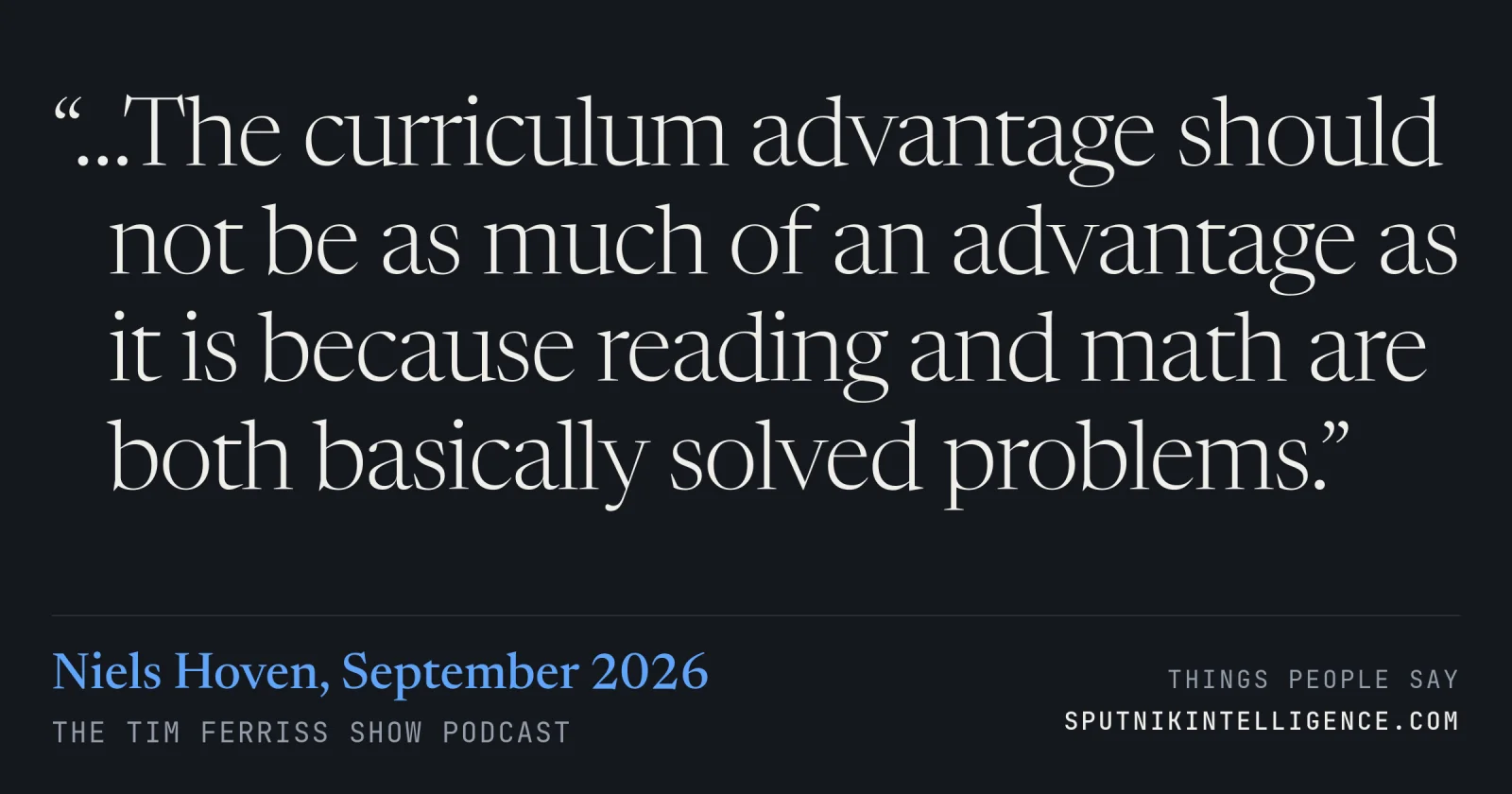
Hoven is the founder of Mentava, a reading and math product for two- to four-year-olds, and he says this while naming his own company's two advantages. The point is that phonics works and has been known to work, so any edge his curriculum holds is a verdict on the field rather than on him. He calls it unconscionable that this has been a live debate in education for a generation.
…my background is in games. I spent a long time designing games and designing tutorials. And it's just design problems all the way down. And I felt like this is a problem that I could solve that I wanted to solve for myself that I wanted to solve for other people. And that's where Mentava came from.
And what's the magic sauce? Why does it work? Why is it better than the 12 other things that I've seen you rate from a scale of, I think, one to 10 in different ways and giving your reasons?
The key things that Mentava brings to the table is an extremely optimized curriculum and a lot of really good motivation design. The curriculum advantage should not be as much of an advantage as it is because reading and math are both basically solved problems. You know, we know how to teach reading. You teach kids letter sounds and then you teach them to blend them together. And honestly, for $15, you can get a book off of Amazon that will let you do that. You have to be the teacher. It's a lot of heavy lifting from the parent side, but like it will get the job done. It's kind of unconscionable that this has been a debate in education for a generation, but this is very much a solved problem. So we take phonics, we optimize it, we teach it really nicely, we make really good UX, we make it really easy for two and two, three and four-year-olds to use.
And this is on an iPad, typically a tablet.
Yeah, on an iPad. You know, just as an anecdote is where the bar is hanging in terms of low-hanging design. In one of the apps that I was using before we built Mentava to have my kids learn, if you have a two-year-old, if you have a three-year-old and they're using an iPad, they kind of brace it on…
You mean like variable reward, or how does the slot machine example map to motivation design? The