TC

Tom Claburn

Things Tom Says on Podcasts

Where to Find Them

Tom Claburn hosts The Register Kettle .

Recently: “Anthropic's IPO prospectus is big on promises, short on answers to tough questions” on The Register Kettle (November 2026); “ShinyHunters, schminyhunters: Who needs human hackers when you can have Mythos do the hard work?” on The Register Kettle (October 2026); “A new challenger appears: Jev fights LLMs for enterprise supremacy” on The Register Kettle (September 2026); “AI is going to kill everyone, and apparently we're just going to let it” on The Register Kettle (September 2026); “Jensen's purchase of a new toy could reshape the entire AI industry” on The Register Kettle (September 2026); “Everything is crazy and, yes, you can blame AI” on The Register Kettle (August 2026).

What They Said

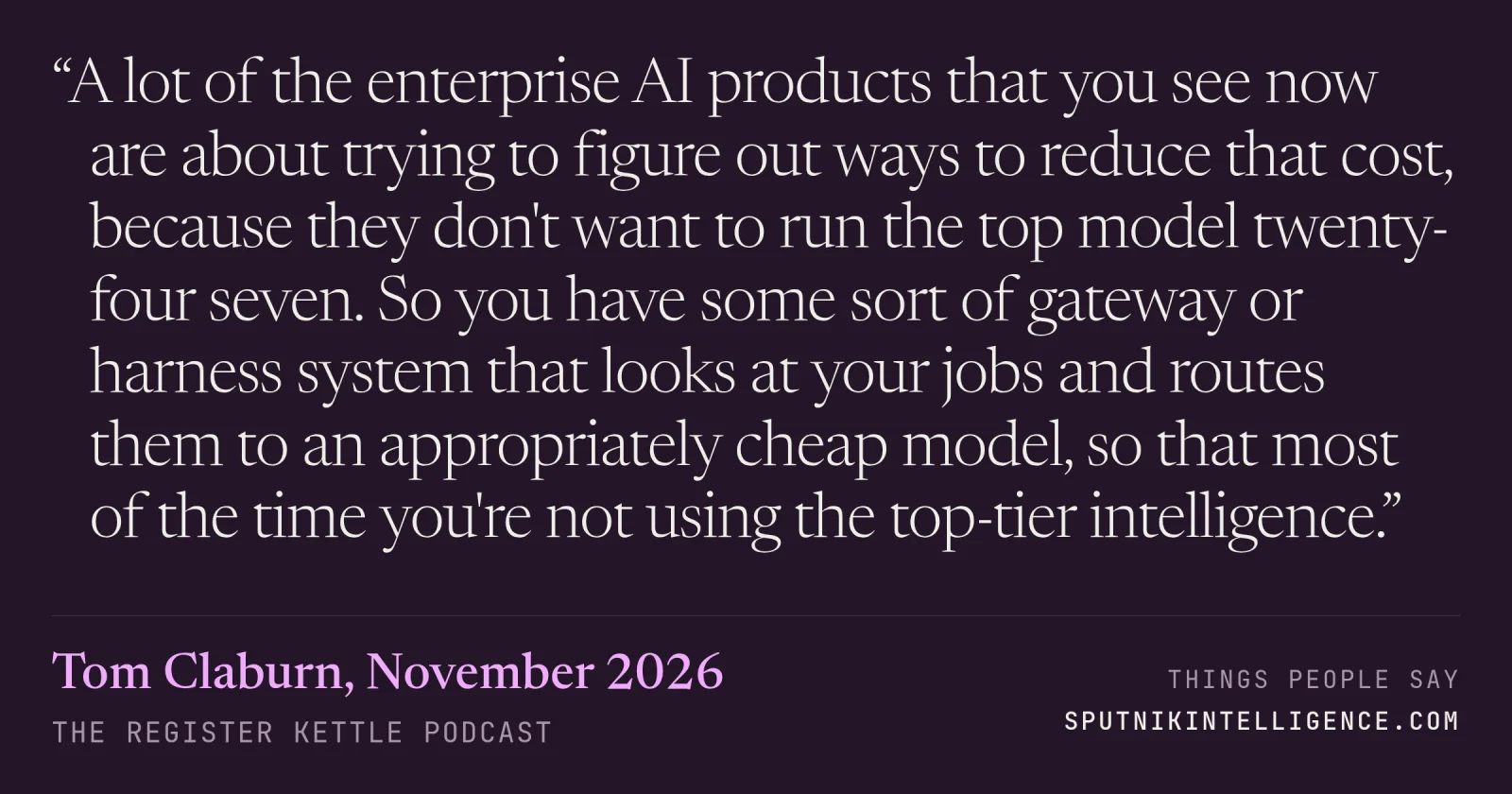
“A lot of the enterprise AI products that you see now are about trying to figure out ways to reduce that cost, because they don't want to run the top model twenty-four seven. So you have some sort of gateway or harness system that looks at your jobs and routes them to an appropriately cheap model, so that most of the time you're not using the top-tier intelligence.” — Tom Claburn, The Register Kettle

The hosts had noted that big cloud companies are telling their own engineers to use fewer tokens. Tom adds that enterprise products now route most work to cheaper models, which squeezes frontier labs including Anthropic.

The Register Kettle · 2026-11-02 Permalink → Listen →
The Register Kettle Around 16:04 into the episode
Tobias Mann

…if their revenues can't keep up with their commute compute commitments, they could default. And that default could turn into a cascade where Mm-hmm. they if they can't pay one bill, they can't get enough compute to generate revenues that are necessary to pay the next bill, and it all falls apart.

Brandon Vigliarolo

…of a larger problem. Right. And that's that people are basically saying what a lot of non AI companies or companies that do AI along with other things like AWS, right, are basically saying we don't need these massive frontier models for the vast majority of business purposes. They're not necessary.

Tom Claburn

Right. Yeah, and and a lot of the enterprise AI products that you see now are about trying to, you know, figure out ways to reduce that cost too, you because they don't want to run, you know, the fable, you know. twenty four seven, so you've got a a way of you have some sort of gateway or or harness system that looks at your jobs and routes them to an appropriately cheap model so that most Mm-hmm. of the time you're not using the you know the the top tier intelligence you're maybe using you maybe just a a decision model or you know a regular classifier or or you know some you know something like Gemma that to just to do language translation. I don't know. It's but you don't always have to use that expensive model and that price pressure is gonna hit them too.

Tobias Mann

Yeah. actually to Tom's point, Cadence Systems, which does a lot of electronic design automation and circuit board layout and that kind of thing, just rolled out a new product line called Maestro that's currently built around NVIDIA's Nemotron, OpenWaights models. But the idea is that they had been…

Brandon Vigliarolo

Yeah. Yeah. Right. And that that again, right, I I can't imagine most businesses are gonna say, well, we're gonna fork over all this money to these proprietary model providers when we don't need those resources. it it just it really makes me wonder, how much of this of this IPO is is basically…

Tom Claburn

Yeah. Go Google was Google was hammered with they lost like five hundred billion in in, you know, stock value based on the fact that their search was underperforming. that's even that bad, but you know, that's you know, that's
Speaker names come from our own diarization. The position is estimated from where the line sits in the episode.
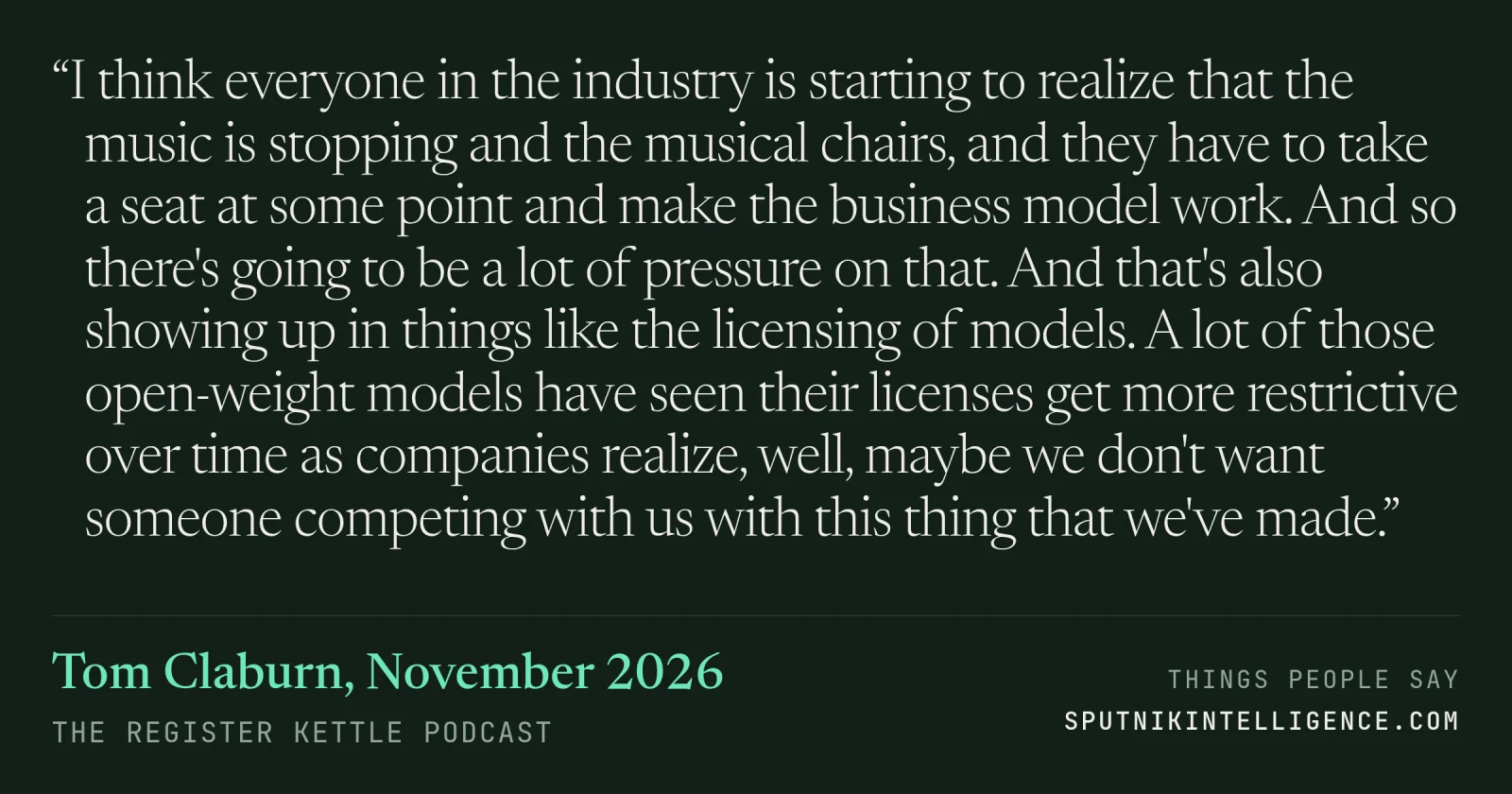
“I think everyone in the industry is starting to realize that the music is stopping and the musical chairs, and they have to take a seat at some point and make the business model work. And so there's going to be a lot of pressure on that. And that's also showing up in things like the licensing of models. A lot of those open-weight models have seen their licenses get more restrictive over time as companies realize, well, maybe we don't want someone competing with us with this thing that we've made.” — Tom Claburn, The Register Kettle

The discussion was about whether inference costs will keep falling and whether Anthropic's pricing power holds. Tom argues that commodity inference pricing is pushing the whole industry to find real margins, and that it shows up in tightening model licenses.

The Register Kettle · 2026-11-02 Permalink → Listen →
The Register Kettle Around 11:09 into the episode
Tobias Mann

…that period over the next year, which is definitely not going to happen. they're they're they've already said they're going to keep making compute contracts. So this number just keeps getting more absurd the the further out you go, unless inference magically gets dirt cheap, which we haven't seen.

Brandon Vigliarolo

…ATT, right? Anyone who's not those big three in the United States is operating a virtual network that piggybacks on someone else's infrastructure. And when that infrastructure is busy, you get less priority. You know, Yeah. so I mean we could see them run into a similar situation there, I imagine.

Tom Claburn

Yeah, th there's an interesting trend that there's another piece I'm working on later today that that touches on this. That's apparently s some of the the AI open AI or the the AI gateways like open router are now starting to move away from sort of just focusing on pricing price metering and looking towards things like, you know, times you know, fastest time to tokens and all the sort of quality of service metrics in terms of the way that they price and deliver the models, because the inference pricing is such as sort of has become very commodity in terms of what they're dealing with. they're not necessarily s serving all the frontier models at very high prices. They're dealing with a lot of open weight models. And if you just focus on the lower end of the market, it's there's not a lot of margin there. So it makes sense to go, well, you know, maybe if we deliver this faster or we, you know, have better better reliability or service we can move up the price and get a little profit. And I think that everyone in the industry is starting to realize that the music is stopping and you know the musical chairs and they have to take a seat at some point and you know make the pro the business model work. And so there's a I there's gonna be a lot of pressure on that. And that's also…

Brandon Vigliarolo

Yeah, Mistral, yeah, that reminds me of Mistral just released the open weight version of what is it? I think Large Four. and they're yeah, Le

Tobias Mann

Let's try.

Tom Claburn

Yeah.

Speaker names come from our own diarization. The position is estimated from where the line sits in the episode.