Dave Smith

Things Dave Says on Podcasts

Software developer who co-hosts Soft Skills Engineering, a weekly advice show for software engineers. The show covers career growth, code quality, team communication and work-life balance. Hosts Soft Skills Engineering with Jamison Dance.

Where to Find Them

Dave Smith hosts and writes Soft Skills Engineering , writes Dave Smith Dharma and hosts Part Of The Problem .

Recently: “Dharma as Activism...Waking Up Inside the World.” on Dave Smith Dharma (November 2026); “Episode 539: Why does it take me so long to get tasks done and my team got moved to a different timezone” on Soft Skills Engineering (November 2026); “Massie Impeaches Hegseth” on Part Of The Problem (November 2026); “Episode 538: toxic manager or low impact project and over-staffed?” on Soft Skills Engineering (November 2026); “Episode 537: Is my ADHD affecting my work and my startup got acquired” on Soft Skills Engineering (November 2026); “Episode 536: Mentoring and how to help my team not lose their soul to AI?” on Soft Skills Engineering (October 2026).

What They Said

“All the things that happen naturally in person, like camaraderie and bonding and trust building, that stuff now has to be made explicit in your calendar. And that means regular one-on-ones with people on the team.” — Dave Smith, Soft Skills Engineering

A listener's new team sits seven hours away and they are the only remote person. Jamison said the two hours of overlap should be scheduled carefully; Dave adds what has to go into that window.

Soft Skills Engineering · 2026-11-16 Permalink → Listen →
Soft Skills Engineering Around 30:45 into the episode
Dave Smith

seen that too. So full remote teams can go longer without interacting with one another, but I still think it's a good idea to get together in person every year or half year. But if you're the only one, you got to get out there and be in person. I stand behind that.

Jamison Dance

Huh. I like that advice. The only one not in the office. I mean, there's some obvious stuff around, okay, you've got two hours of overlap. You should carefully schedule that time. That is not your heads down grind away on stuff time.

Dave Smith

Yeah, make sure your stand-ups are during that. Time, make sure you get one-on-ones. You're going to have to schedule one-on-ones. That's another thing. Like, all the things that happen naturally in person, like camaraderie and bonding and trust building, that stuff now has to be made explicit in your calendar. And that means regular one-on-ones with people on the team. Yeah. At the very least.

Jamison Dance

Yeah. I had other smart things to say, and I forgot what they were because your smartness overwhelmed me.

Dave Smith

It got eclipsed. Yeah. They mustn't have been very smart because my smartness isn't that big. So your smartness must have been. What

Jamison Dance

is a candle to the sun? Oh, I have fallen victim to this before. If I have a limited amount of time, I can sometimes just become very robotic. And what we got? 10 minutes? Surely we cannot waste two of those minutes talking about how we're doing. Just grinding through stuff as quickly as possible.…

Speaker names come from our own diarization. The position is estimated from where the line sits in the episode.
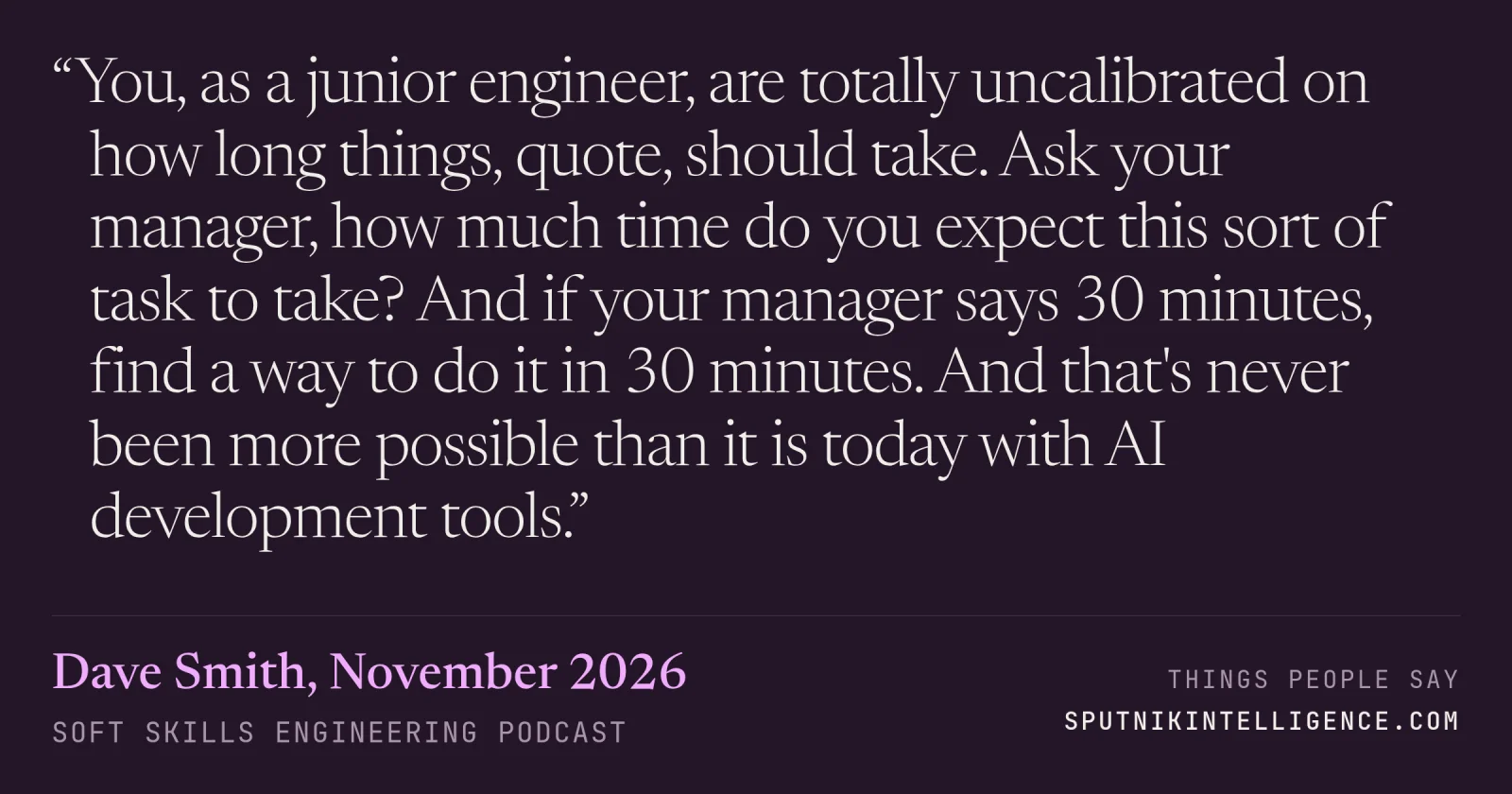
“You, as a junior engineer, are totally uncalibrated on how long things, quote, should take. Ask your manager, how much time do you expect this sort of task to take? And if your manager says 30 minutes, find a way to do it in 30 minutes. And that's never been more possible than it is today with AI development tools.” — Dave Smith, Soft Skills Engineering

Jamison had suggested timing a task as if it had to be done in a week, a day or an hour. Dave adds that a junior developer should ask the manager what size the task is meant to be, the way a product manager asks for an estimate.

Soft Skills Engineering · 2026-11-16 Permalink → Listen →
Soft Skills Engineering Around 22:50 into the episode
Speaker 3

Great idea.

Jamison Dance

…to do it in a day? What if I had to do it in an hour? What if I had to do it in 10 minutes? Just see how hard you can push it. You might not use all those. They might not throw some of them away, but I think it's useful to challenge your assumptions about how long something might take sometimes.

Dave Smith

I think that's great. And can I take that in a slightly different direction? Talk to your manager who's giving you, whoever it is is giving you your task assignments and ask them, what size do you want this to be? You know, like, or what size would you expect an engineer to do this in to help understand? Because this is kind of like buying and selling stuff. And I've noticed product managers, like good product managers, do this really well. They'll ask an engineering team, hey, what's the effort to build this feature? And a good engineering team will tell them, like, oh, yeah, that's like a one-week kind of project. Oh, that's like an afternoon kind of project. Well, that's like a month of work. And the product manager will decide if he or she wants the feature at that price. You know, like, oh, this is a three-month project. Don't want it. And sometimes they'll ask, what's the one-week version of this? Because that's all I could afford. And then the engineers describe it and the product manager goes, I don't want it, or I do want it. And I think you, as a junior engineer, are one of the downside…

Jamison Dance

Also, the robots do that to you. They say, and this will take three weeks. And then you say, no, do it. And then

Dave Smith

it's done. You go do it. Sloppy and paste.

Jamison Dance

Okay. Have we answered? Yes.

Speaker names come from our own diarization. The position is estimated from where the line sits in the episode.
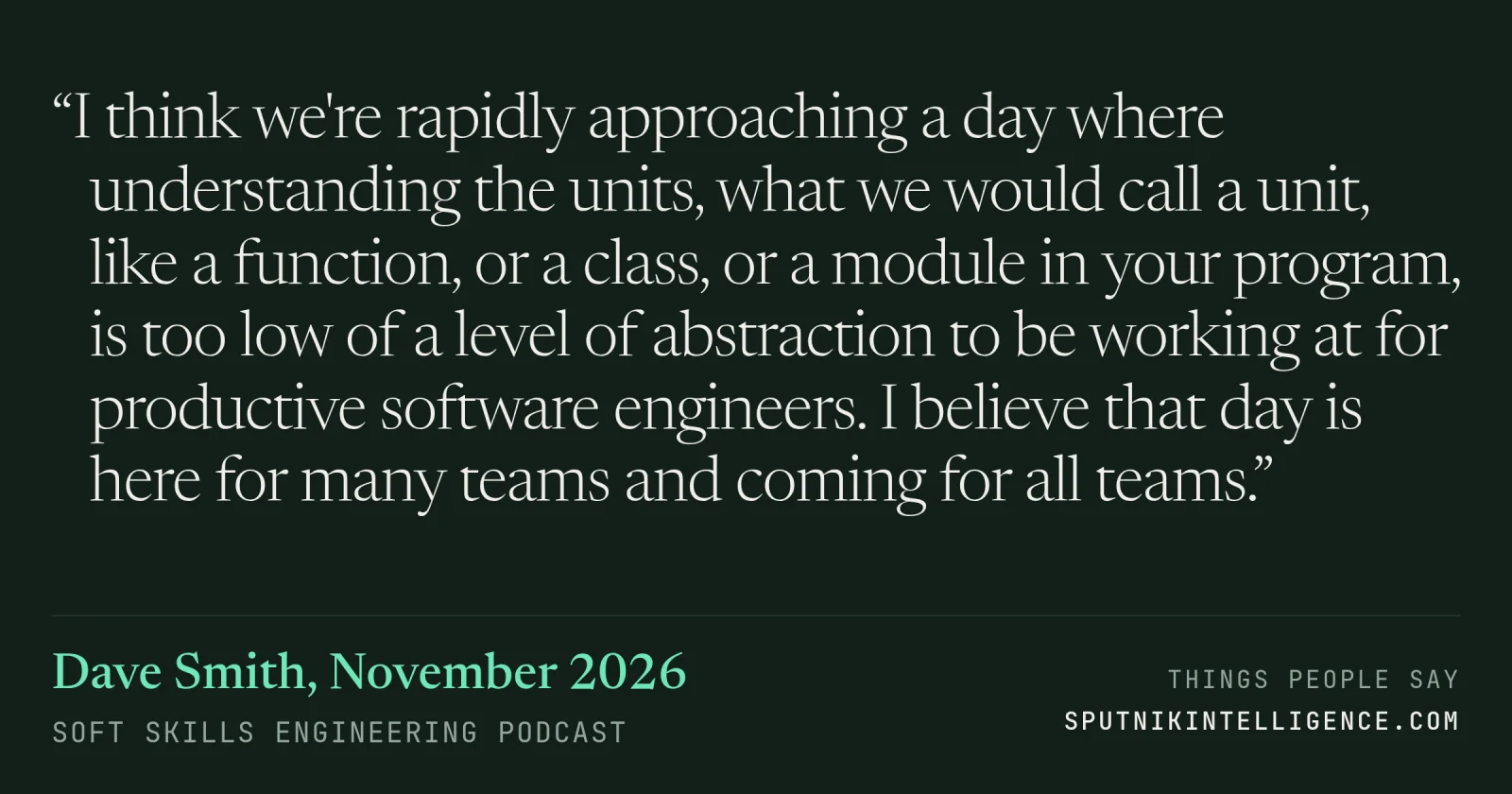
“I think we're rapidly approaching a day where understanding the units, what we would call a unit, like a function, or a class, or a module in your program, is too low of a level of abstraction to be working at for productive software engineers. I believe that day is here for many teams and coming for all teams.” — Dave Smith, Soft Skills Engineering

The hosts were answering a first-job developer who says writing a handful of unit and integration tests takes a whole day. Dave says the level engineers need to work at keeps moving up, and unit-level work is now something models do well.

Soft Skills Engineering · 2026-11-16 Permalink → Listen →
Soft Skills Engineering Around 20:25 into the episode
Dave Smith

or maybe it's like figuring out what the test should be because the product is crazy complicated.

Jamison Dance

…And some of that comes from knowing what is happening in the code base. And that's something you can do at any job, like no matter your experience level, is like understand what your code does. I think that will always make you faster if you just know how it works, even if you're using robots.

Dave Smith

Yeah, for sure. At a certain level of granularity. And that level of granularity is rising fast, I think. You know, it used to be back in way, way back time, 60 years ago, developers had to understand what was happening at the level of machine code or at the level of the drum of your disk and how it rotates, you know, what RPM it rotates at. Yeah. And that level of abstraction required to be a productive software engineer just keeps moving up and up and up. And now I think it's kind of, it's higher than it's ever been for sure. Higher than I ever thought it would be in my lifetime. And so, you know, this question of I need to write unit tests, it's like, yeah, unit, I guess. I mean, I kind of feel like now this might be a controversial thing to say, but I think we're rapidly approaching a day where understanding the units, what we would call a unit, like a function, for example, or a class or a module in your program is too low of a level of abstraction to be working at for productive software engineers. I believe that day is here for many teams and coming for all teams. And so when I see I…

Jamison Dance

Yeah, I think you've got the curse of knowledge really bad, where it's really hard to imagine what is difficult with the knowledge that a junior developer has as a senior developer. And I expect, I mean, there's this huge rise in electronic music, right? You used to have to have like a physical…

Speaker 3

Yeah.

Jamison Dance

Build music. And maybe that's kind of what's going to happen is like the seniors of tomorrow, there'll be some that have developed the learning knowledge themselves, but a bunch of them will just be like, check out this incredible thing I made that you never in a million years would be able to just…

Speaker names come from our own diarization. The position is estimated from where the line sits in the episode.
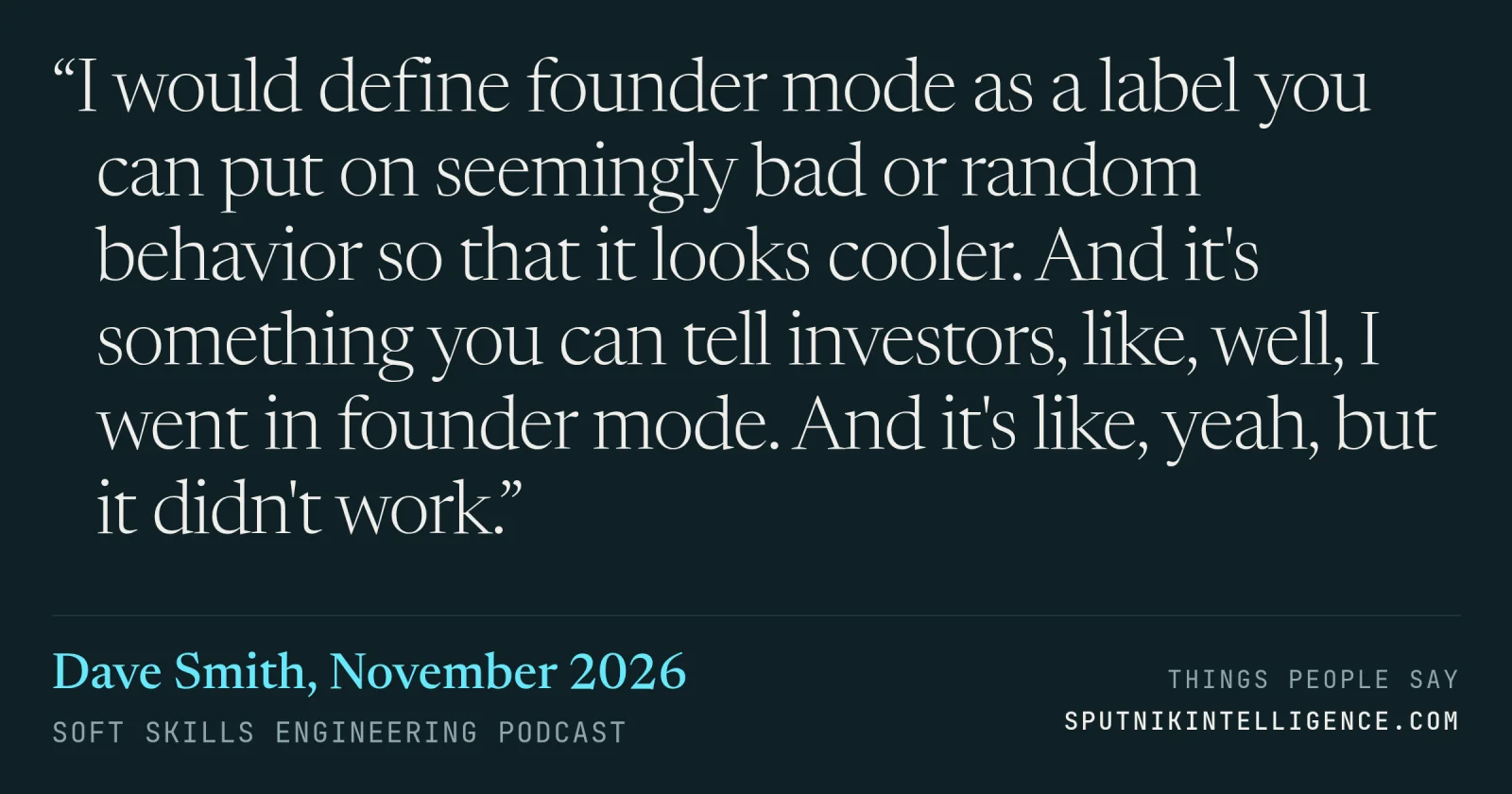
“I would define founder mode as a label you can put on seemingly bad or random behavior so that it looks cooler. And it's something you can tell investors, like, well, I went in founder mode. And it's like, yeah, but it didn't work.” — Dave Smith, Soft Skills Engineering

A staff engineer wrote in about a founder who went 'full founder mode' and now runs the tiny team top down. Asked how he would define the term, Dave Smith gives his cynical definition before offering some more charitable readings.

Soft Skills Engineering · 2026-11-09 Permalink → Listen →
Soft Skills Engineering Around 21:18 into the episode
Dave Smith

Yeah.

Jamison Dance

The full founder mode thing is interesting. Are you familiar with the phrase founder mode, Dave?

Dave Smith

Oh, yes. That got popularized, I think, last year. That's when it hit my radar.

Jamison Dance

Yeah. I mean, how would you define it? It's sort of like you just do things instead of try to align groups of people kind of more top-down, more action-oriented, more tell people to do stuff and do stuff yourself. Is that it?

Dave Smith

I would define founder mode as a label you can put on seemingly bad or random behavior so that it looks cooler. And it's something you can tell investors, like, well, I went in founder mode. And it's like, yeah, but it didn't work.

Jamison Dance

Yeah, but that's founder mode. You miss every shot

Speaker names come from our own diarization. The position is estimated from where the line sits in the episode.
“Throughout my career, the things that fall into the category of things I shouldn't have to do are actually where I've found the most success. And I think it's because most people won't do things they shouldn't have to do. They'll look at it and be like, I shouldn't have to do that. And then they don't. And then they don't get the benefits.” — Dave Smith, Soft Skills Engineering

Dave Smith advising a listener whose manager keeps creating messes for the team. Some people won't change however well you deliver the message, he said, and working around them has produced some of his biggest professional wins.

Soft Skills Engineering · 2026-10-19 Permalink → Listen →
Soft Skills Engineering Around 15:02 into the episode
Dave Smith

…do that. I was like, well, I guess that's the end of this. Like, what am I supposed to do with that? You know, like, and so then you go into workaround mode, I think, where it's like, okay, how do I, how do I kind of like attenuate the pain canon that's being aimed at me so that it doesn't hurt as

Jamison Dance

much? And you put on your padding or whatever. Yeah,

Dave Smith

exactly. And I'll tell you what, though, there can be great success in that as well. Some people will not be able to hear you no matter how good you are at delivering these, you know, these kinds of or executing on these kinds of. Conversations. And I have found that working around people's particular mode of work or mode of being at work has produced some of the most fruitful success in my professional career. And it falls in this category of things that someone once told me is a category called things I shouldn't have to do. Throughout my career, the things that fall into the category of things I shouldn't have to do are actually where I've found the most success. And I think it's because most people won't do things they shouldn't have to do. They'll look at it and be like, I shouldn't have to do that. And then they don't. And then they don't get the benefits. So I won't share any examples of this right now because I don't want to incriminate. I don't want to like, what's the word? I want to protect the innocent and the guilty.

Jamison Dance

Yeah.

Dave Smith

But I've definitely done things in my career that most people would say, you shouldn't have to do that. And they've been the best thing I've ever done.

Jamison Dance

Yeah.

Speaker names come from our own diarization. The position is estimated from where the line sits in the episode.
“We are walking into a tidal wave right now that is washing up on shore. And that tidal wave is AI-generated code. And I am convinced that we cannot oppose this tidal wave. We have to find a way to live with this volume, with this new way of writing code. And we cannot insist on the old way of carefully reviewing every line.” — Dave Smith, Soft Skills Engineering

Answering the same listener, Smith said the complaint carried an expectation that code would still look like the carefully written, human-authored code of five years ago. He added that code which doesn't do what the spec says is bad engineering whether AI wrote it or not.

Soft Skills Engineering · 2026-10-05 Permalink → Listen →
Soft Skills Engineering Around 16:29 into the episode
Dave Smith

Not only that, but it just won't be good. You know, it just won't be what you want.

Jamison Dance

…they'll prompt their way to looks as if a human wrote it, if nothing else than just from the sheer level of output. So I think you have to decide: do I want to expect them to do this by hand or produce handwritten looking output or not? And that's separate from like, is the output any good? Like,

Dave Smith

does it do what the spec says to do? Which this question asker says it does not. Yeah. And that's just bad engineering, regardless of whether it's AI or not, if that's the case. Yeah. I mean, by the way, I think you're right, Jameson, that this question asker is indeed, does indeed carry an expectation that the code will look like the code that we used to review five years ago. You know, carefully thought out, human-authored. But I don't know how else to say this, but we are walking into a tidal wave right now that is washing up on shore. And that tidal wave is AI-generated code. And I am convinced that we cannot oppose this tidal wave. We have to find a way to live with this volume, with this new way of writing code. And we cannot insist on the old way of carefully reviewing every line and having it feel like human, curated, carefully written, so that a human can read it. It's just, we just can't have that anymore, I think. Whether we like it or not. You know, it's just, I don't think we can have that. So I have to ask, how do we learn to live in this new world? I

Jamison Dance

don't know if I could clearly articulate what good AI planning output looks like. I feel like that's something we need to figure out if we're going to use AI to author not just the code, but these kind of meta documents. I don't know. I just quickly jumped to, well, obviously this was written by…

Dave Smith

Yeah, I think there's one really simple heuristic, which is how many prompts did it take to get the document to its current state? And if the answer is like less than, I don't know, 20, then you probably have a crap document when it comes to like design docs, planning docs, large ticket planning…

Jamison Dance

Yeah, we need to like, there's some new crypto algorithm. I mean, cryptography, not cryptocurrency. Yep. Although I'm sure, sure, put an NFT on it, I

Speaker names come from our own diarization. The position is estimated from where the line sits in the episode.
“There's one really simple heuristic, which is how many prompts did it take to get the document to its current state? And if the answer is less than, I don't know, 20, then you probably have a crap document when it comes to design docs, planning docs, large ticket planning docs, things like that.” — Dave Smith, Soft Skills Engineering

A listener had written in about coworkers sending him AI-written pull requests and planning documents to review. The hosts were trying to work out how a reader can tell whether a person put real thought into an AI-assisted document.

Soft Skills Engineering · 2026-10-05 Permalink → Listen →
Soft Skills Engineering Around 17:00 into the episode
Dave Smith

…every line and having it feel like human, curated, carefully written, so that a human can read it. It's just, we just can't have that anymore, I think. Whether we like it or not. You know, it's just, I don't think we can have that. So I have to ask, how do we learn to live in this new world? I

Jamison Dance

…of the it was written by AI sense, even if you are able to make it good, you know? Like, so I think we have like a signal problem to show, no, no, no, like, yes, this was produced with AI, but also I have, I have worked on it enough with my own human brain to put my stamp of approval on the output.

Dave Smith

Yeah, I think there's one really simple heuristic, which is how many prompts did it take to get the document to its current state? And if the answer is like less than, I don't know, 20, then you probably have a crap document when it comes to like design docs, planning docs, large ticket planning docs, things like that. Maybe, maybe 10 to 20, somewhere in that range. But that may be what needs to happen here. We need some kind of mechanism that says this was a one-prompt document.

Jamison Dance

Yeah, we need to like, there's some new crypto algorithm. I mean, cryptography, not cryptocurrency. Yep. Although I'm sure, sure, put an NFT on it, I

Dave Smith

guess. Then it'll be worth something. Yeah,

Jamison Dance

some new signature you add to say, like, I assert that, I don't know.

Speaker names come from our own diarization. The position is estimated from where the line sits in the episode.

Collections They Appear In