Owens runs a brand design studio and says he uses AI tools heavily. His point was that they get a presentation built faster, but making it something people respond to is still the designer's job. He described AI as one ingredient in the recipe.
It's rickety. And I would say the things I dislike most is there's too much choice. You can get it to 85 or 90%. Getting it to the 99 percentile is really hard, sometimes impossible. It's sort of like a slot machine. It can be really satisfying, but then somewhat of a waste of time. Like anything I've learned in my life, you have to be deliberate and you have to have an outcome you have in mind. For example, if we're using cloud code connected to Figma MCP, we're doing it because we have an idea in mind. We have an outcome in mind, right? If we're using Weavy and using licensed 3D work from an illustrator and we're training a model to be able to create a certain output, it's deliberate and we have an idea in mind. That's been the most productive way of using AI for us. Creating a skill that allows me to ingest certain data for a client and then be able to produce. Certain outcomes that I can then get into a presentation more quickly and then iterate from there. All of those things have been infinitely, infinitely helpful, especially for me at least. Distillation, sense-making, summarization, proposal writing, all of that stuff. And then, from a brand systems perspective, it's like sriracha. It's a nice additional ingredient that's integrated into the whole recipe of what we're doing. And it's not replacing something. It's an additive element. I still need a shredder after effects person to make a sizzle reel that's going to be face-melting and compelling. And maybe some of the assets in that sizzle reel are AI generated due to time or whatever it might be. But again, it's another ingredient and it's not a replacement necessarily. For me, I love it. I'm totally on board. And I just wrote an article called Surfing the Jagged Frontier on Substack. Surfing the Jagged Frontier is exactly that, which is you just have to surf it. It's not going to be perfect. You could do a million things in Figma Agent and almost all of it is garbage. But then they'll be like, oh, that one thing, I'll remember that. I'm saving that for later. That's the secret to it: deliberate practice, specific outcome in mind, and then giving yourself the time to like do it right. You know, I think the key thing about all of this is we're in the era of the new orchestration layer. That's what we're doing. And I don't think people necessarily grasp that, which is there's old school project managers doing it in the old way. There's new school project managers doing it in the new school way. It's all about the orchestration layer and seeing the component parts. How does this interrelate? How can we make it rigorous while also preserving creativity? And where does it fall off and isn't a full replacement? In my mind, it's no different than a lot of the other things I've done in the past. It's the same kind of challenge, different tools.
It's funny to me how obstinate these systems can be sometimes too, even when at their sort of advanced stage. So Aaron and I do a lot of research and writing, editing, that kind of thing that it's helpful for. But even when we build a skill, let's say we both, I think, separately asked it to ingest the strunk and white kind of style guide as sort of a base for helping us edit and giving us feedback on the stuff we've written. But it still wants to say, it's this, not this. And anything it edits, you just have to go back and re-edit. So in the end, is it really saving me time? Is it not saving me time? I don't know. I mean, at least it's not starting with a blank page necessarily, but there is that slot machine element to it for sure.
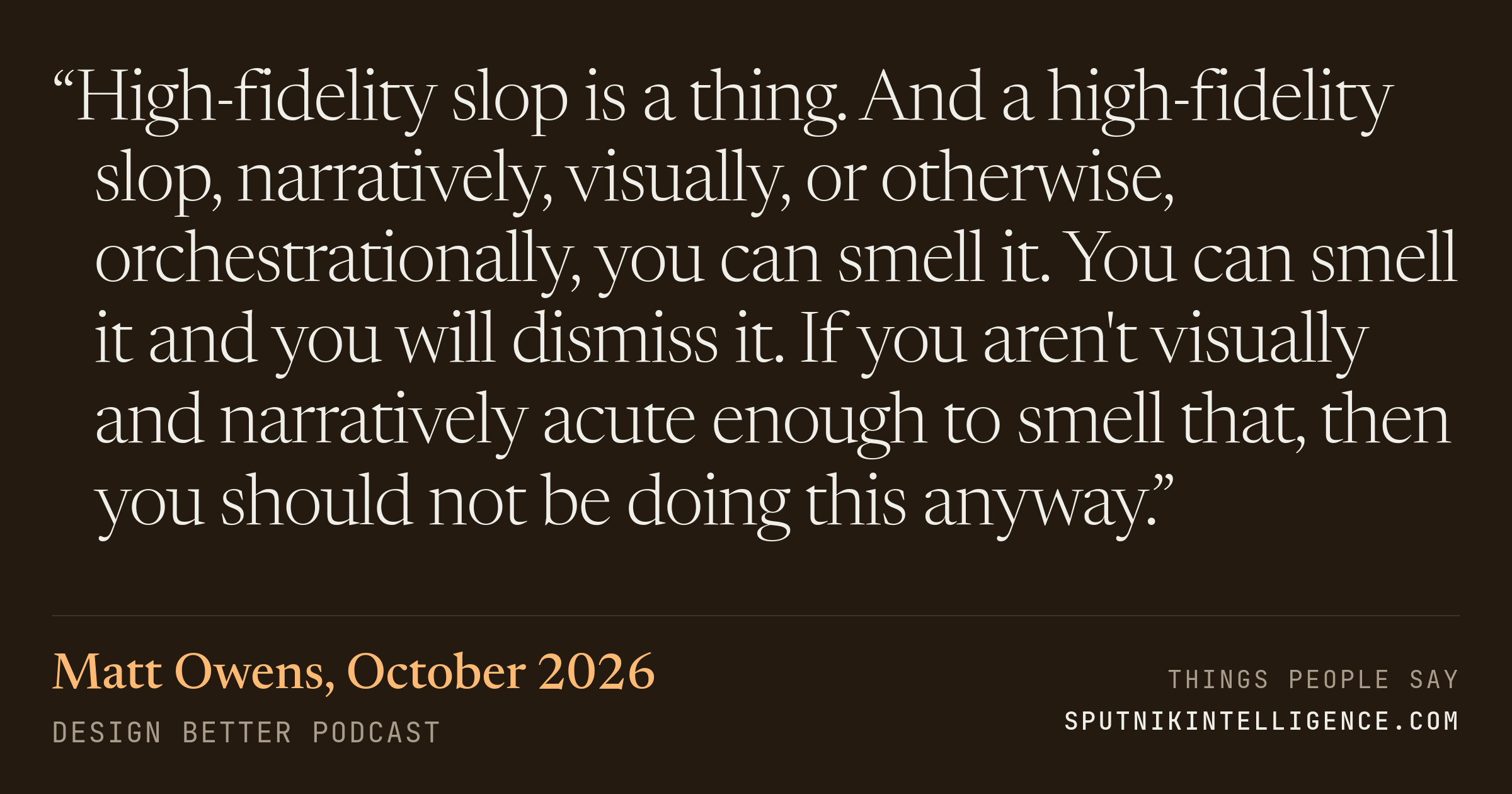
Yeah, I mean, I think the most simple thing, and again, social media is terrible. It's like, are we cooked? I don't know. Am I cooked? It's like, you're not cooked. It's intent. It's all intent. It's like, are you trying to make a workflow to automate your new business pipeline? Sure. Your goal is to automate something that is normally not automated. Cool. Are you trying to like make this presentation really sick and amazing without you having to touch it? Well, you're never going to do that. You will get close. You might get a little further along. But if your goal is to make a amazing, thoughtful, beautiful presentation that rationally, strategically, and romantically makes a creative argument to sell a brand idea, AI might just help you mechanically get there quicker, potentially. But it's up to you to make it a crafted, beautiful human thing that other people appreciate and resonate because high-fidelity slop is a thing. And a high-fidelity slop, narratively, visually, or otherwise, orchestrationally, you can smell it. You can smell it and you will dismiss it. If you aren't visually and narratively acute enough to smell that, then you should not be doing this anyway. Ultimately, it's about that. I love AI. It's not going anywhere. Is it going to be able to make cars faster? Sure. Is it going to automate certain processes? Great. Is it going to recommend better shit on Spotify? Maybe, sure. But for the purposes of my life, I need to see it as part of the recipe. I'm never at it to like replace something. It's not the Ozimpic of brand building, right? Oh, yeah, I mean, it's going to be awesome. I'm just going to make this awesome thing that like is totally idiosyncratic and perfect. And I didn't actually have to do any work. I don't know if Ozimpic of brand building is something that we need to be syndicating on this podcast, but it's
kind of funny.
You wrote a book in 2024, A Visible Distance, Craft Creativity and the Business of Design, which is part personal memoir and part professional manual. Who's that book for and why did you write it?
Considering an extension of putting out a record in a weird way from like back in the day. During the pandemic, I wrote a ton, you know, making sense of a man of a certain age. What does it all mean? How can you take a lifetime of opportunity, frustration, and everything in between? And it's like, what do you do with all? Of those things, you certainly don't come home every day and complain about it to your significant other. It's like it has to go somewhere. And I think for me, a visible distance was complete graphic design therapy, sense making, codifying, getting things off my chest in a productive manner, all of those things. It was a little bit of like the punk rock record thing. It's like, I'm going to put a book out. I'm going to try and do that again. I'm going to see what that's all about. I've never done that. And, you know, set margins were generous enough to publish it. Set margins are way more radical and maybe more progressive than my book is. But I come from the same ethos. I'm a self-made human being that believes deeply in the agency of the individual and that creativity is within all of us. And I think a visible distance is not a perfect artifact at all. The fact that I got it done, I wrote it, I got it edited, I got it published, I completed something. It wasn't just a half-baked idea that's sitting on a shelf or in a hard drive. It's a real thing. And I think that was sort of the point. The point wasn't to make the perfect book. It was to make something that captured as many of the ideas as I had at that time. And I'm happy I did it. Is it perfect? No. I don't know if you guys are Descendants fans in the Descendants documentary, Bill Stevenson, the drummer. He says, Why should it be shameful that five people show up to your rock show? You should be stoked that five people just saw your band. That's how I feel about my book. I'm just stoked that there's this thing out there in the world that somebody might read some page that's 20 or a version of me now. And it's like, that's good. That's going to inform this thing in my life. And it changes their life ever so slightly or gives them a little bit of information that helps them make a better decision or avoid a mistake or whatever it is. I feel like that's the reason I did the book. You know, it's a good tool. It's like, I can give it away. I can talk about it. And I do pick it up from time to time and say, is this garbage? Am I an idiot? And it's like, I'm like, oh, it's not too bad. It's true. I don't want to be mean to like all the other designers that are like, I have a book out and I'm going to do a thing at the AIGA about it. It's like, I don't really feel like that. You know what I mean? Consider it more of like a really high-fidelity cassette of my band at the time. And I'd recorded it and paid the money to get it in the studio. And I don't really know if it's that great, but I'm glad I did it. And I definitely learned a lot. There's definitely another book in me if I need it. Plenty to complain about, plenty to unpack.