
MG
Michael Grinich

Michael Grinich

Things Michael Says on Podcasts

Where to Find Them

Michael Grinich has been a guest on The Changelog (3 times) , Scaling DevTools (2 times) , TBPN (2 times) , The Engineering Leadership Podcast and Semaphore Uncut .

Recently: “A seminal moment in computing (Interview)” on The Changelog (November 2026); “Building what's next (Interview)” on The Changelog (October 2026); “From open source hits to OpenAI (Interview)” on The Changelog (June 2026); “Anthropic vs DoW, Ben Thompson Joins, Ellison Says The Biggest Number | James Beshara, John B. Quinn, Michael Grinich, Adam Simon, Matthias Wagner, Joan Rodriguez, Zach Yadegari, Andy Markoff” on TBPN (March 2026); “Satya Nadella LIVE on TBPN | Alexander Embiricos, Kyle Daigle, Jay Parikh, Jared Palmer, Michael Grinich” on TBPN (October 2025); “The End-to-End Engineer: How WorkOS Collapsed the Talent Stack for High-Velocity Execution, Ownership & Better Product Decisions w/ Michael Grinich” on The Engineering Leadership Podcast (August 2025).

What They Said

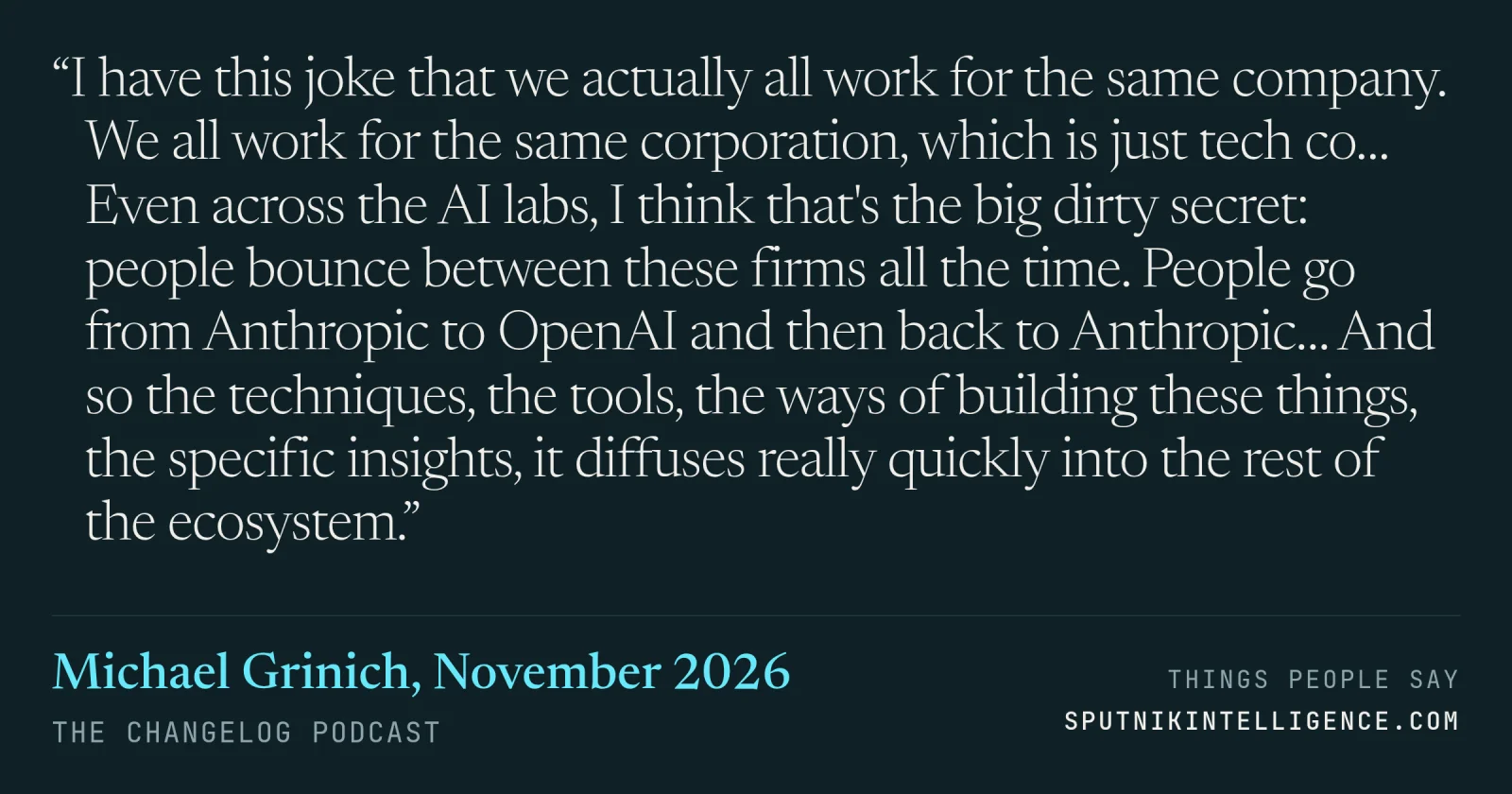
“I have this joke that we actually all work for the same company. We all work for the same corporation, which is just tech co… Even across the AI labs, I think that's the big dirty secret: people bounce between these firms all the time. People go from Anthropic to OpenAI and then back to Anthropic… And so the techniques, the tools, the ways of building these things, the specific insights, it diffuses really quickly into the rest of the ecosystem.” — Michael Grinich, The Changelog

Grinich describes how people, tools and methods circulate between Bay Area companies, including rival AI labs. He thinks that fast spread of techniques is good for the world.

The Changelog · 2026-11-20 Permalink → Listen →
The Changelog Around 31:24 into the episode
Michael Grinich

…New York is used to be six months behind. Now it's like a year behind where the Bay Area people are thinking. And Europe is like even further, like several years kind of behind this way of operating and thinking. That's just kind of the gut assessment I have. That's not quantitative in any way.

Adam Stacoviak

Anecdotal. This is from your perspective, remember?

Michael Grinich

Yeah. And so being on the frontier, I think, is that. It's like kind of seeing what other organizations are doing, how they're trying stuff, how they're adopting. And something about working in the tech industry in the Bay Area is like, I have this joke that we like, we actually all work for the same company. We all work for the same corporation, which is like just tech co, you know? And we all have different companies that are trying different projects and different things and trying to experiment with different ideas and different markets. But the Bay Area recycles teams and talents and process and tools and like open source is a big part of it. And, you know, the way the process of how people operate and work and what titles people have and how teams execute and stuff. All that's kind of the same. You know, it's kind of this industry of how we build software. And it's the reason why new companies can form and have like a culture already on day one. It's because you're kind of working within the culture of the industry. And there's a lot of sharing that goes on across people around ideas and tools. It's much more collaborative than I think people might expect it to be, to be competitive. Even across the AI labs, I think that's…

Adam Stacoviak

This episode is brought to you by our friends at Fingerprint. There's an interesting problem happening today building products. You want to make sure things are as easy as possible for your users, but you also need to know who or what you can trust. That's getting more complicated today with AI. AI…

Michael Grinich

I think that's well said. Yeah. You know, the reason to embody it sort of in something like Atlas is not because it makes the AI better. It's because it makes it easier for us to connect with. Like we as humans, like we work with other people. We work on teams. We form relationships with others. We…

Adam Stacoviak

Is it really? I was going to bring that up because Waymos don't have the steering wheel, right? And that's

Speaker names come from our own diarization. The position is estimated from where the line sits in the episode.
“If you look at the new Waymos that they have, the vans, the steering wheel is much smaller. It kind of looks like this bolted-on thing that you could just unplug it and throw it away. The steering wheel is kind of this backup… It's almost like a debug port. It's like you pull out the steering wheel when you have to do it manually.” — Michael Grinich, The Changelog

Grinich argues that AI teammates will first copy human ways of working and then drift away from them. He uses the shrinking steering wheel in self-driving cars as his example.

The Changelog · 2026-11-20 Permalink → Listen →
The Changelog Around 34:37 into the episode
Michael Grinich

…And then over time, they'll start to look different. We discover the new kind of characteristics that can emerge from it. Like the new electric cars, the self-driving ones, some of them don't have steering wheels. The new Zooks cars, it just is like kind of a box. You sit in a different way.

Adam Stacoviak

Is it really? I was going to bring that up because Waymos don't have the steering wheel, right? And that's

Michael Grinich

getting afraid of it. If you look at the new Waymos that they have, the vans, the steering wheel is much smaller. It kind of looks like this kind of bolted-on thing that you could just unplug it and throw it away. The steering wheel is kind of this backup. If you go check out some of the self-driving cars they have in China, they even have these things with the steering wheel sort of fold into the console. It's almost like a debug port. It's like you pull out the steering wheel, you know, when you have to do it manually. It's the CLI

Adam Stacoviak

of the car, man. It's like the turbine drop

Michael Grinich

down to be low level, you know. With the

Adam Stacoviak

command line of this vehicle.

Speaker names come from our own diarization. The position is estimated from where the line sits in the episode.
“What it means to be an engineer is changing. Now you're managing agents. You kind of babysit multiple threads. I think every engineer now is kind of like a manager, exercising their executive function to operate. And that's a harder job.” — Michael Grinich, The Changelog

The host asked whether engineers still lead when agents write the code. Grinich says WorkOS will stay engineering-led, but the engineer's job is shifting toward supervising agents.

The Changelog · 2026-11-20 Permalink → Listen →
The Changelog Around 12:04 into the episode
Michael Grinich

…and Base 10, like all these companies, Replit, all these amazing companies. So we've just kind of found we're in the middle position of all this stuff happening. And it's very engineering-led. So the engineers are going to build. They're going to build new things and see what the future holds.

Adam Stacoviak

Seems like you're pro-engineering for life, right? Not going to stop that buck anytime soon. Just because agents do the coding doesn't mean we don't have engineers leading the agents, right?

Michael Grinich

Yeah. I mean, engineers at WorkOS also do a lot of product stuff. Very small product management team. So engineers are the ones shaping things, talking to users, driving them forward end-to-end. Our end customers are engineers. So it's like engineers building for engineers. We even find engineers who do the marketing. You know, it's something where it's very hard to do marketing if you're not technical for a technical product. I think we'll be quite engineering led forever as a business. Good. What it means, though, to be an engineer is changing. Like you said, now you're managing agents. You kind of babysit multiple threads. I think every engineer now is kind of like a manager, sort of like exercising their executive function to operate. And that's a harder job. You can move faster. You can build new stuff. We are structured so we have very small teams that have high agency and ownership over an area. So they go really deep and own the thing end-to-end. And then just a bunch of those different teams working in different…

Adam Stacoviak

Yeah, a lot of things come to mind, a lot of technical things too, but I'm really curious as a leader, how you keep up. Like, do you, and you don't have to be, but feel free to be a little vulnerable. Like, do you feel overwhelmed? Do you feel it's hard to just maintain where things are going with…

Michael Grinich

You know, when I was in college, I was at MIT, and there's this phrase that people say there: it's like drinking from the fire hose. And it feels like that right now. Yeah,

Adam Stacoviak

it does. It's

Speaker names come from our own diarization. The position is estimated from where the line sits in the episode.
“One thing that you see with developer-focused companies is the acceptance that agents will be the ones choosing our technical stack and kind of becoming the consumer class to sell to… When we launched this auth.md thing, it's really about allowing agents to go sign up for products and services.” — Michael Grinich, The Changelog

Asked what frontier he sees from where WorkOS sits, Grinich says developer companies are starting to treat AI agents as the customer. He admits it's a gut conviction more than data, and a polarizing one.

The Changelog · 2026-11-20 Permalink → Listen →
The Changelog Around 29:47 into the episode
Michael Grinich

…It's like a really long bike ride or something. But especially when it's raining, like in the winter, I just like burrow down, you know, make a pot of coffee on a Saturday morning and just like, you know, ship 20, 30,000 lines of code that day. That's a pretty, that's a pretty good Saturday. Yeah.

Adam Stacoviak

…what you get to see given the nightly events and the company you run and the things you're shipping and the internal teams and the labs and just the inertia around what you get to experience. What exactly, how would you describe that frontier? What exactly is that frontier? How do you describe it?

Michael Grinich

…that I think you can articulate. And then a lot of stuff that's More like gut sense intuition, but high conviction that leads to investment in certain areas. So, like one thing that you see with developer, especially developer-focused companies, is the kind of acceptance that agents will be the ones choosing our technical stack and kind of becoming the like consumer class to sell to. You know, when we launched this auth.md thing, it's really about allowing agents to go sign up for products and services. Like, if you build an um, you know, an infrastructure service and you want to allow an agent just to go register, without this, the agent has to have an email address or somehow verify its identity somehow, or it has to impersonate a human. It can't show up and just say, I'm an agent and get a API key. And so, we built a thing around this. And it's kind of polarizing. A lot of people were like…

Adam Stacoviak

Anecdotal. This is from your perspective, remember?

Michael Grinich

Yeah. And so being on the frontier, I think, is that. It's like kind of seeing what other organizations are doing, how they're trying stuff, how they're adopting. And something about working in the tech industry in the Bay Area is like, I have this joke that we like, we actually all work for the…

Adam Stacoviak

This episode is brought to you by our friends at Fingerprint. There's an interesting problem happening today building products. You want to make sure things are as easy as possible for your users, but you also need to know who or what you can trust. That's getting more complicated today with AI. AI…

Speaker names come from our own diarization. The position is estimated from where the line sits in the episode.
“I believe the world has an infinite appetite for software. We can just make software forever. And the constraint has always been people making it. And now that constraint is lifted.” — Michael Grinich, The Changelog

The host said building software is getting easier but selling it and serving customers is still hard. Grinich agrees those parts stay hard, but argues demand for software has no ceiling and the only bottleneck was people to build it.

The Changelog · 2026-11-20 Permalink → Listen →
The Changelog Around 1:03:36 into the episode
Michael Grinich

…It's learning the code. That's like one of the things you have to learn, but you got to learn how to do sales. You got to learn how to do marketing. You got to learn how to do finance. Like learning to code is just one of the things, you know, and it's more learnable today than ever before.

Adam Stacoviak

…said so many years ago. And it's funny that you say that now, that like that's the critical thing to capitalize on is like software, mostly some version of easy, right? Some version of easy today. The hard part is interfacing with the world, serving them, selling them, fulfilling all the things.

Michael Grinich

Always going to be hard. Always going to be hard. And there'll just be more need for it. We're entering this era where there's so much opportunity for software. Like the world, I believe, has an infinite appetite for software. Like we just can make software forever. And the constraint has always been people making it. And now that constraint is lifted. So I think the software industry is about to go through this explosion of usage and creativity. And we'll go from, you know, there being roughly 30 million professional software engineers in the world to at least 10x that in terms of people doing stuff, probably 100x, you know, in our lifetimes.

Adam Stacoviak

Yeah. I mean, if GitHub's hockey stick, I mean, GitHub's been the epicenter of our world for so long. If they're hockey sticking, is that even a word, a phrase? I don't know. If they're in the hockey stick moment, how does that multiply across the world? You know, more if they go, I think the…

Michael Grinich

Yeah, but you got to learn different things. Yeah. It's like, it's like you don't really have to learn like how to manage memory today. Like, it's convenient if you know it. Yeah, but you don't have to. You can build so much stuff. So much stuff without that. You know, if there's 30 million…

Adam Stacoviak

Wow.

Speaker names come from our own diarization. The position is estimated from where the line sits in the episode.
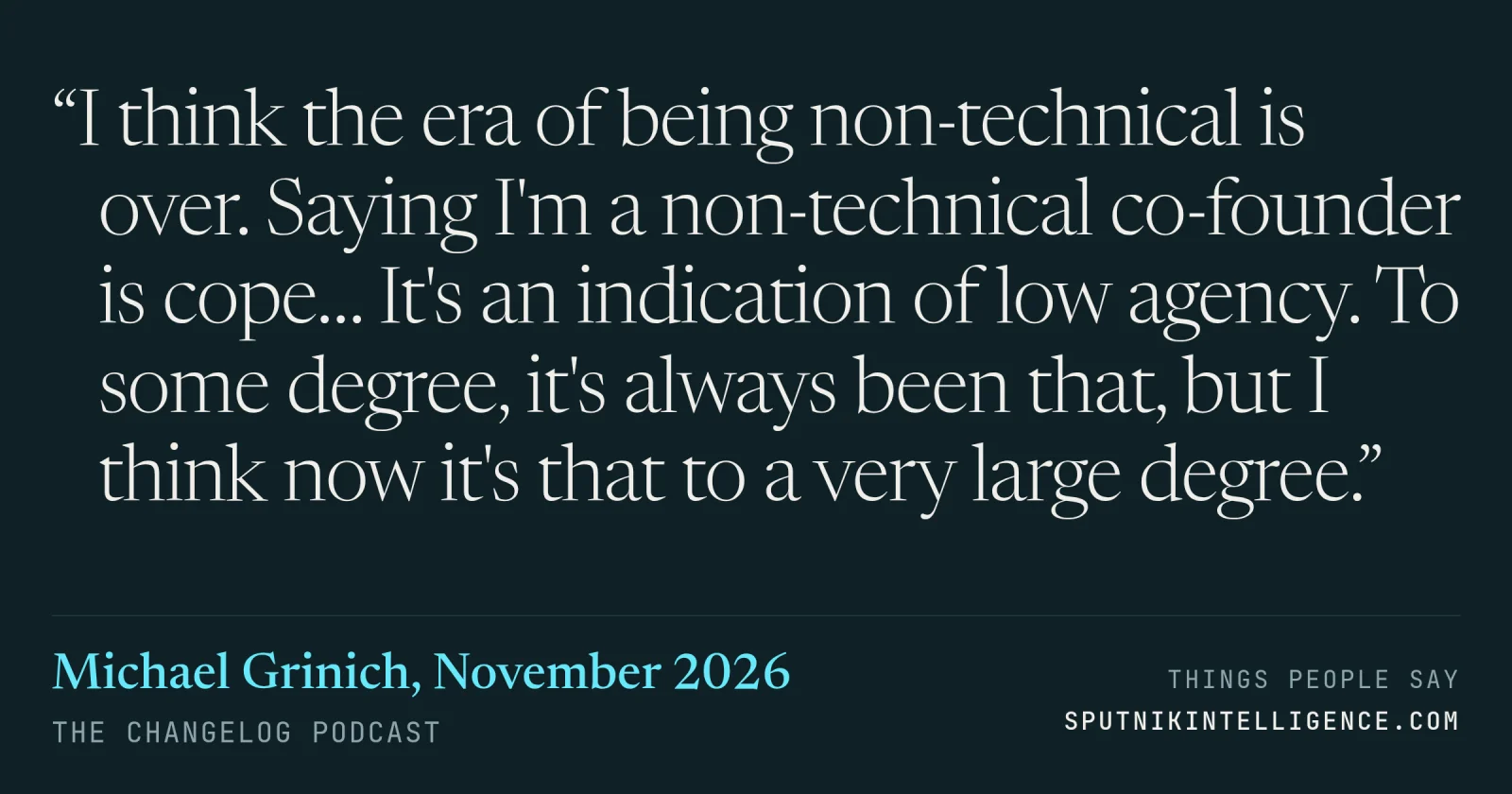
“I think the era of being non-technical is over. Saying I'm a non-technical co-founder is cope… It's an indication of low agency. To some degree, it's always been that, but I think now it's that to a very large degree.” — Michael Grinich, The Changelog

The host asked whether a strong engineer should still team up with a domain expert to start a company. Grinich, founder of WorkOS, says AI tools now let anyone build a working version themselves, so coding is just one more thing a founder has to learn, like sales or finance.

The Changelog · 2026-11-20 Permalink → Listen →
The Changelog Around 1:02:00 into the episode
Michael Grinich

…thing that that person wants to be done better or is, you know, if it was cheaper, it would change their business or their life, or there's a sticking point that they can't solve themselves. And then you just put your engineer hat on and you're like, all right, I'm going to go solve this. Yeah.

Adam Stacoviak

…a practitioner here locally in my town that's focused on health and wellness and we both align. They're the expert in the health and wellness. I'm the expert in software engineering. We kind of pair up and we build them. Do you see that as sort of like a new flywheel to start to create and spin?

Michael Grinich

…that. Not so much anymore. If you can think it, you can still use it. You can at least build a version of it that's useful that you can use to validate it and get some initial momentum and traction and then attract people to come build it and scale it with you. So I think the era of being non-technical is over. Saying I'm a non-technical co-founder is cope. It's like, you can just go learn it. It's an indication of low agency. To some degree, it's always been that, but I think now it's that to a very large degree. Because you can just go figure it out. Just try it. And it's not that hard. The amount of engineering skills you need to build software products, to build SaaS, you don't need to be the PhD computer science person working at Google for 15 years to do this stuff. The tools are good enough. The platforms are good enough. The systems are good enough that you can put it together. But you do have to…

Adam Stacoviak

That's funny you mentioned that because one of the things I enjoyed most about, I think, our first podcast together, which was years and years ago now, like right around the middle, we started talking about sales. And I was like, let's stop talking about like work OS and the technical details and…

Michael Grinich

Always going to be hard. Always going to be hard. And there'll just be more need for it. We're entering this era where there's so much opportunity for software. Like the world, I believe, has an infinite appetite for software. Like we just can make software forever. And the constraint has always…

Adam Stacoviak

Yeah. I mean, if GitHub's hockey stick, I mean, GitHub's been the epicenter of our world for so long. If they're hockey sticking, is that even a word, a phrase? I don't know. If they're in the hockey stick moment, how does that multiply across the world? You know, more if they go, I think the…

Speaker names come from our own diarization. The position is estimated from where the line sits in the episode.

Collections They Appear In