Naftali, who grew up in Canada, later became an American citizen, and ran the Nixon Presidential Library, was asked what most separates the two countries' political cultures. He names the absence of a national exceptionalism story in Canadian schooling and calls it an advantage. Coleman Hughes puts the counterargument to him right after: that exceptionalist language gave reformers a standard to hold the country to.
That's true.
What's the biggest difference between Canadians and Americans culturally? I mean, we're so similar in so many ways, but you might have a unique vantage point.
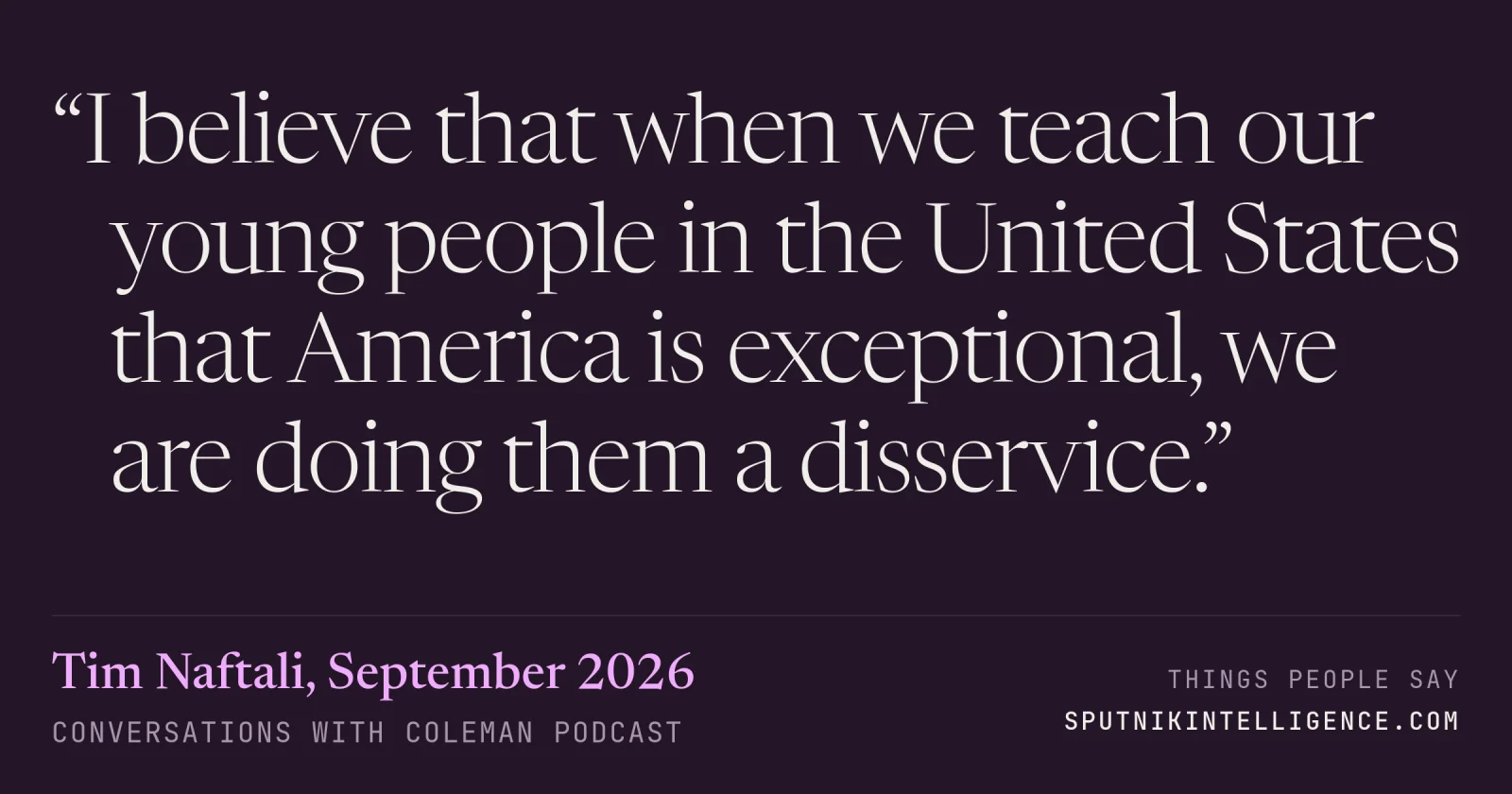
…proud to my adopted country. And I partly chose to become an American because I teach American history. I teach international history, but through an American lens. And I wanted to be able to say we, because I thought it was important for students to understand that I understood the sort of the nature of America's role in the world, not simply as an outsider, but now as an insider. That said, I believe that when we teach our young people in the United States that America is exceptional, we are doing them a disservice. It is a burden. It is a burden because if you have a place that's exceptional, it's hard to argue that it can improve. And one of the joys of studying American history is to see this arc of change. Canadians, I think, have a sense that their country's flawed and they're proud of what it is, but they recognize that, you know, it has flaws and therefore you can tinker with it without really…
Yeah, and it's interesting. I was talking to Matthew Iglesias, and he had a very different frame for understanding American exceptionalism. And the argument he made on our podcast was the version of American exceptionalism, which can strike the ear as naive, especially to a historian that is all…
Well, Matt is a super smart guy, and I would just disaggregate a little bit of what he's saying. I absolutely agree that Jefferson's language and the language of the framers has been an impetus for change for activists on both sides of the aisle. Absolutely, totally agree with it. Jefferson didn't…
Let's get into your areas of research. You've written many books about the Cold War, about Khrushchev. You've been deeply involved in the study of presidential transcripts of Nixon, I believe, Kennedy, LBJ. So there's a lot of possible ways to start this interview. But one I want to ask you is…