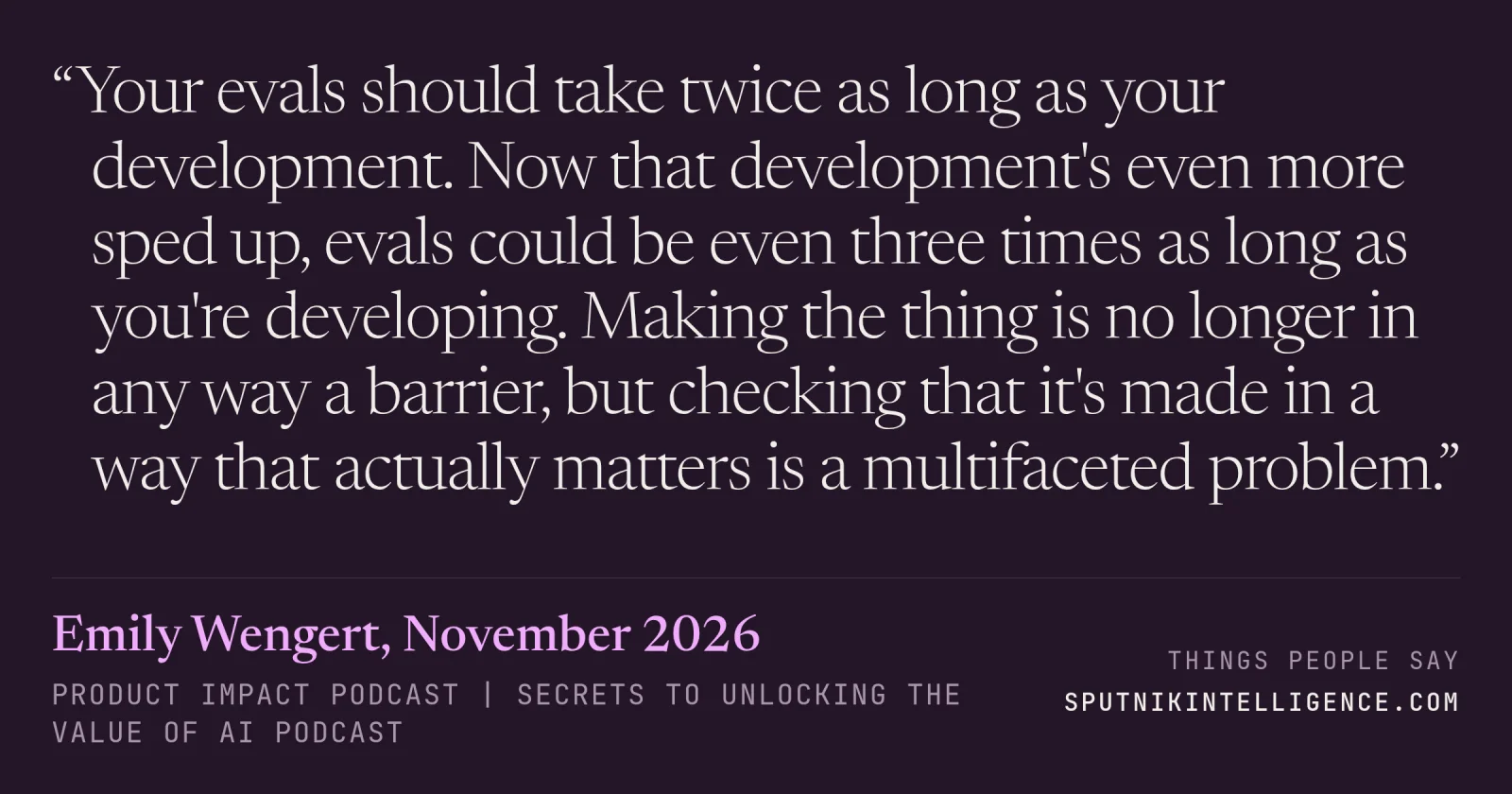
Asked how to tell a demo that will survive real users from one that will fall apart, Wengert says human testing usually comes too late. She cites a talk she heard on eval time and extends its ratio herself.
…massive end state to me is a much more interesting i enjoy working with ai i really enjoy it so why are we trying to have it go off and do its own thing and then just show me something that i feel like i had no hand in you know what it's just i i'm i'm saying no as if i can to that model no no i
…find it, it just falls apart. You've shipped these things at scale where, you know, where failure can be extremely public. How do you tell the difference between a demo that's going to survive contact with people with users and one that's going to burst into flames or something in between, right?
Yeah. I think actually we're, we've pushed the human exposure, the human sort of vetting step far too late in product development. Like I think that's coming off of how hard it is to sort of get products out the door in the old days. And so you'd sort of squeeze in some research now and then or try to do UAT at the tail end. Lies We should be doing UAT every week. You know, we should be like looking at this stuff and trying to figure out if this is really working or not. And so I think there's an enormous shift we need to do that actually, this comes back to both my humans at the helm, but also my YUX. We need more people who want to put humans into the insight into the space itself. And so I think the best tools are the ones that humans have seen early and often and vetted constantly. And, you know, one thing we found when we were building Ollie is we had come to have some habits in terms of how we were testing it. And we had some automated evals we were running, but then we would get in there too and kind of play around. And, you know, when is Simone Biles on is a really easy…
Yeah. And I think on the flip side of that, while we're advocating to say, hey, you need to get there and talk to users and bring them closer to your team, I think there are a lot of users who have a very divergent experience where every touch point is getting automated, support, sales, onboarding…
I hope we don't get there. I don't want to be in personless companies. But you're absolutely right. I have been seeing some data lately that talks about CX and especially call center transformation. And there's an interesting kind of middle ground where sometimes actually the AI conversation that…
Okay, final question. If your 25-year-old self jumped in a time machine, came up to 2027 and needed to figure out a new career path starting now. What advice would you give her?