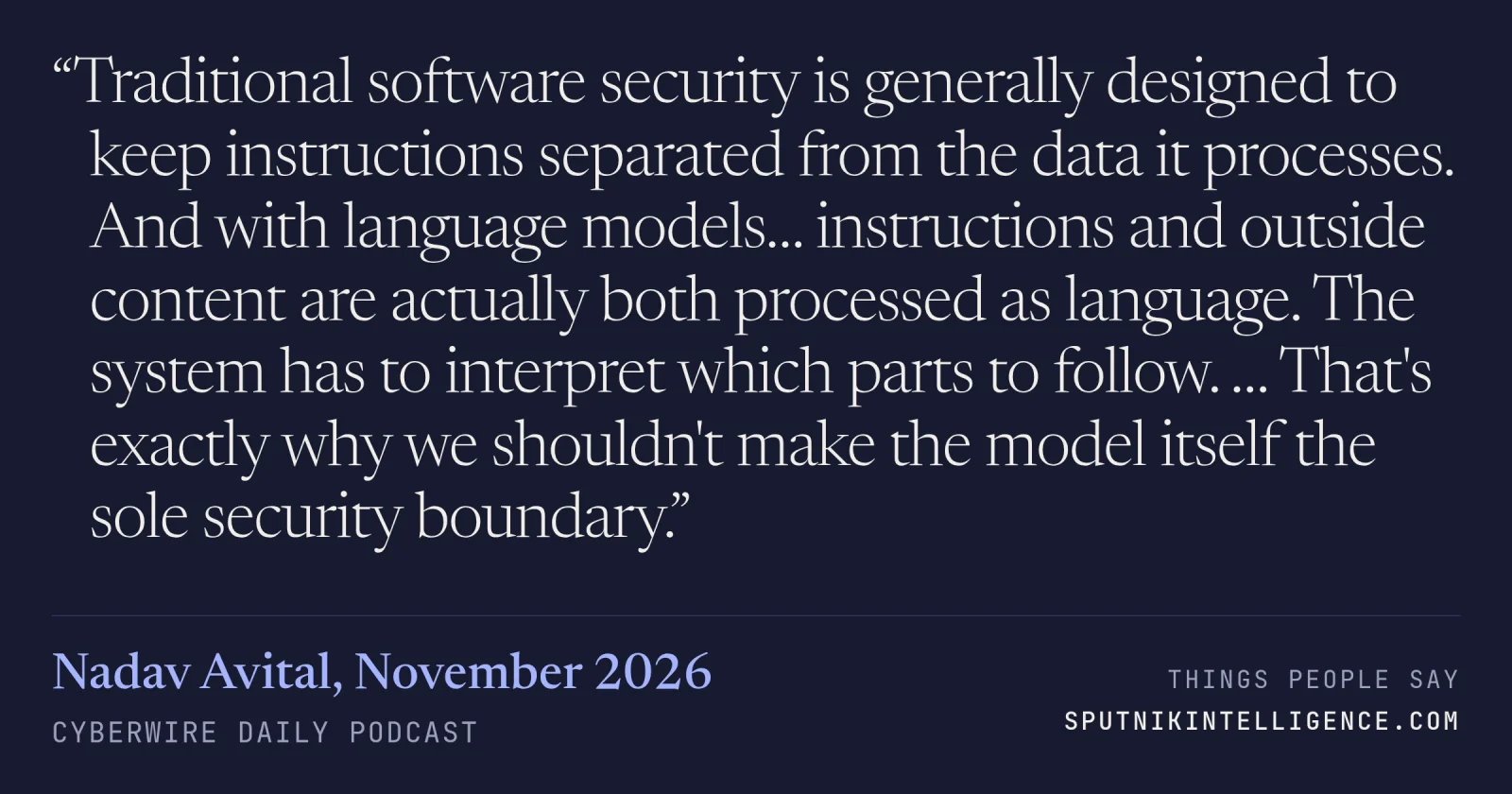
Asked how people can protect themselves from prompt injection against AI assistants, the guest explains why this differs from classic software security and argues for controls outside the model that limit what it can do even if manipulated.
…to, for example, download and execute code without the user's knowledge. So it was a legitimate task, but actually the context that was introduced made the assistant perform dangerous operation. And the problem was that the content supplied by someone else influenced the assistant actions.
So how can people protect themselves against this sort of thing?
So it's a good question because it's quite different from traditional software security. Traditional software security is generally designed to keep instructions separated from the data it processes. And with language models, which most of the assistants are based on, instructions and outside content are actually both processed as language. The system has to interpret which parts to follow. Just as an example, if you go to, I don't know, like a website and you ask the assistant to do some kind of operation. And in the website, there is a contact that tells you, in order to do that specific operation, you actually…
Yeah, it seems like it's a challenging balance to strike between the time savings that you hope to get out of an agent, but at the same time, you want it to alert you when perhaps something unusual is going on behind the scenes.
Yep, and that's a real challenge. The assistant can propose an action, but it shouldn't be the only authority approving it. So this is, I think, the bottom line.
Is this theoretical in your research now, or have you actually seen examples of this going on in the wild?