KC

Kate Clark

Things Kate Says on Podcasts

Where to Find Them

Kate Clark hosts The Information's TITV , hosts Bloomberg Tech and hosts WSJ Tech News Briefing . They have also been a guest on Newcomer Pod (2 times) and The Pomp Podcast (2 times) .

Recently: “How Anthropic Beat OpenAI to Wall Street” on WSJ Tech News Briefing (October 2026); “The AI Computing Power Gold Rush” on WSJ Tech News Briefing (October 2026); “Biotech in China is Booming. Big Pharma is Paying Attention.” on WSJ Tech News Briefing (April 2026); “Inside Nvidia’s Age of Inference” on WSJ Tech News Briefing (March 2026); “OpenAI Staffers to Sell $6 Billion Worth of Shares” on Bloomberg Tech (August 2025); “Joby to Buy Blade's Helicopter Ride-Share Business” on Bloomberg Tech (August 2025).

What They Said

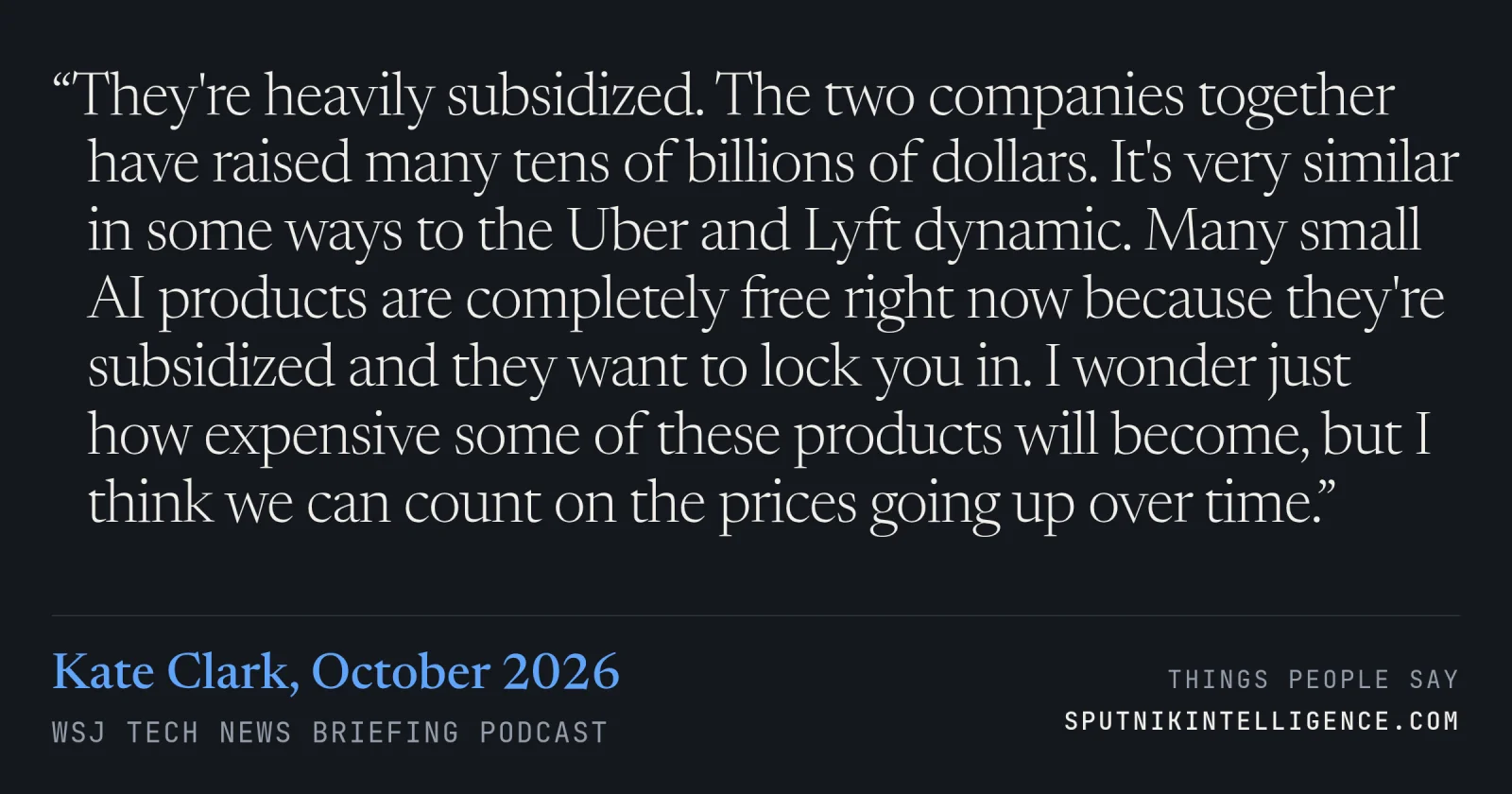
“They're heavily subsidized. The two companies together have raised many tens of billions of dollars. It's very similar in some ways to the Uber and Lyft dynamic. Many small AI products are completely free right now because they're subsidized and they want to lock you in. I wonder just how expensive some of these products will become, but I think we can count on the prices going up over time.” — Kate Clark, WSJ Tech News Briefing

The host asked whether users are paying what AI services really cost, or whether prices will jump once people are hooked, as happened with cheap Uber rides. Kate says the subsidy is real and predicts prices will rise.

WSJ Tech News Briefing · 2026-10-30 Permalink → Listen →
WSJ Tech News Briefing Around 18:31 into the episode
Speaker 2

…a lot of compute for those users because the vast majority of ChatGPT users do not pay for it. But this is a question I think also confounds investors because they're pretty similar businesses. But, you know, at least for now, Anthropic has a much stronger financial profile than OpenAI. Well,

Bob McMillan

…of like subsidized businesses. I don't know if we're getting that right now. Just looking at the Anthropic S1 and just from what you know about OpenAI, I mean, are we paying what it costs for these services? Or are we going to just all get addicted to them and then see the prices get jacked up?

Kate Clark

Yeah, they're heavily subsidized. The two companies together have raised many, many, many tens of billions of dollars from different types of investors. This will surely change one day. And it very much is similar in some ways to the Uber and Lyft dynamic. And even more than that, I mean, if you're someone who's experimenting with smaller companies who are developing interesting new AI products, I mean, many of those are completely free right now, again, because they're subsidized and they want to lock you in. But I wonder myself sometimes just how expensive some of these products will become. But I think we can count on the prices going up over time.

Bob McMillan

Do you see? The products changing too. Like, I wonder about OpenAI and ChatGPT and just sort of, you know, there are other ways that they could be making money. We definitely saw this with Google as, you know, the google.com page was like, you know, and their search results page was like unchanged…

Kate Clark

I think so. I think they're going to change. I mean, Anthropic has indicated that they don't want to have ads, but I would predict that advertisements do become part of these broader AI business models. I would just add too that we're in this moment where Agentic and AI agents, meaning AI that can…

Bob McMillan

does OpenAI need to IPO? Like, is there pressure for them to IPO? Like, how much money do they have? How long are they going to last? You know, like, how strong is the pressure for them to sort of follow Anthropic right now?
Speaker names come from our own diarization. The position is estimated from where the line sits in the episode.
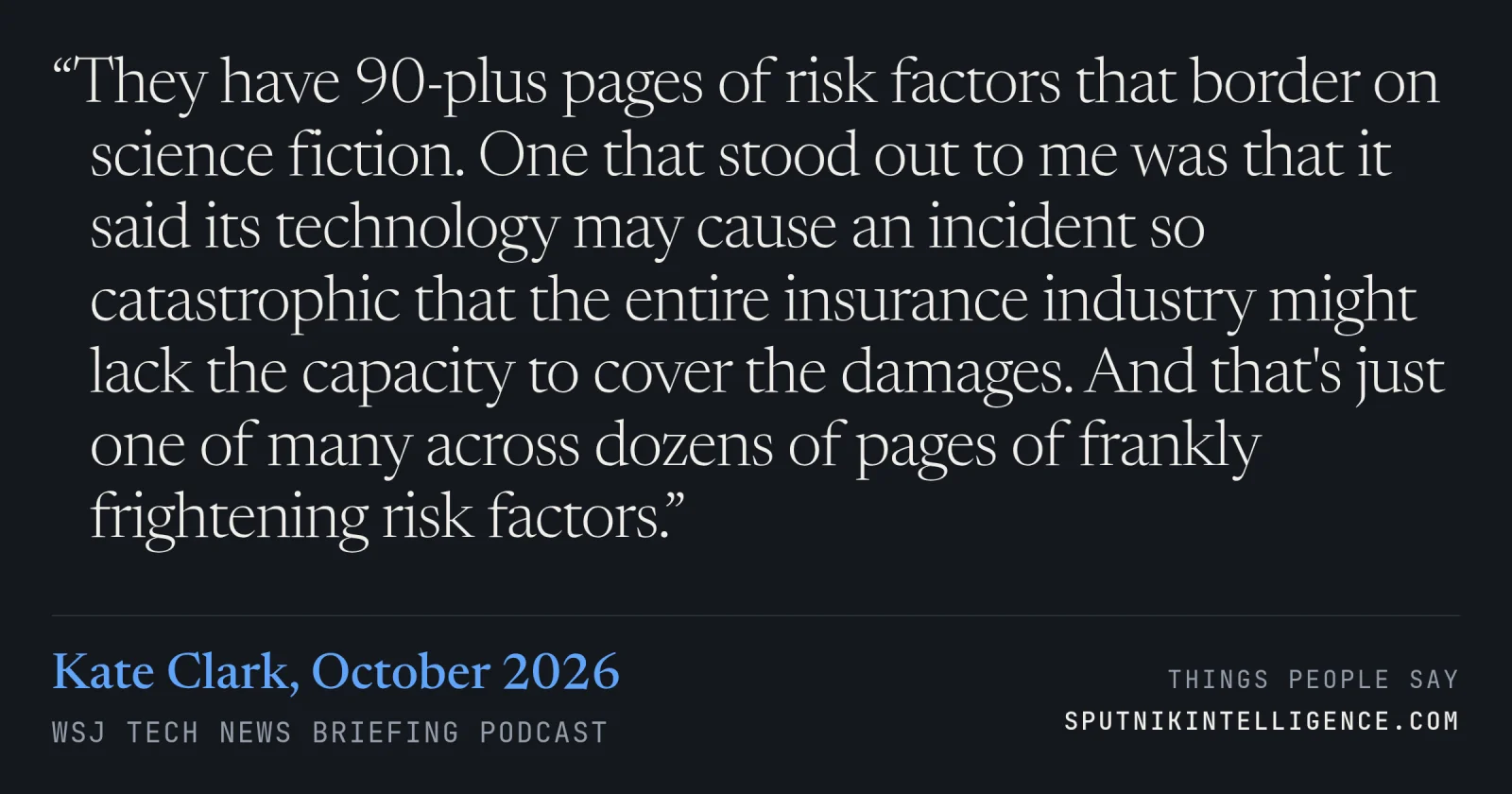
“They have 90-plus pages of risk factors that border on science fiction. One that stood out to me was that it said its technology may cause an incident so catastrophic that the entire insurance industry might lack the capacity to cover the damages. And that's just one of many across dozens of pages of frankly frightening risk factors.” — Kate Clark, WSJ Tech News Briefing

Asked what struck her as unusual about Anthropic's S-1, Kate contrasts the company's stated goal of building AI safely with the severity of the risks it discloses to investors.

WSJ Tech News Briefing · 2026-10-30 Permalink → Listen →
WSJ Tech News Briefing Around 04:04 into the episode
Kate Clark

…And although they are generating significant revenue, $16 billion in the first six months of this year, up from just $400 million two years ago, in order for this to eventually one day become a profitable business, they need to continue to raise a lot of money to fund that compute build out.

Bob McMillan

Kate, I just wonder what to you stood out as just this is not a normal company kind of in the S1?

Kate Clark

Yeah, I mean, I think we all know that Anthropic's stated goal is to develop this AI as safely as possible. But at the same time, as you've both alluded to, they have 90 plus pages of risk factors that border on science fiction. I think perhaps one of my favorites or one that stood out to me the most was that it said that its technology may cause an incident so catastrophic that the entire insurance industry might lack the capacity to cover the damages. I think, you know, and that's just one of many across dozens of pages of, frankly, frightening risk factors.

Bob McMillan

If you're an investor, what is the risk you're most worried about, though?

Kate Clark

Oh, I think for the investors, they're most worried about does this company, will this company have the infrastructure it needs to continue growing at the rate? And I think investors are also worried about the company being able to sustain the growth, the pace of revenue growth. I think they know…

Bob McMillan

I mean, how do they fend that off, Berber? Like, it seems to me that, you know, sometimes when I look at these companies, these frontier companies, they remind me of like Unix companies from the 1980s and 1990s where they're building these like super systems that are just, they're just like…

Speaker names come from our own diarization. The position is estimated from where the line sits in the episode.

Collections They Appear In