DG

Duncan Greatwood

Things Duncan Says on Podcasts

Where to Find Them

Duncan Greatwood has been a guest on CyberWire Daily .

Recently: “The next name on CISA's door.” on CyberWire Daily (November 2026).

What They Said

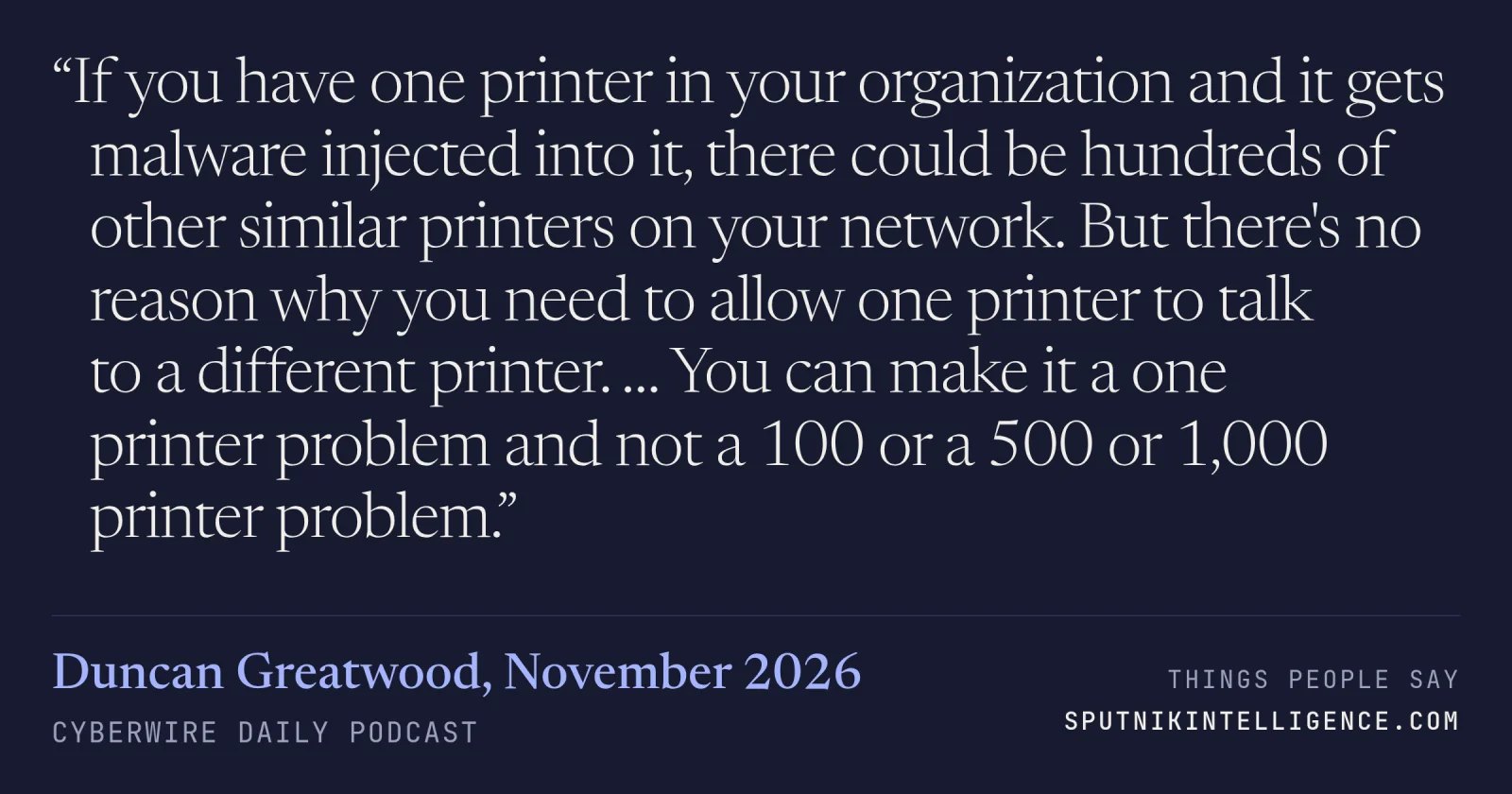
“If you have one printer in your organization and it gets malware injected into it, there could be hundreds of other similar printers on your network. But there's no reason why you need to allow one printer to talk to a different printer. … You can make it a one printer problem and not a 100 or a 500 or 1,000 printer problem.” — Duncan Greatwood, CyberWire Daily

Asked how defensive strategy should change if everything can't be patched, Greatwood argued for prevention over detection through zero trust and micro-segmentation. The printer example shows how to limit an infection to a single asset.

CyberWire Daily · 2026-11-10 Permalink → Listen →
CyberWire Daily Around 18:18 into the episode
Speaker 4

…night, it would go offline for a few minutes to get a patch. But now, you might be having to patch many times every day. And that's not acceptable to the business. So you have to start to find some more preventative methods versus just the reactive patching that you've maybe done in the past.

Dave Bittner

Well, let's dig into that. I mean, if we accept that we can't patch everything, what's the alternative? How should organizations rethink their defensive strategy?

Speaker 4

You know, I think the absolute headline level, it's sort of shift more of the effort towards prevention rather than detection and reaction or detection and response, as people in the industry say, of course. The nature of the prevention, I think, is multiple. It's partly really strict control of who's allowed to do what. So it's no longer so satisfactory just to sort of put an asset on a network and say, yeah, I'm sure anybody who needs it, they can get access to it. Maybe they need some sort of login or something, but it's still pretty exposed on the company network or the organizational network, whatever it might be. And the kinds of techniques which have been developed in recent years, often under the heading of zero trust, if that's not too much for a marketing cliche, but that zero trust idea, leaving aside the marketing, but the idea of only allow the minimum to go through the minimum authorization, the minimum entitlement, that reduces the attack surface pretty dramatically. And then, you know, I think the thing that has really accelerated this year, perhaps even more, is this idea of…

Dave Bittner

What are your recommendations to, let's say, a CISO who's listening to our conversation who feels like they need to make some changes here, that perhaps this is a journey that they're ready to start. How do they begin? How do they prepare themselves?

Speaker 4

Yeah, you know, I think assessing where you are is always helpful. So take a cold-eyed look about what assets you have, which you know are vulnerable. Maybe you've got some older business applications or whatever, which might be vulnerable in the future. And we've seen with the PHP problems over…

Dave Bittner

That's Duncan Greatwood, CEO at Zage Security. When you run security for a company that's scaling fast, the stakes just keep climbing. More compliance frameworks, more vendors, more risk, and a board that wants to see it all in one place. And all the information you need, it's scattered everywhere.…
Speaker names come from our own diarization. The position is estimated from where the line sits in the episode.
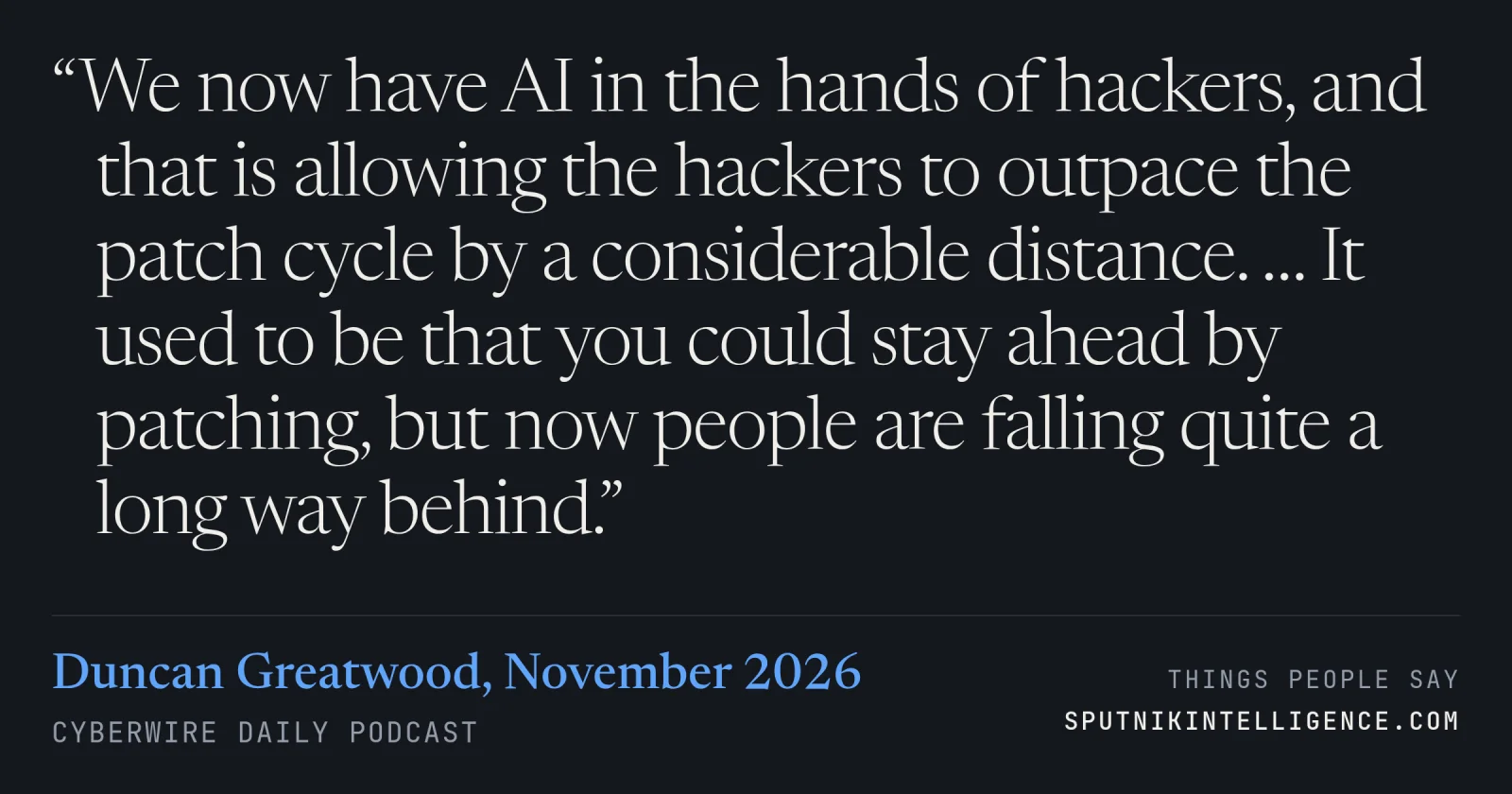
“We now have AI in the hands of hackers, and that is allowing the hackers to outpace the patch cycle by a considerable distance. … It used to be that you could stay ahead by patching, but now people are falling quite a long way behind.” — Duncan Greatwood, CyberWire Daily

In a sponsored Industry Voices segment, Dave Bittner asked what has changed about patching. Greatwood, CEO of Xage Security, says AI-discovered bugs and AI-built exploits have overwhelmed the traditional detect-and-respond approach.

CyberWire Daily · 2026-11-10 Permalink → Listen →
CyberWire Daily Around 11:51 into the episode
Speaker 3

that, you'll never look at a free night's plan the same way again. Learn more at txu.com, rep number 10004.

Dave Bittner

Duncan Greatwood is CEO at Zage Security. In today's sponsored Industry Voices segment, we discuss the cybersecurity problem you can't patch away.

Speaker 4

A few things have changed, and the single biggest one is that we now have AI in the hands of hackers, and that is allowing the hackers to outpace the patch cycle by a considerable distance. You know, traditionally, patching has been a matter of threat detection, threat analysis, response, and detection response still has a place in the cyber pantheon, but it's really being almost overwhelmed right now with the case of bugs that AI is discovering, the exploits that AI is able to create, and the ability of AI to run those exploits against companies and other organizations. So suddenly, it used to be that you could stay ahead by patching, but now people are falling quite a long way behind.

Dave Bittner

Is it fair to say that there are a lot of defenders out there who are feeling overwhelmed?

Speaker 4

I think June of 26 was the biggest month for patches of Windows and Linux and everything we'd ever seen by a factor of two or three. And then July was twice as big as that, and August, even bigger. So we've seen this kind of almost exponential growth really in the need to patch. And also the number…

Dave Bittner

Help me understand the situation where an organization knows that a system is vulnerable, but they simply can't patch it. What sort of things keep them from fixing it?

Speaker names come from our own diarization. The position is estimated from where the line sits in the episode.

Collections They Appear In