Chelsea Finn

Things Chelsea Says on Podcasts

Chelsea Finn is an assistant professor of computer science and electrical engineering at Stanford, where her lab studies how robots learn broadly useful skills through interaction rather than task-specific programming. She helped develop meta-learning methods for training models that adapt quickly to new situations, and her more recent work asks whether one model can control many different robot bodies. On Possible, she described that cross-platform generalization as easier than the field had assumed, comparing it to how a person moves between controlling their own body, a car, and a video game character. She is also a co-founder and research lead at Physical Intelligence, a startup building general-purpose robot control models, and earlier did research at Google. She holds a PhD from UC Berkeley and a bachelor's from MIT, and has received the Sloan Fellowship, an NSF CAREER Award, and the ACM doctoral dissertation award.

Where to Find Them

Chelsea Finn has been a guest on Y Combinator Startup Podcast (2 times) , The TWIML AI Podcast (2 times) , No Priors , Future of Life Institute Podcast , Pioneers of AI , Gradient Dissent: Conversations on AI , Eye On A.I. , The Gradient , The Future of Everything , Possible , What's Your Problem? , The Robot Brains Podcast and Foundering .

Recently: “Possible: Training robots for a world they've never seen” on Pioneers of AI (September 2026); “Training robots for a world they’ve never seen” on Possible (September 2026); “Chelsea Finn: This is the State of the Art in Robotics” on Y Combinator Startup Podcast (August 2026); “Chelsea Finn: Building Robots That Can Do Anything” on Y Combinator Startup Podcast (July 2025); “Teaching Robots How to Do Everything” on What's Your Problem? (June 2025); “The Robotics Revolution, with Physical Intelligence’s Cofounder Chelsea Finn” on No Priors (March 2025).

What They Said

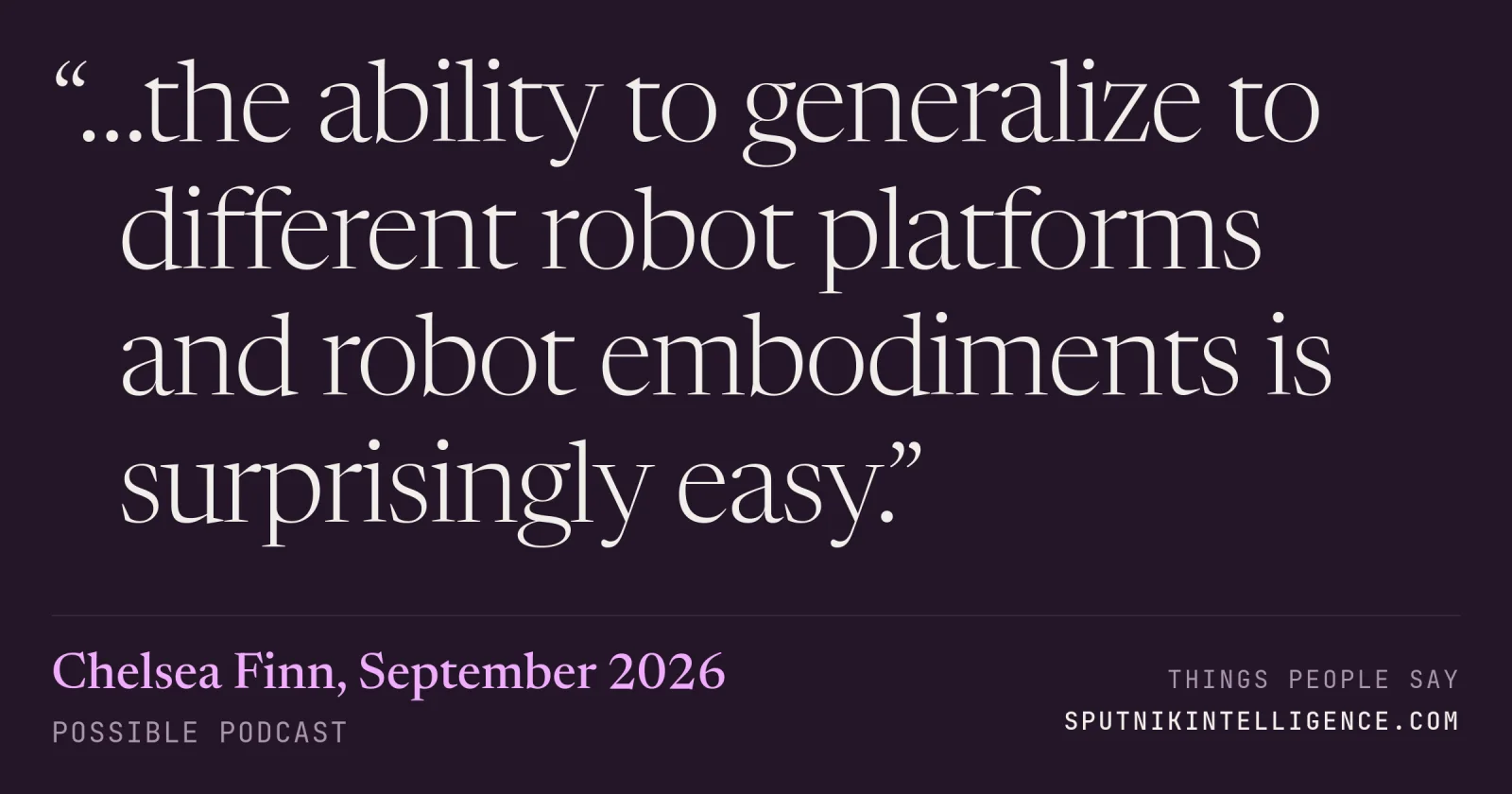
“…the ability to generalize to different robot platforms and robot embodiments is surprisingly easy.” — Chelsea Finn, Possible

Finn was asked what it proved that her team fine-tuned a model for a robot they had never seen, from data sent remotely, without knowing how its actions were represented. Her answer is that the field's working assumption — that each robot platform needs its own model, and that crossing platforms would be very hard — turned out to be wrong. She compares it to how people move between controlling their own body, a car, and a video game character.

Possible · 2026-09-02 Permalink → Listen →
Possible Around 30:01 into the episode
Speaker 3

But

Aria Finger

you guys fine-tuned your model on a robot you'd never seen from data you received remotely without even knowing exactly how its actions were represented. And it worked. So like, what does that actually prove? Because you did a lot of that hard stuff.

Chelsea Finn

Yeah. So one thing that we found that I think is perhaps surprising is that the ability to generalize to different robot platforms and robot embodiments is surprisingly easy. We actually, so this was actually technically not the first time that we had done this. So we had previously, even before starting physical intelligence, we had a project where we're specifically trying to train on train models on multiple embodiments. In the past, people had only trained models for like one robot platform and assumed that like if you're trying to get to work across lots of…

Aria Finger

And so just so people understand, this is different universities who have different robots that do not look the same, have sort of different specifications, and they're using your technology and it is still performing better than what they had trained in-house.

Chelsea Finn

Exactly. And the robots, they look different. They might have different numbers of joints. They might be larger or smaller. Their cameras are set up in different ways too. Like where they're mounted, where they're like even completely different orientations of the cameras, the height of the table…

Reid Hoffman

Although it is interesting to watch people who are not familiar with video games try to do video game characters. But yes, it was some experience.

Speaker names come from our own diarization. The position is estimated from where the line sits in the episode.

Collections They Appear In