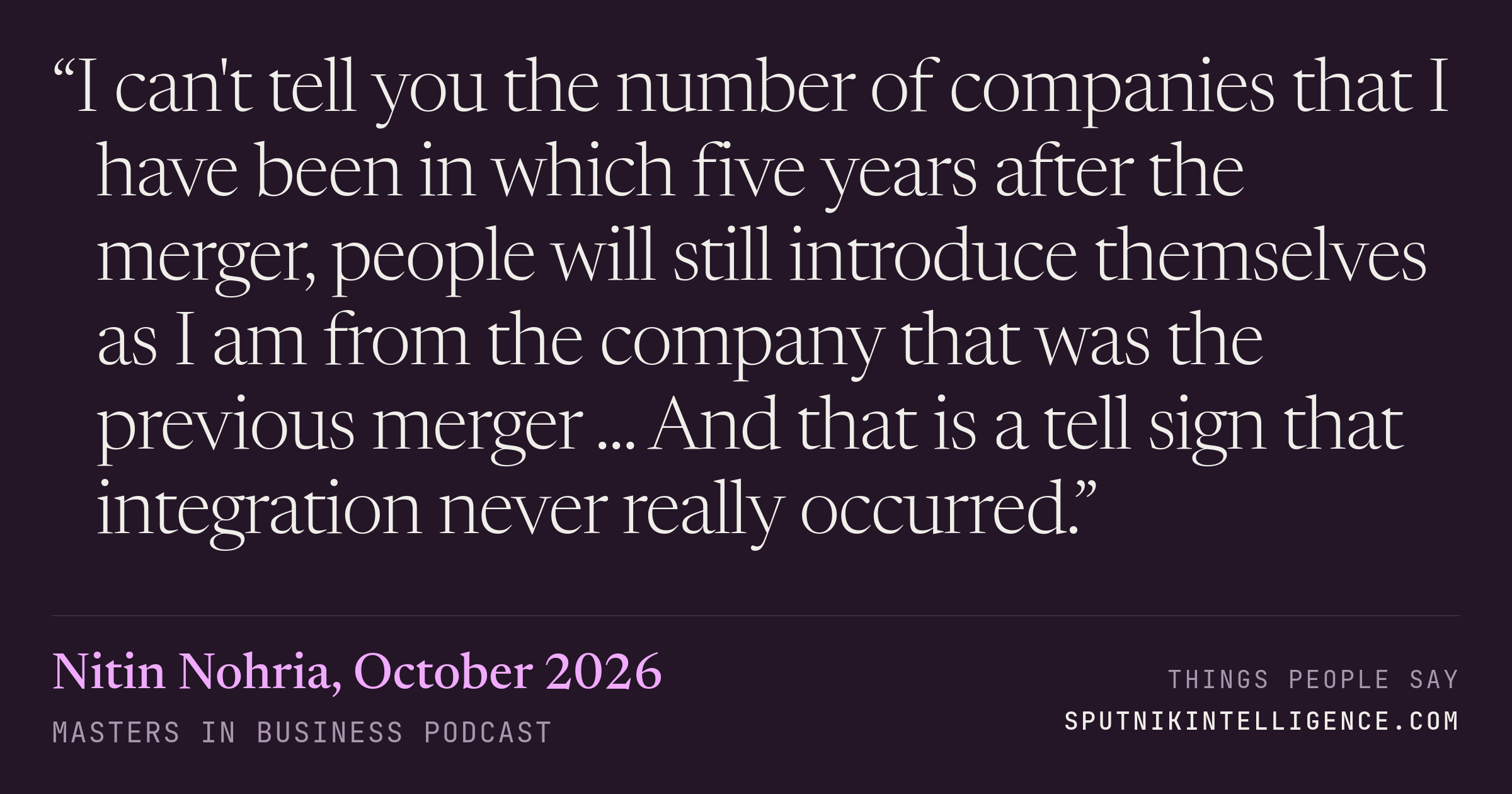
Nohria is explaining why most mergers disappoint, a number he says hasn't moved in 30 years. He gives two causes: bidding wars that end in overpaying, and underestimating what it takes to integrate the two companies afterwards. This is his test for the second.
Yeah. And this is a number that's been a number that hasn't changed for like 30 years. And you would think that given how commonly this number is known, we would get better. But there are two things that end up happening, I think, in most M ⁇ A situations that are that create the statistic. One is that it's hard to not fall into a bidding war. And because you've committed so much to it, the risk is that you overpay,
that in the end, there's the winner's curse. You want to win
desperately. And the winner's curse occurs again and again and again. And the second is that people tend to underestimate all that will take to integrate the merger once it's done. I can't tell you the number of companies that I have been in which five years after the merger, people will still introduce themselves as I am from the company that was the previous merger. They introduced themselves carrying the identity of their Original company, as opposed to the merged company. And that is a tell sign that integration never really occurred.
Huh, really, really interesting. There are some quotes from the book that I thought were really telling. And you've already talked a little bit about communication and focus, but this one jumped out at me. If the message doesn't travel intact, it doesn't matter how well I set it in the room. It has to keep its shape when I'm no longer there. We don't usually think about how do we communicate, not just to express something in the moment, but to make sure that when there's second and third effects, when there's copies of copies, the message, the telephone game, doesn't somehow invert the message.
I think that this is, I did a study once in which I asked the CEOs, what are the five things that you hope everybody in your organization knows? And then with their permission, just like my time study, this I could only do with half a dozen people. I said, can I just randomly send out to 30 people in your organization, randomly chosen? What would they say are the five messages that the CEO most wanted to hear? Most CEOs
were aghast by what came back. They were surprised by what people actually believed was not in any way aligned with what they thought they had to say. And this is what led me to this quote: which is: