His co-host had just said the International Space Station is hugely inspiring to kids even if its science is thin. He agrees crewed spaceflight is adventure, but argues it shouldn't be funded out of the science budget.
…in space. And that's one of the useful things that you can do in space that you can't do on Earth is be in a microgravity environment. And it's probably, frankly, the only useful, well, among the only useful science you can do in a space station. I'm not sure it's worth the cost. But anyway, I
…this kind of thing and it was hugely inspirational. They wanted to know everything about rockets and space flights and gravity and so on and so forth. And since then, I kind of think, you know, I've underestimated the inspirational value of doing this kind of thing. It's not the scientific turnout.
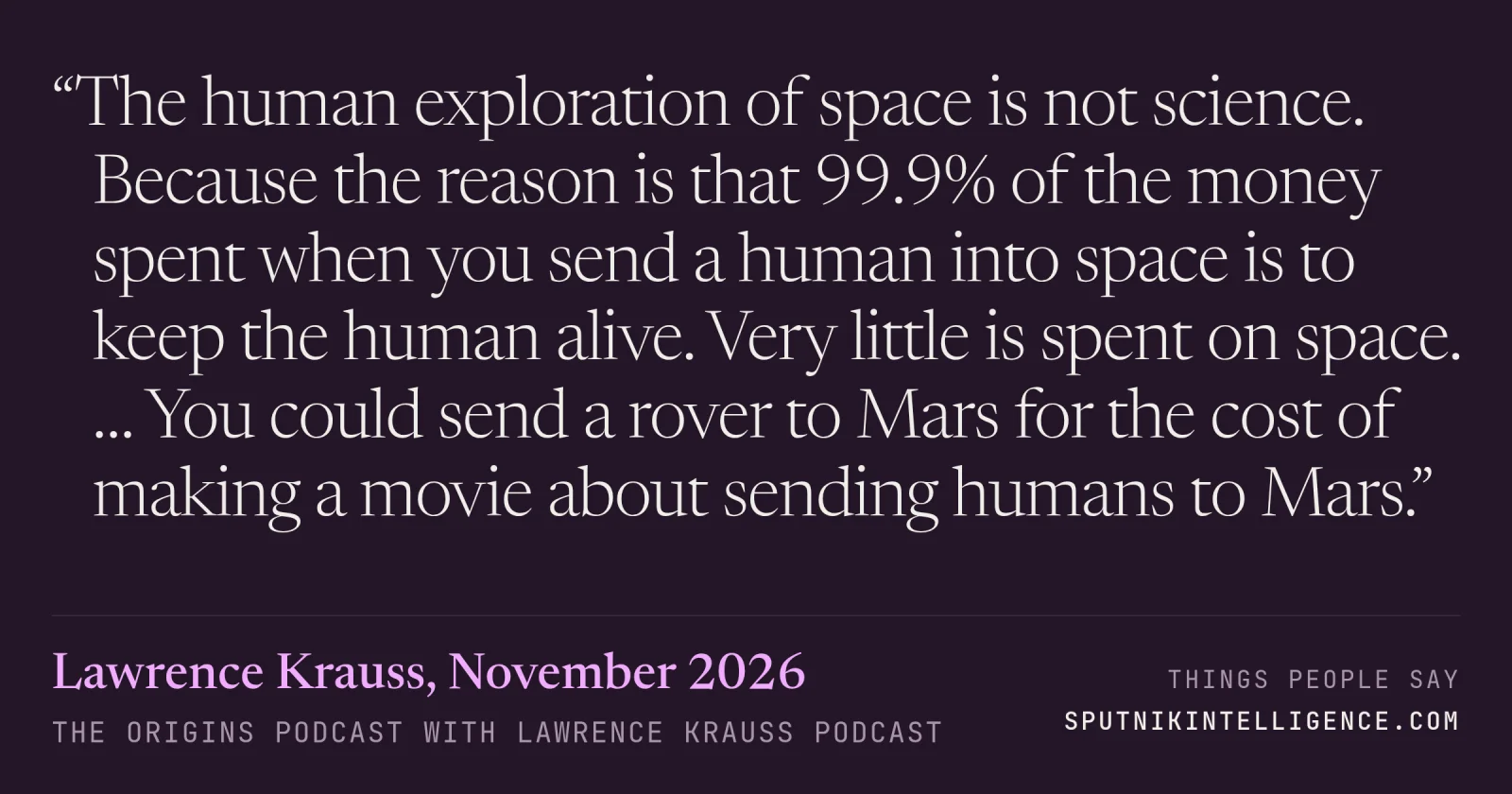
…human exploration of space is useful because it's adventure. It inspires kids. I've been on stage with astronauts and everyone wants to touch them because they've been in space. And that's what space exploration is. It's adventure. You shouldn't sell it as science because when you do, what you do is you take money from the science budget and put and spend it on human exploration of space. And the human exploration of space is not science. Because the reason is that 99.9% of the money spent when you send a human into space is to keep the human alive. Very little is spent on space. We spend, you know, you can spend, as I like to say, you could send a rover to Mars for the cost of making a movie about sending humans to Mars. But the inspirational basis of sending humans into space to get kids interested in science can't be, you know, can't be overstated. And I know from my own circumstances, I grew up when the astronauts were going to the moon. And I stayed home from…
So I came across this full disclosure through an article, New Scientist. And when I looked at it, I realized that I'd actually bookmarked some of the papers from this group because I wanted to look it up. So I finally came around to do it. So they've been running a program that they call reverse…
Well, it's good that some people do it, I guess. It looks to me like it's almost philosophy and therefore I cringe. But I was, look, when I was at Harvard, there was a group that did axiomatic quantum field theory. And they basically spent years and years and years trying to prove that a very…
I think it's interesting is that we might actually have, for the first time, found something that we actually disagree on. It's because I think that both things can be true. You have to look for experiments and try to uncover new laws of physics, but you also have to know what it is that you're…