Patrick asked whether Anthropic and Google tightening their vulnerability disclosure windows to 30 days will help. Jason says it pressures exhausted maintainers and small vendors, and that many AI-found bugs aren't practically exploitable.
Yeah, I too know a lot. What will you pay me? Yeah,
…does this, does this help? Does it help? What do you think, Jason? Is this a good motivator to get people to get their ducks in a row and auto-generate patches and spin up a modern program? Or is it just like it just, to me, it just feels like a case of what the Americans say. It is what it is.
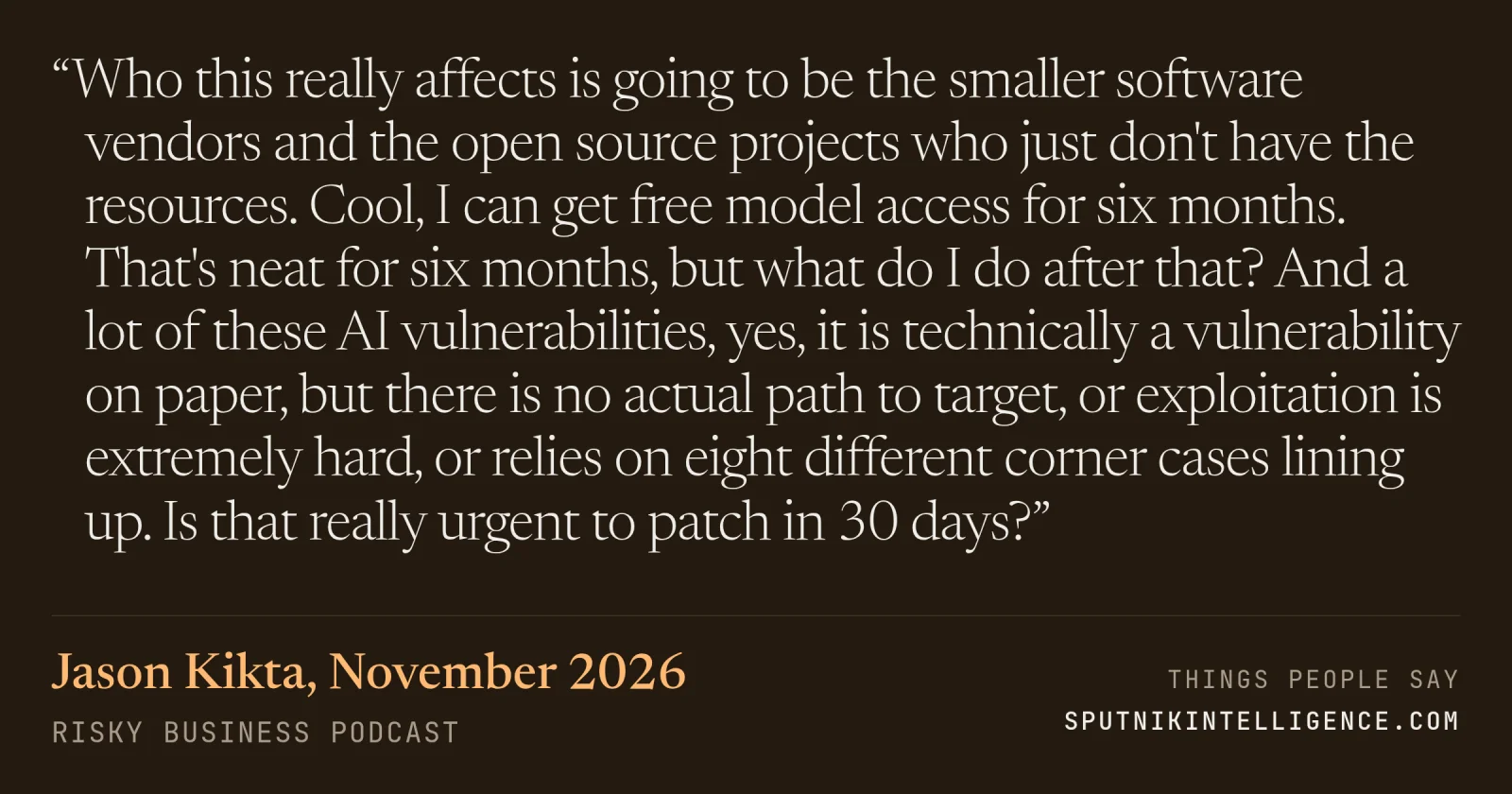
It feels a little bit like, you know, getting kicked wire down, right? And that's another thing on all these outages we've seen is like everyone's exhausted. Everyone's beyond exhausted. And, you know, having somebody pressure you harder on bugs, you know, and again, we're not talking about the massive multinational companies here that are, you know, in a trusted program. Like who this really affects is going to be the smaller software vendors, the open source projects who just don't have the resources. And like, cool, I can get, you know, free model access for six months. Like that's neat for the six months, but what do I do after that? Right. You know, right now, you know, there needs to be a lot more thought on how, you know, how to help people dig out of this rather than watch my new whiz-bang model go off and discover a bunch of things. And it's also, you know, like it's a really limited use case where this would potentially be a useful response simply because, you know, if you need something where a non-US model, you know, frontier model can find the vulnerability during an embargo period and then use it for quiet exploitation and on and on it goes. And oh, by the way, you know, not for nothing, but a lot of these AI vulnerabilities we've seen, like, yes, it is…
Oh, now here's some fun news. Google has mathematically like for has done a has done a formal verification on parts of Signal. Why I find this funny is they have formally verified bits of the protocol that absolutely nobody worries might be insecure while all of their users are getting QR code…
Yeah, absolutely. I'm thinking about third SaaS vendor from the left and, you know, small kind of niche open source project being able to do formal verification on the crypto libraries that they're using in their implementation of it. And I like that future, I think, is amazing. And so, you know, I…
Yeah. I mean, don't forget, too, how complicated this sort of formal verification is. I mean, for a long time, everybody would talk about the SEL4 Linux kernel or the microkernel because it was basically the only thing on the planet that had been formally verified. Australian project, mind you. So…