Sean Bowe

Things Sean Says on Podcasts

Where to Find Them

Sean Bowe has been a guest on Bankless .

Recently: “The Complete Zcash Roadmap | Sean Bowe and Dev Ojha” on Bankless (November 2026).

What They Said

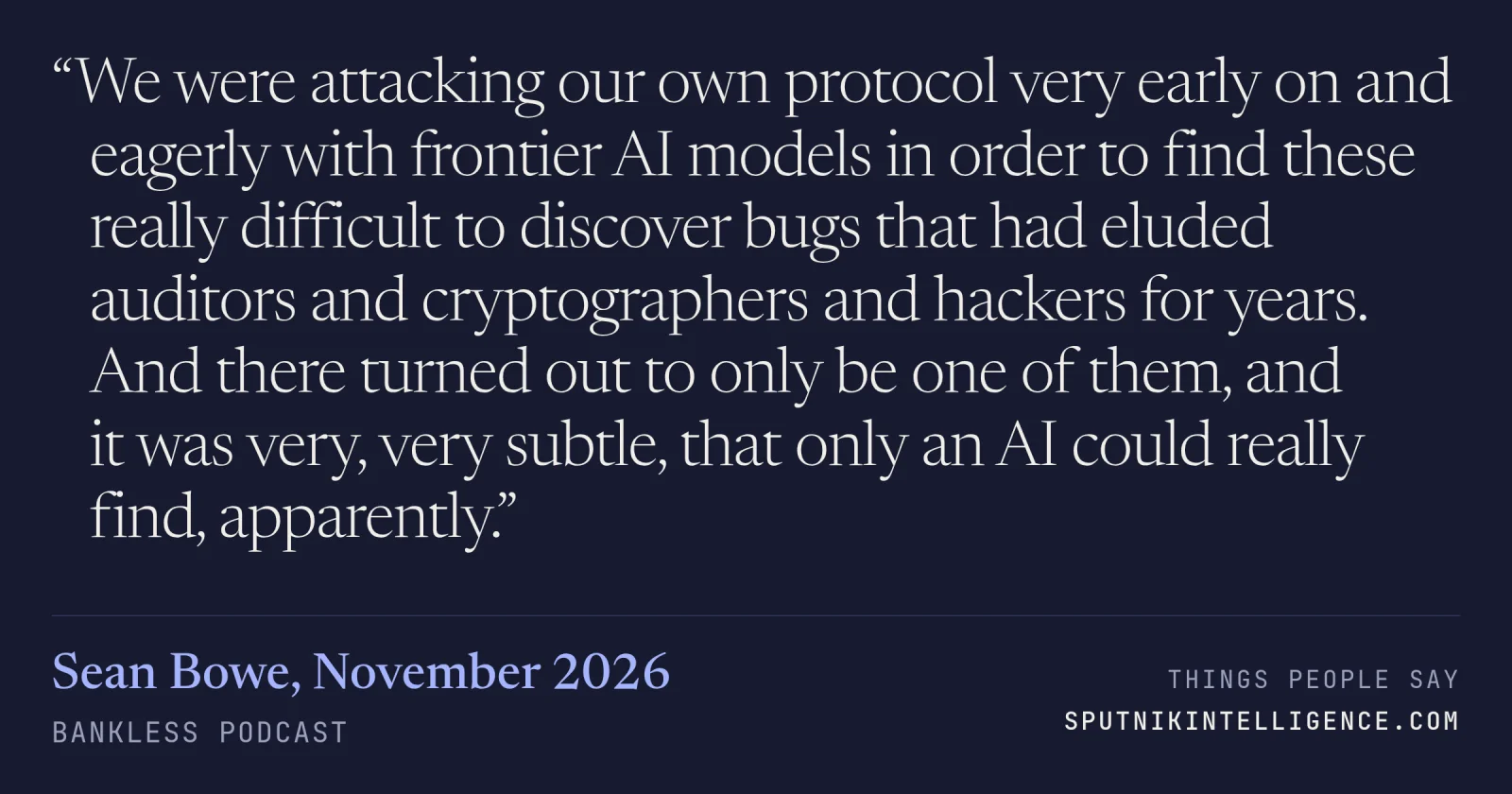
“We were attacking our own protocol very early on and eagerly with frontier AI models in order to find these really difficult to discover bugs that had eluded auditors and cryptographers and hackers for years. And there turned out to only be one of them, and it was very, very subtle, that only an AI could really find, apparently.” — Sean Bowe, Bankless

Asked about formal verification and AI threats to cryptography, Bowe describes how an earlier counterfeiting bug in a Zcash shielded pool was found by pointing frontier models at the protocol. The team then formally verified the pool.

Bankless · 2026-11-02 Permalink → Listen →
Bankless Around 1:02:55 into the episode
Sean Bowe

…people on the other side are just like denying the threat entirely of AI or quantum computers and stuff like that. And they look silly. So I think Justin probably ran into maybe the extent to which he can be a doomer without looking kind of ridiculous. That's just my personal view, personal view.

David Hoffman

What about the subject of formal verification just to give Zcash longer term, stronger, harder assurances about the hardness of the whole entire system?

Sean Bowe

We have been working on, so with Tachyon, we were already writing, doing formal verification of Tachyon because Tachyon's actually kind of, it's using more esoteric cryptography. So like a year ago, we had already set up contracts with these like formal verification people to help us build this stuff and integrate it into our into our cryptography stack. And so we were already kind of ahead of the game on that. Then this orchard counterfeiting bug was discovered earlier this year. And so we needed to basically rule out that it was impossible for any more counterfeiting bugs to exist. And you can do this with formal verification. Like we can mathematically prove that there are no undetectable counterfeiting bugs in the protocol anymore inside of the shielded pool. And so we had this like massive month and a half long or two month long sprint to prove that to formally verify it. And we pulled it off and shipped this upgrade. And I think it's like been hugely inspirational. I've heard from every project in the crypto world has messaged me and said, how are we? Going to do this for our protocol? What'd you guys do?…

Dev Ojha

What's kind of cool is for verification is like getting more and more capable every month. Like literally today, one of my friends made a post after this whole PHP instant about how do you do formal verification off of the raw assembly to protect like a PHP like thing again, where TLDR, this PHP…

David Hoffman

So with all this formal verification stuff, there's just a ton of auditing to do with regards to all the code. Like Dave just talked about all this fuzzing, which is a term I once knew, but not really familiar. Why do we believe in this, in formal verification? What does this really do for Zcash in…

Sean Bowe

So you can formally verify things. What does it mean to formally verify something? It means that you have some kind of proof that some code or some math is correct according to some property or specification. And that's really vague because the specification can be wrong. Like the property you're…
Speaker names come from our own diarization. The position is estimated from where the line sits in the episode.
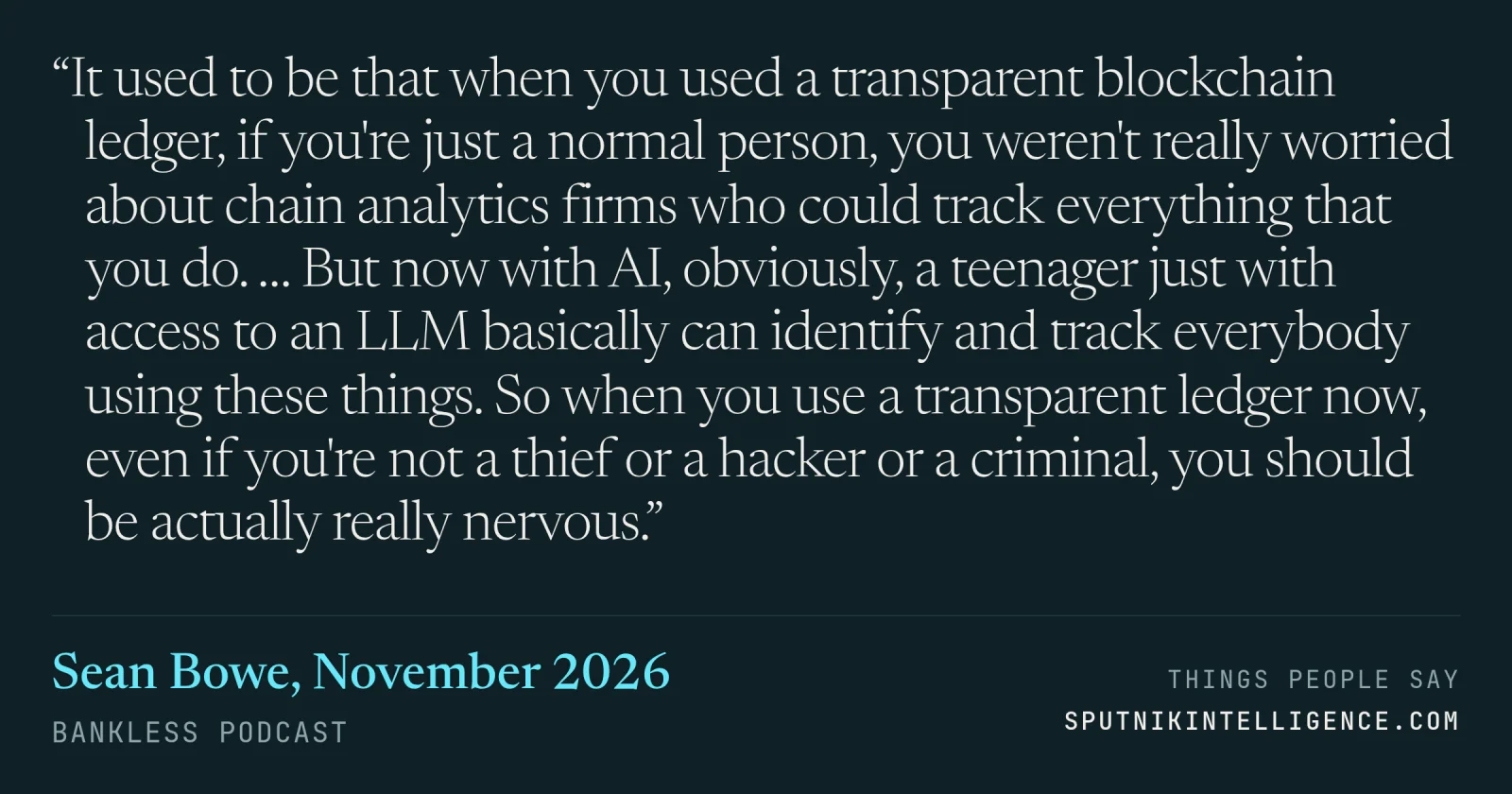
“It used to be that when you used a transparent blockchain ledger, if you're just a normal person, you weren't really worried about chain analytics firms who could track everything that you do. … But now with AI, obviously, a teenager just with access to an LLM basically can identify and track everybody using these things. So when you use a transparent ledger now, even if you're not a thief or a hacker or a criminal, you should be actually really nervous.” — Sean Bowe, Bankless

Asked why privacy is urgent in 2026, the Zcash co-founder argues AI has changed the risk for ordinary users of transparent blockchains, not just criminals.

Bankless · 2026-11-02 Permalink → Listen →
Bankless Around 14:09 into the episode
Dev Ojha

…about privacy. Who I was on calls what six months ago pitching stuff for like, well, we're doing it. No, it only cares. No one, this will never matter. I was like, oh, wow. Okay. So Zcash succeeding is also inspiring for the rest of the world to care about privacy in a way that other things aren't.

David Hoffman

…privacy very quickly soon after proof of stake. And not only did proof of stake not really come very quickly, but neither did privacy, with the exception of in Zcash. So, Sean, I'll ask you guys both this, but I'll start with you, Sean. Like, what's your case for why privacy is urgent these days?

Sean Bowe

Yeah, so it used to be that when you used a transparent blockchain ledger to transact, you know, if you're just a normal person, you weren't really worried about the fact that these chain analytics firms existed who could basically track everything that you do, associate all your transactions together, figure out your online activity based on that, for example, because you weren't really a real target. I was worried, but most like normal people weren't. And hackers and thieves. These are not normal people. Right. So hackers and thieves were always really nervous and careful about using these things. But now with AI, obviously, a teenager just with access to an LLM basically can identify and track everybody using these things. So everyone using crypto. So when you use a transparent ledger now, even if you're not a thief or a hacker or a criminal or any of that, you should be actually really nervous. So in the coming years, I think it's going to get much worse. It's going to get so bad, in my view, that you will have these just public. Databases, these free public databases that will have completely mined the blockchain of information, where every single individual who's been transacting on public ledgers has been quantified and tracked in…

Dev Ojha

the follow-on problem is it's not just your blockchain transactions. It's also every other data leak that in the world compounds like each Coinbase exchange leak. Oh, that's your address that gets tied to all this. Not just like your physical address. It's not just like there's one human in the…

David Hoffman

So in myself and also a lot of listeners probably are very familiar with Ethereum's like swim lane roadmap. I'm wondering if there's something like that as scaffolding for knowledge for understanding the rest of the Zcash Roadmap, because that's really what I'm looking to understand here with you…

Sean Bowe

Well, I'd be curious to see how Dave would categorize it, but I would, I guess there's, in my mind, I think there's three camps or three like categories. There's the cryptography side. So there's trying to make the cryptography more secure and more efficient. There's the there's the kind of the…

Speaker names come from our own diarization. The position is estimated from where the line sits in the episode.

Collections They Appear In