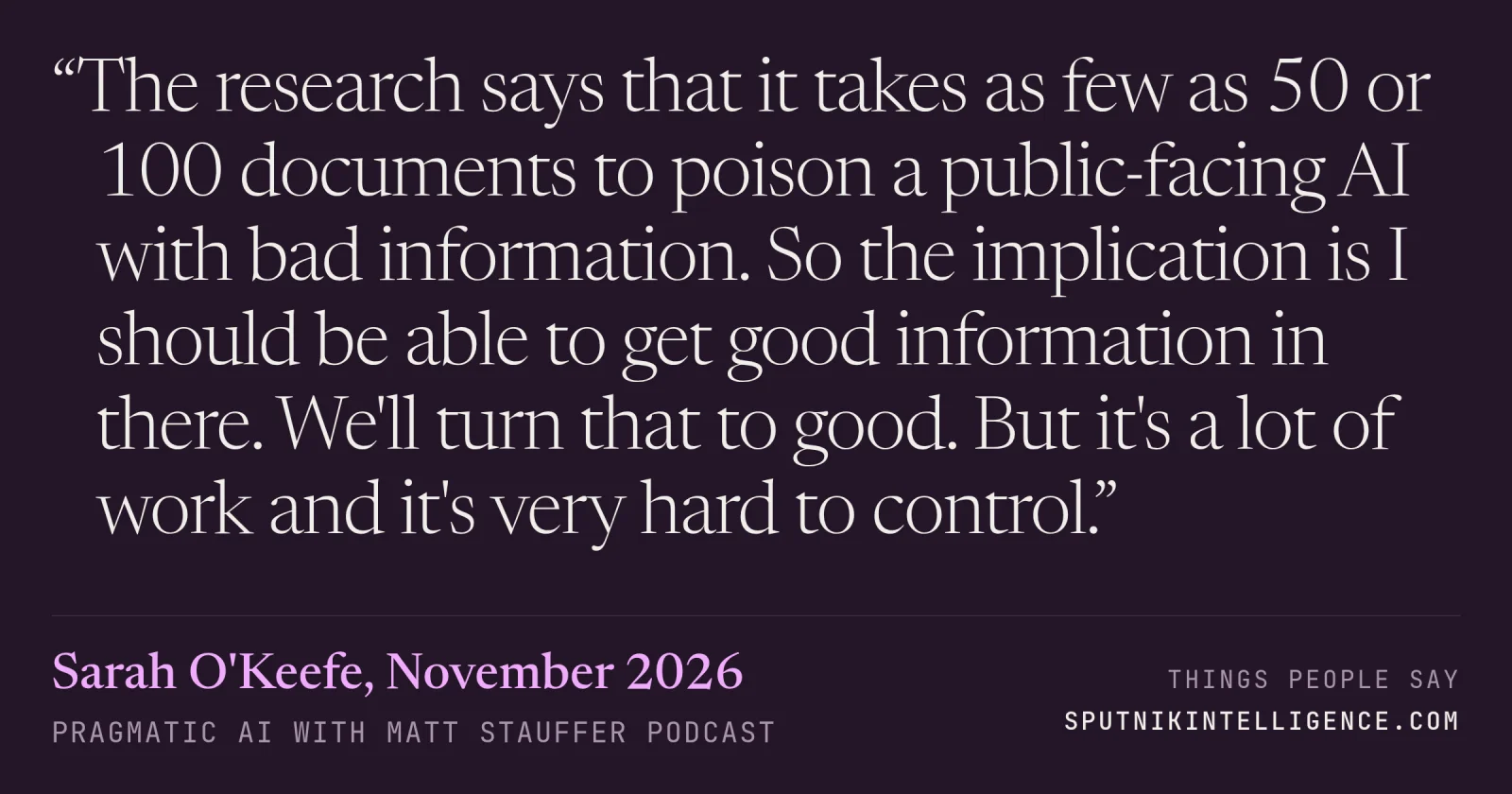
Matt Stauffer asked whether content owners have any control over public chatbots such as ChatGPT or Claude. She says influencing them is surprisingly similar to SEO, and cites research on data poisoning as a sign of how little it takes to shift what they say.
Pragmatic AI with Matt StaufferAround 28:05 into the episode
Sarah O'Keefe
It's just always three. Yeah. It's always three. And you can go in there and you can look at the code and you can say, oh, crap, and you can fix it.
Matt Stauffer
Yeah.
Sarah O'Keefe
Probabilistic, which is AI, machine learning, and all that, you know, broadly, that whole bucket of things, one plus one is sometimes a different number. Usually it's two, but maybe not. And so at the end of the day, the question is: how deterministic does your content need to be? How predictable do you need it to be? And what are the use cases where predictability is critical? And what are the use cases where having it be more probabilistic and giving you the average of what's in the database is acceptable? That's the determination that you have to make. And so there's a lot of really fascinating questions about how you deal with this and what you do and what are your standards. Now, I think the brutal reality is that for product and technical content, generally the standard has not been that high. Like a lot of this content's not very good. And so just getting it to average feels like an improvement potentially. So here we are.
Matt Stauffer
Yeah. So I'm going to, that was really, really, really helpful context. I'm going to re-ask one piece of my question because I'm still curious. Do you feel like your clients and the authors or the readers of this book have any control over how, I don't know what the right phrase is, but like…
Sarah O'Keefe
So first, I mean, it's obviously true that if you build your own internal private processor, private chatbot, that you can control that. You can tell it what information it has access to. You can exclude things. You can tell it not to ask entertain questions like, what is the weather tomorrow? And…
Matt Stauffer
Yeah.
Speaker names come from our own diarization. The position is estimated from where the line sits in the episode.
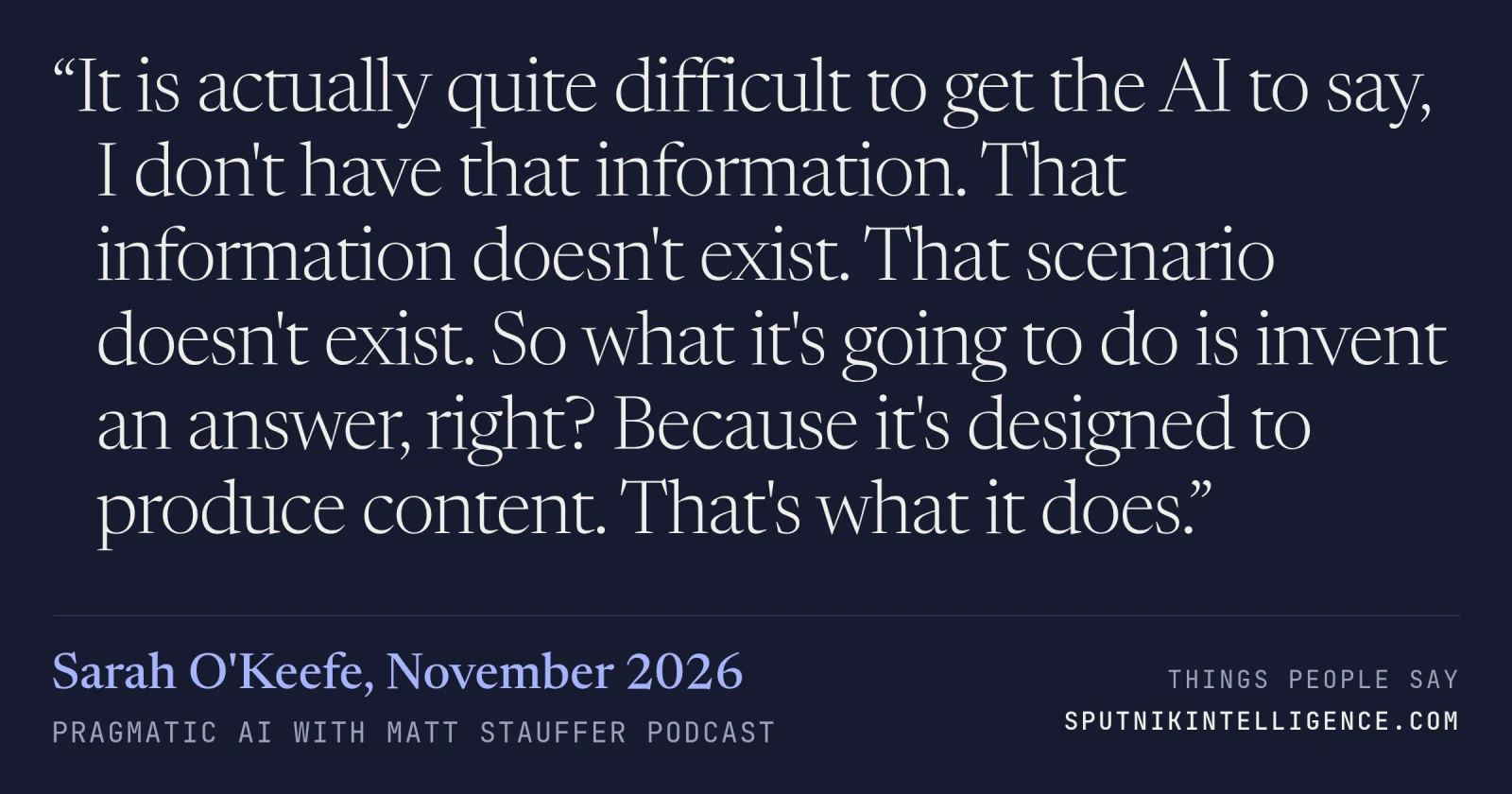
Matt Stauffer said people turn to AI for docs because it can answer their exact scenario. She replied by asking what happens when that scenario isn't in the docs, as her case against trusting confident-sounding AI answers about technical content.
Pragmatic AI with Matt StaufferAround 09:37 into the episode
Sarah O'Keefe
…and it gave me an answer right away and it gave me exactly the answer that I asked for. And it looks good. So there's a very, very big disconnect between what is the job of somebody producing technical content and why are you being, it's not disintermediated, right? It's like re-disintermediated.
Matt Stauffer
…that you mentioned was you said it's a failing of the original content. So is there a vision that you have or would have had in the past for how we should differently either write or present content that would have not necessitated the AI replacement? Or like, what's the solution to that problem?
Sarah O'Keefe
It's a great question. So first, if you ask the AI Fails super specific question, then what you want is for it to return the exact answer.
Matt Stauffer
Yeah.
Sarah O'Keefe
And if you set things up correctly and if you have, you know, kind of the right guardrails around your AI, you can set it up in such a way that when you ask that, I have X and then I configured Y and then Z happened and it says, oh, here you go.
Matt Stauffer
Okay.
Speaker names come from our own diarization. The position is estimated from where the line sits in the episode.
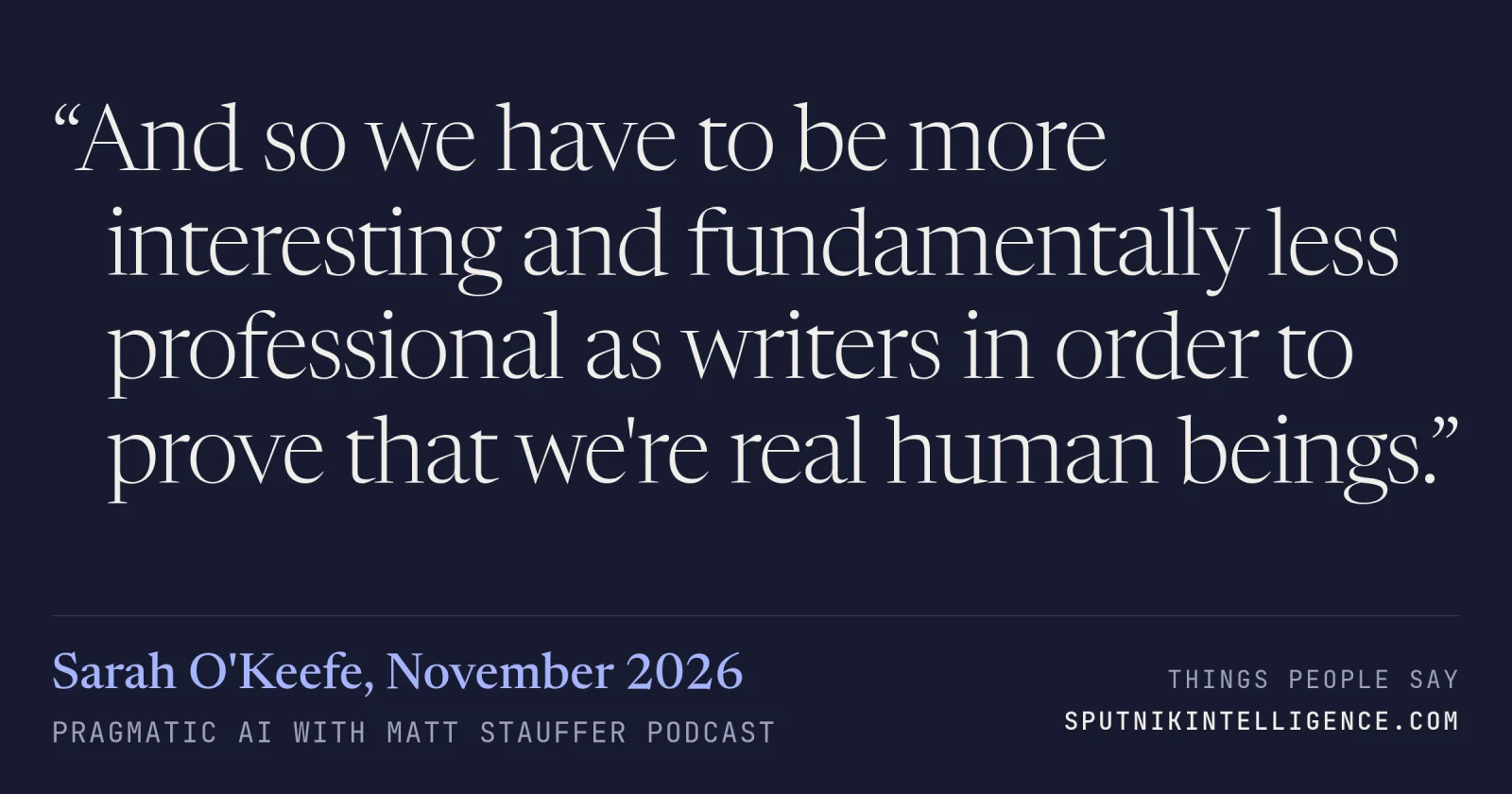
She had just described writing her first post-AI book: editors now leave in over-the-top lines, because taking them out makes the text look machine-written. This was her conclusion about how AI is changing human writing.
Pragmatic AI with Matt StaufferAround 43:50 into the episode
Sarah O'Keefe
…but I don't think that's necessarily a pro use. That's just a really obvious usage. If you speak multiple languages, ask it the same question in multiple languages and notice that or ask it to translate, not translate, but answer in that language and notice that the answers are different.
Matt Stauffer
Fascinating. I've never. All right. Is AI going to ruin the world?
Sarah O'Keefe
So it is September 2026. So far, no. Ask again next week or maybe later this afternoon. I think that the LLMs know. Large language models are just large language models. They are not that big a deal. And it's not that difficult to manage an autocomplete engine. The people that are operating them that are using them in irresponsible ways are a big problem. Should you glue an inference engine onto like a bioweapons lab? No, you should not. Are they going to? Almost certainly yes. Am I happy about it? No.
Matt Stauffer
Yep. Yep. All right. And your last question is, what is the most controversial take you have about AI?
Sarah O'Keefe
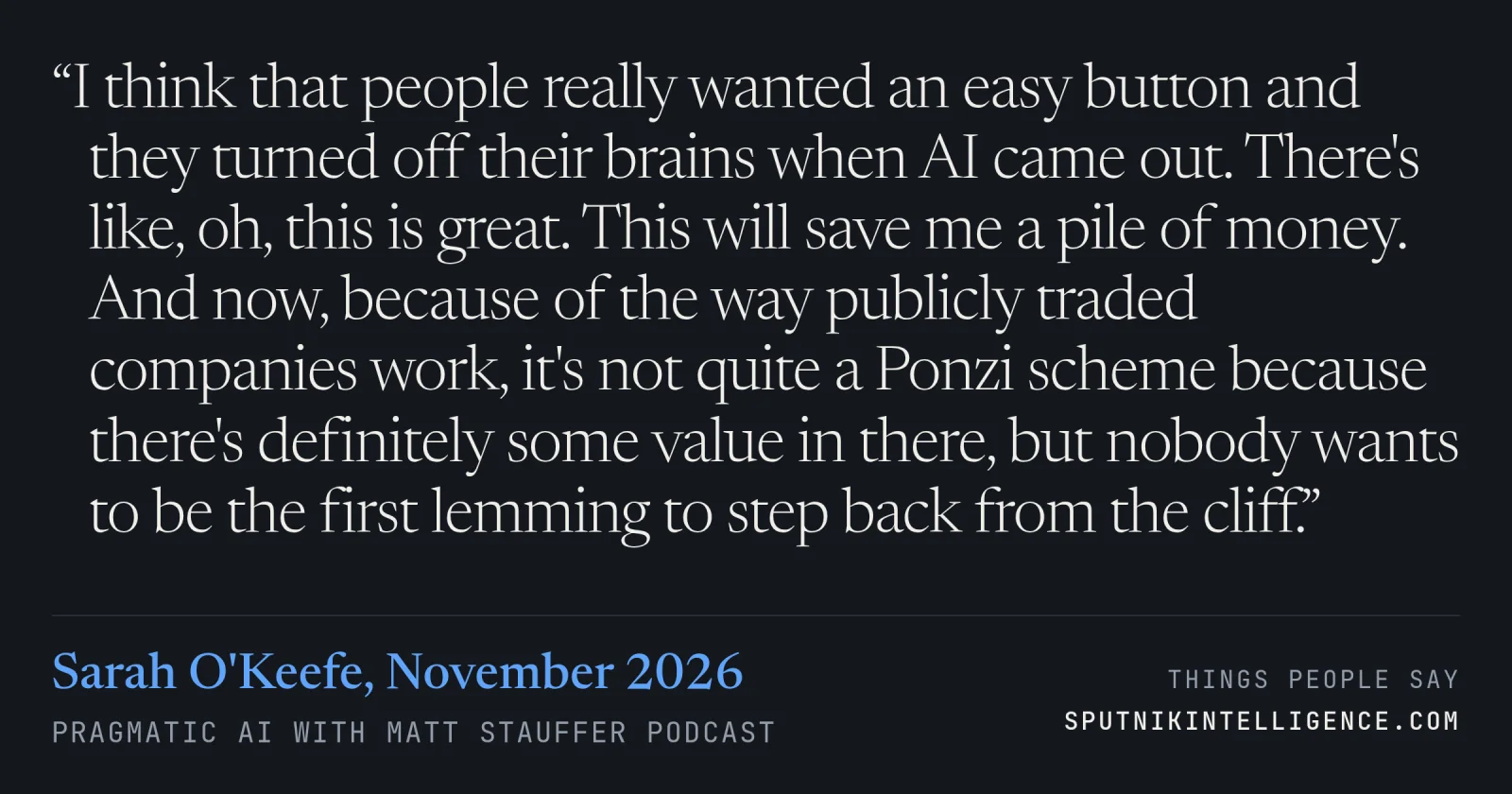
I think that people really wanted an easy button and they turned off their brains when AI came out. There's like, oh, this is great. This will save me a pile of money. And now, because of the way publicly traded companies work, it is a, it's not quite a Ponzi scheme because there's definitely some…
Matt Stauffer
I really shot myself in the foot not being supposed to answer when you guys get these questions because it's some of the best stuff. First lemming to step back from the cliff. Wow. Okay. Well, it'll all be fine. Okay. There you go.
Speaker names come from our own diarization. The position is estimated from where the line sits in the episode.
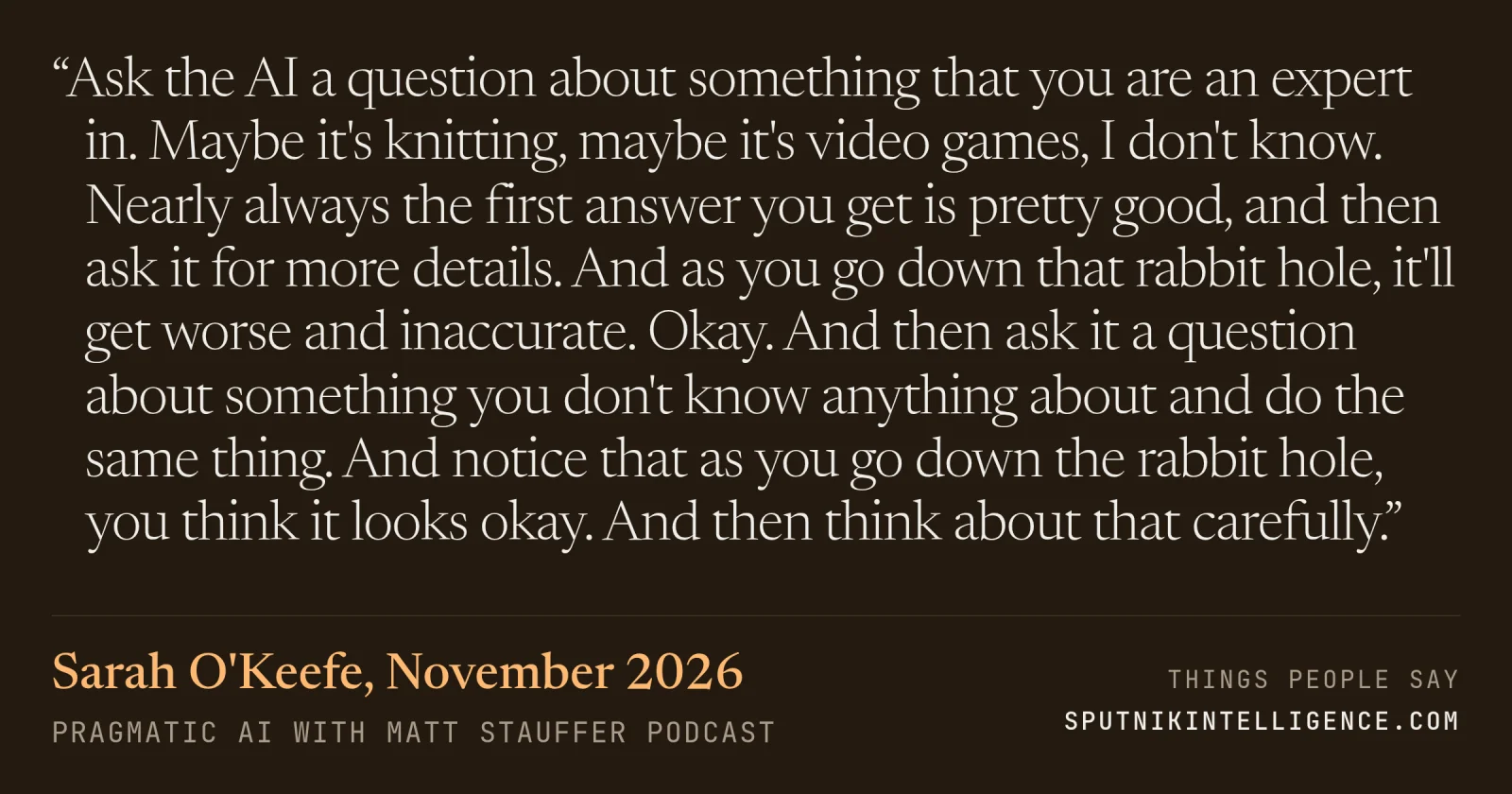
In the speed round Matt Stauffer asked whether she had ever cussed out an AI. She said she mostly laughs and takes screenshots, then proposed this experiment for seeing how AI's confidence outruns its accuracy.
Pragmatic AI with Matt StaufferAround 39:14 into the episode
Sarah O'Keefe
…about big AI. So clearly a public-facing chatbot you don't own and you don't have sovereignty over because you've got all these issues. But if you bring it in-house, so you have an enterprise license of one of these things and you bring it in-house, well, then you kind of own it, maybe, right?
Matt Stauffer
Yeah.
Sarah O'Keefe
But there's these really interesting questions about what level of control do you need over your AI systems. And as a big enterprise, are you going to license one of the public systems? Are you going to build your own on an open source or open weight, which are not the same thing system? And then you have to worry about, well, what if that system gets banned in my jurisdiction? So you're in the U.S., you decide to use a Chinese model, it gets banned, or vice versa, right? So if you're a global organization, you have to think pretty carefully about what your AI Fails looks like because you could get yourself in all sorts of trouble, both on the output side and on the input side, if you don't understand the regulatory nightmares that we're dealing with. And I should close this by saying I am not a lawyer and you should definitely talk to your IP lawyers about this.
Matt Stauffer
Yeah. Yeah. I appreciate you saying that. I mean, we build systems for our clients and still I don't think this has come up with any of them yet. So I'm like, I should make sure we dig into that with my lawyer. So I appreciate that. Okay. Are you ready for your speed round?
Sarah O'Keefe
I don't think so, but go ahead.
Matt Stauffer
As ready as you can be. All right. First question is, what is your AI tool? Of choice.
Speaker names come from our own diarization. The position is estimated from where the line sits in the episode.
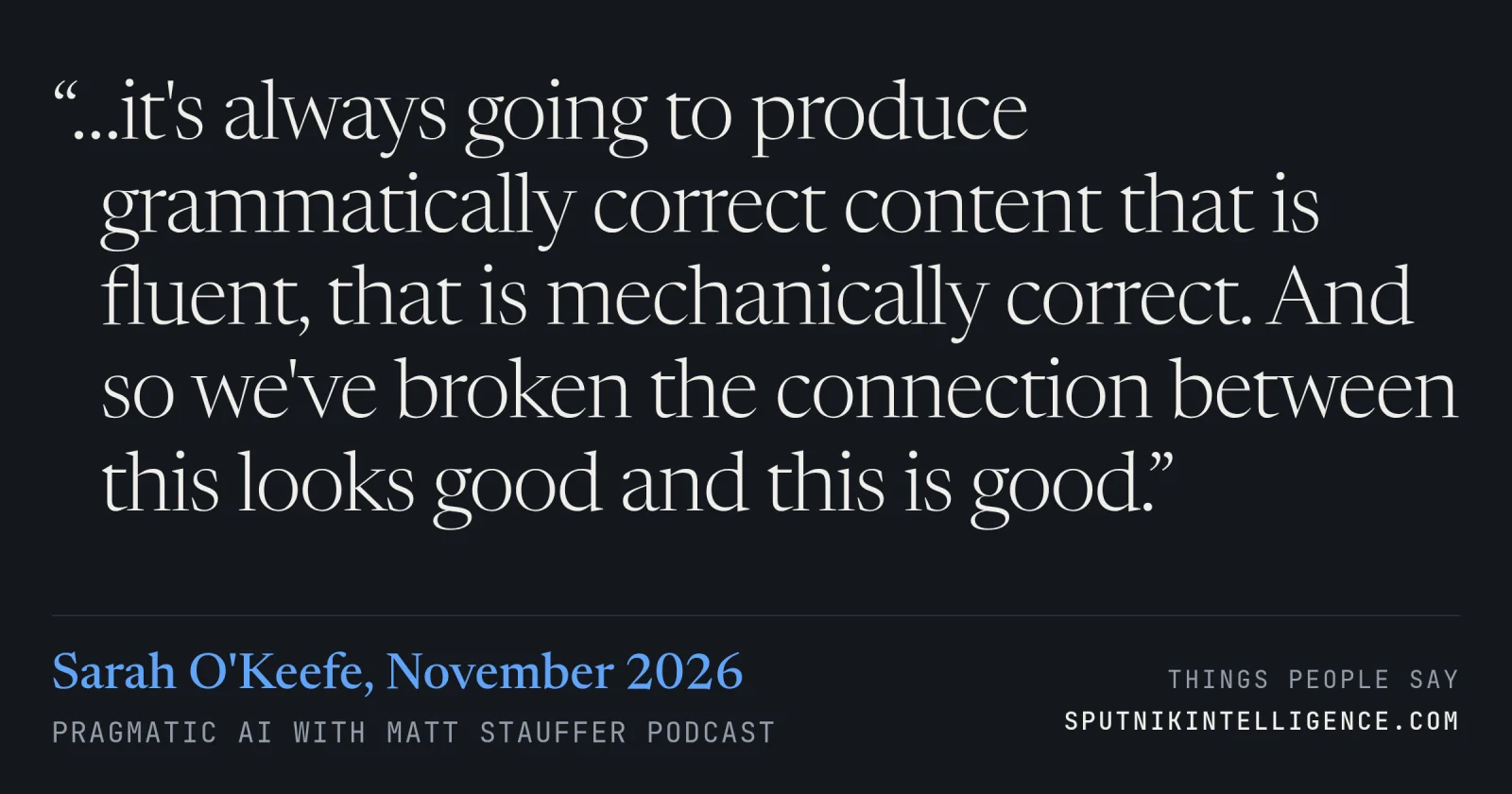
She was arguing that polish, grammar and fluency used to signal that someone had put real effort into content. AI now produces those qualities by default, whether or not the content is accurate.
Pragmatic AI with Matt StaufferAround 34:14 into the episode
Sarah O'Keefe
AI is a tool. And tools should be used in the context that they are good at doing. I mean, this is the old, if everything, you know, if you have a hammer, everything looks like a name. I was
Matt Stauffer
going to say the same thing. I mean, it's just
Sarah O'Keefe
so dumb, but of course it's true. Fundamentally, in order to get the AI to produce useful content, you have to feed it useful content. And so if the input is garbage, the output, I mean, this is just all cliches, right? But people decided that what they could do was take a bunch of unmanaged, unstructured, unvetted, unupdated, unaccurate information and dump it into an AI and it would magically come out pristine on the other end. Now, here's the key thing: it comes out looking pristine.
Matt Stauffer
Yes.
Sarah O'Keefe
It's very lovely, looks great. And the problem is, this is the fundamental issue that we have with AI. I think cognitively, when you see something that looks pretty, you assume it's accurate. The grammar is good.
Matt Stauffer
The writing is structured well. It's
Speaker names come from our own diarization. The position is estimated from where the line sits in the episode.
Matt Stauffer asked for her most controversial take on AI in the closing speed round. She says companies adopted AI hoping for savings, and now none will be the first to pull back.
Pragmatic AI with Matt StaufferAround 41:32 into the episode
Sarah O'Keefe
Honestly, whichever one is lying in front of me, I don't care. They're all terrible.
Matt Stauffer
Okay. Wow. You are the first person who's answered that way. I'm not supposed to comment on your answers here as a speed round, but wow, I'm fascinated. All right. Second question. Have you ever cussed out an AI?
Sarah O'Keefe
No, I point and laugh a lot and take screenshots and share them. You know, when you ask the AI Fails question, this is the experiment I would ask people to do. Ask the AI Fails question about something that you are an expert in. Maybe it's knitting, maybe it's video games, I don't know, something, right? Ask it a question. Nearly always the first answer you get is pretty good, and then ask it for more details. And as you go down that rabbit hole, it'll get worse and inaccurate. Okay. And then ask it a question about something you don't know anything about and do the same thing. And notice that as you go down the rabbit hole, you think it looks okay.
Matt Stauffer
Yeah.
Sarah O'Keefe
And then think about that carefully.
Matt Stauffer
That's so good. I'm going to make my kids do that. Thankfully, my kids don't do a lot of AI, but still I'm like, I need the baseline understanding, you know, about that. All right. What is one pro usage of AI more people should be using?
Speaker names come from our own diarization. The position is estimated from where the line sits in the episode.