DK

Dave Kerr

Things Dave Says on Podcasts

Where to Find Them

Dave Kerr has been a guest on The Changelog (2 times) .

Recently: “We now have Kerr’s Law (Interview)” on The Changelog (November 2026); “Laws for hackers to live by (Interview)” on The Changelog (July 2020).

What They Said

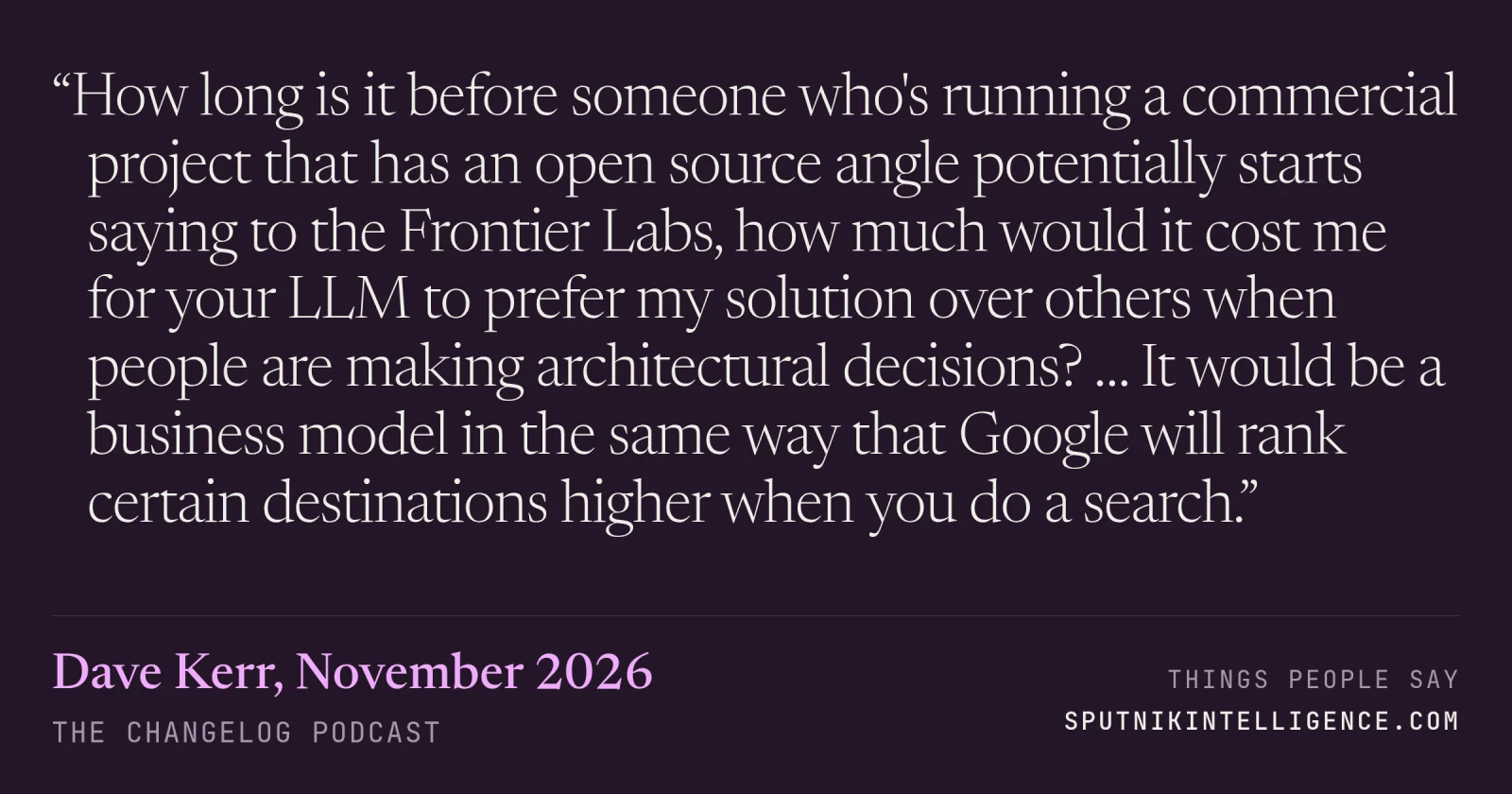
“How long is it before someone who's running a commercial project that has an open source angle potentially starts saying to the Frontier Labs, how much would it cost me for your LLM to prefer my solution over others when people are making architectural decisions? … It would be a business model in the same way that Google will rank certain destinations higher when you do a search.” — Dave Kerr, The Changelog

Discussing how open source is changing in the LLM era, Kerr speculates that model makers could one day sell preference for particular tools in the architecture advice their models give developers.

The Changelog · 2026-11-04 Permalink → Listen →
The Changelog Around 45:54 into the episode
Dave Kerr

…It's a space where LLMs have a preference for certain types of technology and patterns because the corpus of training data says you should use bun for this, you should use whatever it is for this. So I don't know, Adam. What do you think? I mean, you talk to so many people. How do you feel about

Adam Stacoviak

…your code out there in open source and you've got cybersecurity concerns now. Well, now because an LLM is so skilled, you can find the loopholes and the issues in. I mean, this is an absolute bloodbath of sorts in the NPM ecosystem, for example. I mean, like, it's just everywhere. So I'm not sure

Dave Kerr

…about when it comes to, say, capitalism, how long is it before someone who's running a project, commercial project that has an open source angle, potentially starts saying to the Frontier Labs, how much would it cost me for your LLM to prefer my solution over others when people are making architectural decisions? You know, and I'm not going to name any companies' names here because I get it. It would be a business model in the same way that Google will rank certain destinations higher when you do a search. That's how they monetize that. The LLMs have a lot of influence now into making architectural decisions, some of them very consequential architectural decisions. If you're working with a bank and some of your advice is coming from a model, that's potentially going to lead to a very consequential long-term relationship and decision.

Adam Stacoviak

Yeah. You may choose to build something versus buy it when you could have just bought it or bought the open source version of it. That's what I mean by build versus buy. Like use somebody else's thing. Literally buy it or get it for free via open source. You may find yourself, if you listen to only…

Dave Kerr

Yeah. And it is tested to absurd degrees now.

Adam Stacoviak

Absolutely.

Speaker names come from our own diarization. The position is estimated from where the line sits in the episode.
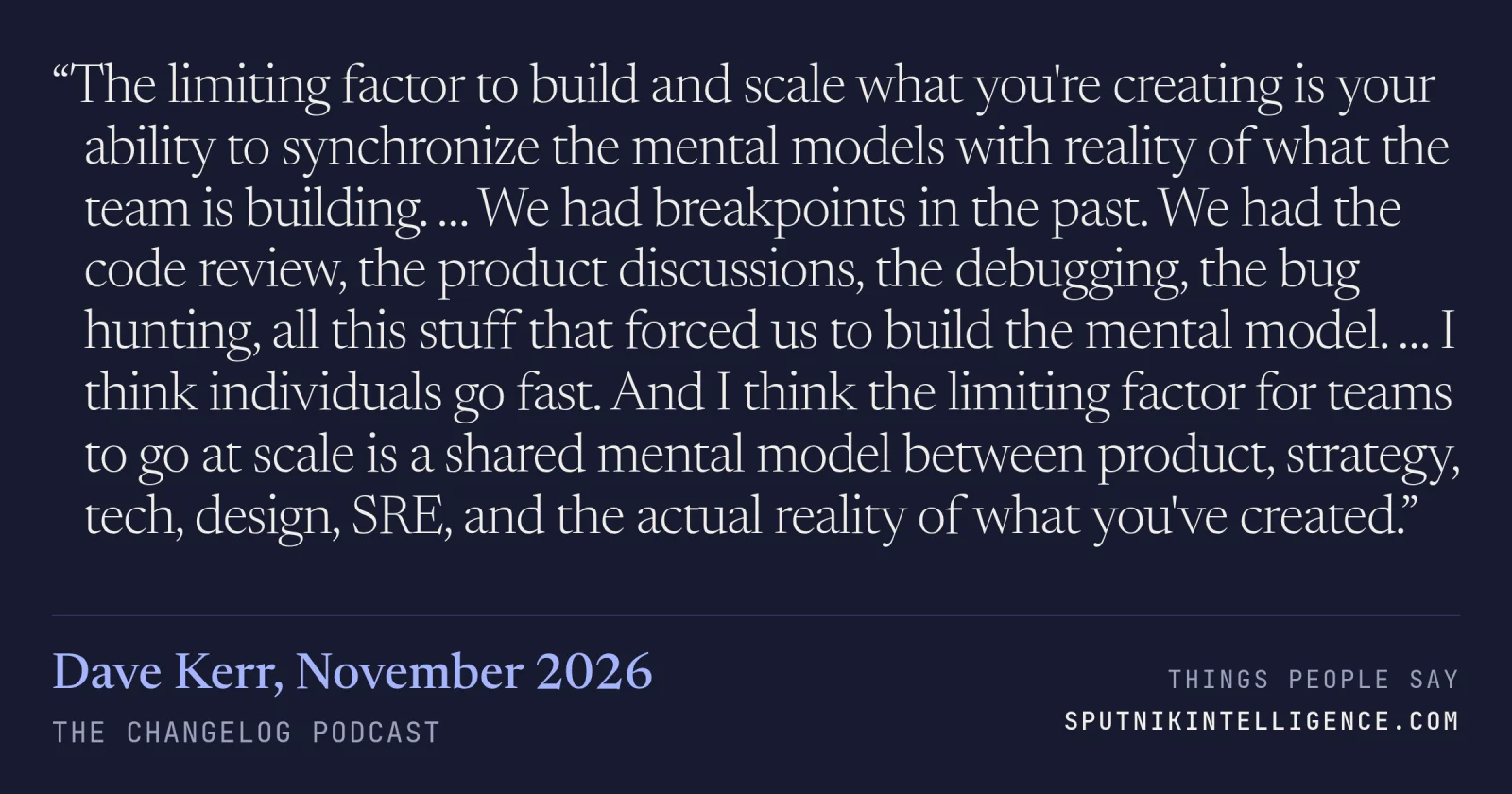
“The limiting factor to build and scale what you're creating is your ability to synchronize the mental models with reality of what the team is building. … We had breakpoints in the past. We had the code review, the product discussions, the debugging, the bug hunting, all this stuff that forced us to build the mental model. … I think individuals go fast. And I think the limiting factor for teams to go at scale is a shared mental model between product, strategy, tech, design, SRE, and the actual reality of what you've created.” — Dave Kerr, The Changelog

Put on the spot to coin a hacker law of his own, Kerr gives this answer, which the host immediately named Kerr's Law. It argues that with agents writing code, the bottleneck for teams is shared understanding, not output.

The Changelog · 2026-11-04 Permalink → Listen →
The Changelog Around 59:01 into the episode
Dave Kerr

Okay.

Adam Stacoviak

…mean that you've got some history and some skill and some experience when I say that is what I mean by that. Could you invent a Kerr’s Law (Interview) here right now, given where we're at? Is there a law or some sort of thing on repeat that you can coin in this moment? Or is that too much pressure?

Dave Kerr

…does. And we had breakpoints in the past. We had the code review, the product discussions, the debugging, the bug hunting, all this stuff that forced us to kind of like, okay, build the mental model. Like, oh, I see there's a thing here. I see there's like a gate here. I see there's a reverse proxy there. I didn't know that before now, but my mental model is close to what the system is. And I think individuals go fast. And I think the limiting factor for teams to go at scale is a shared mental model between product, strategy, tech, design, SRE, and the actual reality of what you've created.

Adam Stacoviak

Wow. Kind of just want to pause for a second and just like steep myself in that. Dude, you did a great job. Okay. You were like, no, I can't do that, but you just did it. Okay. You just curse law to us, right? Okay. Let's put that down and make that a law because that's so true. I find maybe this…

Dave Kerr

Yeah. And it doesn't make for a happy team. I talk to so many engineers and the conversations are always a bit like, you know, when you say, how's it going? There's this kind of like slight grimace of like, yes, it's good. It's good. Yeah, it's good. And they're like, yeah, but it's busy, isn't it?…

Adam Stacoviak

I love the fact that you use the word maladaptive versus bad. You know, like someone will say bad, but maladaptive is actually maybe the better term to use in that kind of case because it's like, it's not good or it's bad. It's just like, it's just sort of in there as a different case though. But…

Speaker names come from our own diarization. The position is estimated from where the line sits in the episode.

Collections They Appear In