LH

Lisa Hansmann

Things Lisa Says on Podcasts

Where to Find Them

Lisa Hansmann has been a guest on Volts .

Recently: ““Repowering” worn out solar fields could create gigawatts of new grid capacity, quickly” on Volts (November 2026).

What They Said

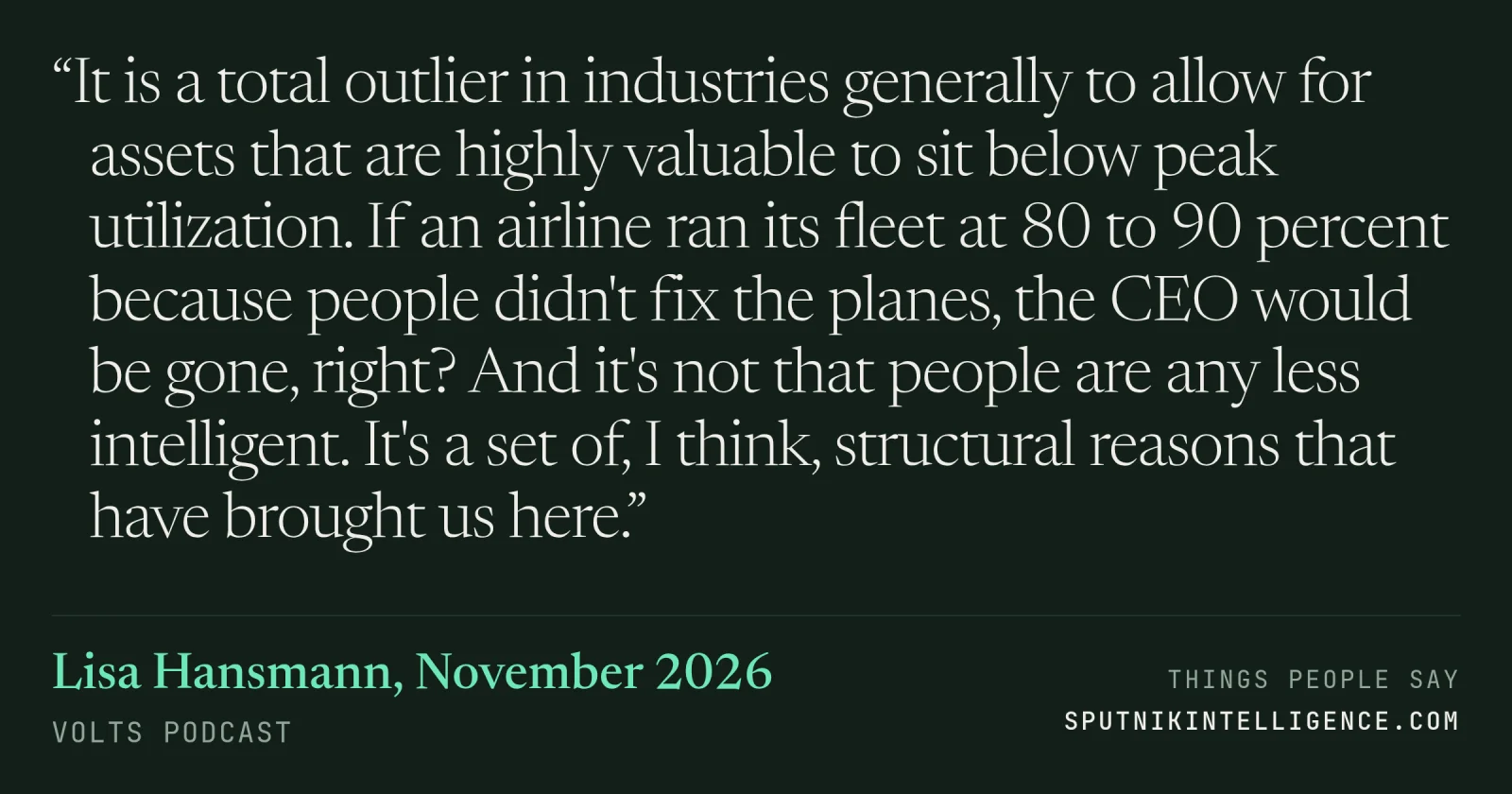
“It is a total outlier in industries generally to allow for assets that are highly valuable to sit below peak utilization. If an airline ran its fleet at 80 to 90 percent because people didn't fix the planes, the CEO would be gone, right? And it's not that people are any less intelligent. It's a set of, I think, structural reasons that have brought us here.” — Lisa Hansmann, Volts

The host asked why the installed US solar fleet is producing about 10% less than forecast. She explains that tax credits reward deployment and short ownership periods, so owners neglected operations, and frames chronic underperformance as a design flaw of the industry.

Volts · 2026-11-18 Permalink → Listen →
Volts Around 17:05 into the episode
Lisa Hansmann

Correct.

David Roberts

We're finding more than we thought, basically. They're degrading more and faster than we thought. And what explains that?

Lisa Hansmann

So, it's exactly as you said. If you look at the work that Kilowatt Analytics has done in this space, they see roughly 7% to 13% below what we call P50, which is kind of the median production estimate that you're underwriting into a solar model relative to 2015. And the why, I think, is super interesting because it is a total outlier in industries generally to allow for assets that are highly valuable to sit below peak utilization. Like, if an airline ran its fleet at 80 to 90 percent because people didn't fix the planes, like the CEO would be gone, right? And it's not that people are any less intelligent, right? It's a set of, I think, structural reasons that have brought us here. And one is that the financial incentives around the industry up until now have in many ways supported an install and forget mindset where there's been a focus on deployment over operations. And I say this as someone who left a lot of blood and teeth on the floor in IRA implementation and believes in the value of deployment deeply. Tax credits reward getting steel in the ground and the ownership model associated with tax credits, deploying and owning a site for…

David Roberts

is there also an element of like, these are smaller fields we're talking about, especially at the beginning? So like if you're a Costco or whatever, or you're a community board or whatever, you're not an energy CEO. You're not necessarily hip. You're not monitoring the output. You know what I mean?…

Lisa Hansmann

For sure. And you were also sold a panel. Presumably in that sales pitch, it didn't really include much around, you know, the upkeep. But also, I think the reality is even for the most sophisticated distributed solar owners, it is incredibly and deceptively hard to maintain these assets, not…

David Roberts

Yes, yes, interesting. But just on a concrete level, inverters. Yes. You know, every solar field goes through inverters on the way to the grid. Inverters are not rated for 25 years. I think they're rated for 15. So, I mean, I don't know if you can generalize yet. You're early on, but like in…
Speaker names come from our own diarization. The position is estimated from where the line sits in the episode.
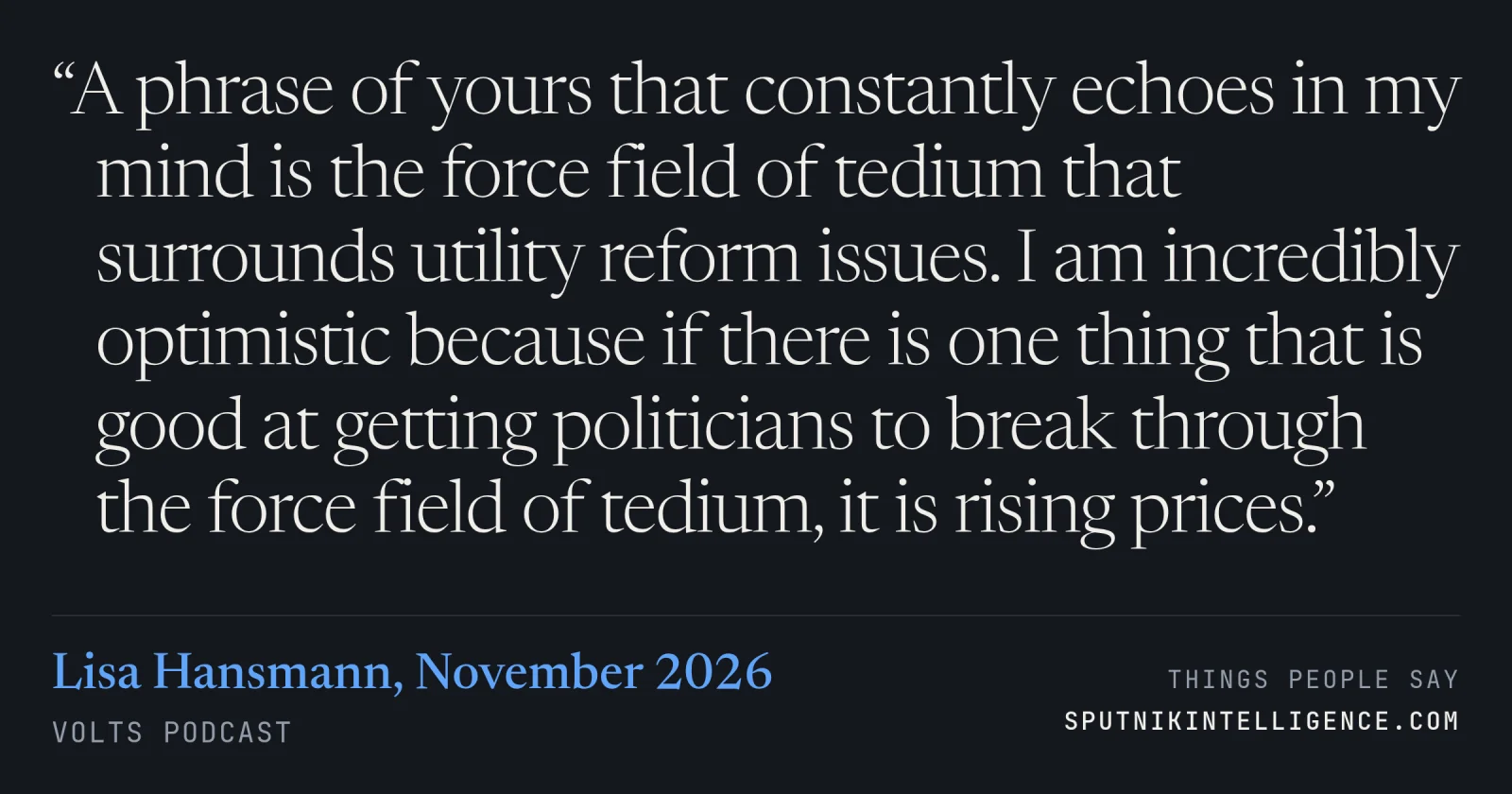
“A phrase of yours that constantly echoes in my mind is the force field of tedium that surrounds utility reform issues. I am incredibly optimistic because if there is one thing that is good at getting politicians to break through the force field of tedium, it is rising prices.” — Lisa Hansmann, Volts

David Roberts had just argued that utility compensation for repowered solar-plus-battery sites should be set by a market, not by utility staff picking numbers. She answers that rising electricity prices will force politicians to fix utility rules, opening by quoting his phrase "the force field of tedium".

Volts · 2026-11-18 Permalink → Listen →
Volts Around 57:19 into the episode
Lisa Hansmann

…solar. And so there should be even more of a demand pull there. Those are some of the fastest capacity sources that exist. I mean, if I think about the political economy of this moment and the vertically integrated monopoly as a business model, I think it's going to come under a lot of pressure.

David Roberts

…I mean, this is a perfect place for a market. Like, how much is a repowered site with a battery worth? We ought to have a market determining that value. That's what markets are good for, right? Exactly. Instead of like Duke people scratching their heads in an office somewhere and making up numbers.

Lisa Hansmann

I can't remember if we put this in the foreign affairs piece or not, but a phrase of yours that constantly echoes in my mind is the force field of tedium that surrounds utility reform issues. I am incredibly optimistic because if there is one thing that is good at getting politicians to break through the force field of tedium, it is rising prices. And again, my introduction to energy markets was through oil and gas, where I lived firsthand what it looks like to have the gas price, which is the most economically significant number in the U.S. economy. The average human being sees it five to six times every day. I had the experience of watching that go up to $5.16, a number that has burned in my mind, right, forever. And I saw what it…

David Roberts

Right. All these data centers that are looking for capacity, they're now starting to buy distributed capacity. And obviously, these small to mid-sized solar fields with batteries. And like data centers have a lot of money. They're willing to pay for rapid time to power. Yeah. So this seems like a…

Lisa Hansmann

Right, exactly. And so in Duke territory, if they wanted to pay, they couldn't today until there's reform. And I expect there to be a lot of pressure on that business model.

David Roberts

You're expecting legislators and PUCs basically to like be under pressure. And eventually they're going to stumble across this giant already existing resource under their feet and pass rules to unlock it, basically, pass rules to make it easier to do this.

Speaker names come from our own diarization. The position is estimated from where the line sits in the episode.

Collections They Appear In