Roberts and Jensen are discussing agrivoltaics and the pushback against solar farms on Danish farmland. Jensen says that growing crops in the semi-shade under panels is still an early experiment, and that biodiversity has to be designed in from the start.
A lot of agrivoltakes in the US, I think, are being built around grazing. But as I understand it, most of the livestock in Denmark is pigs. I don't know if it works as well. I don't think it'll work as well around pigs. I don't think they're as friendly to.
I think we
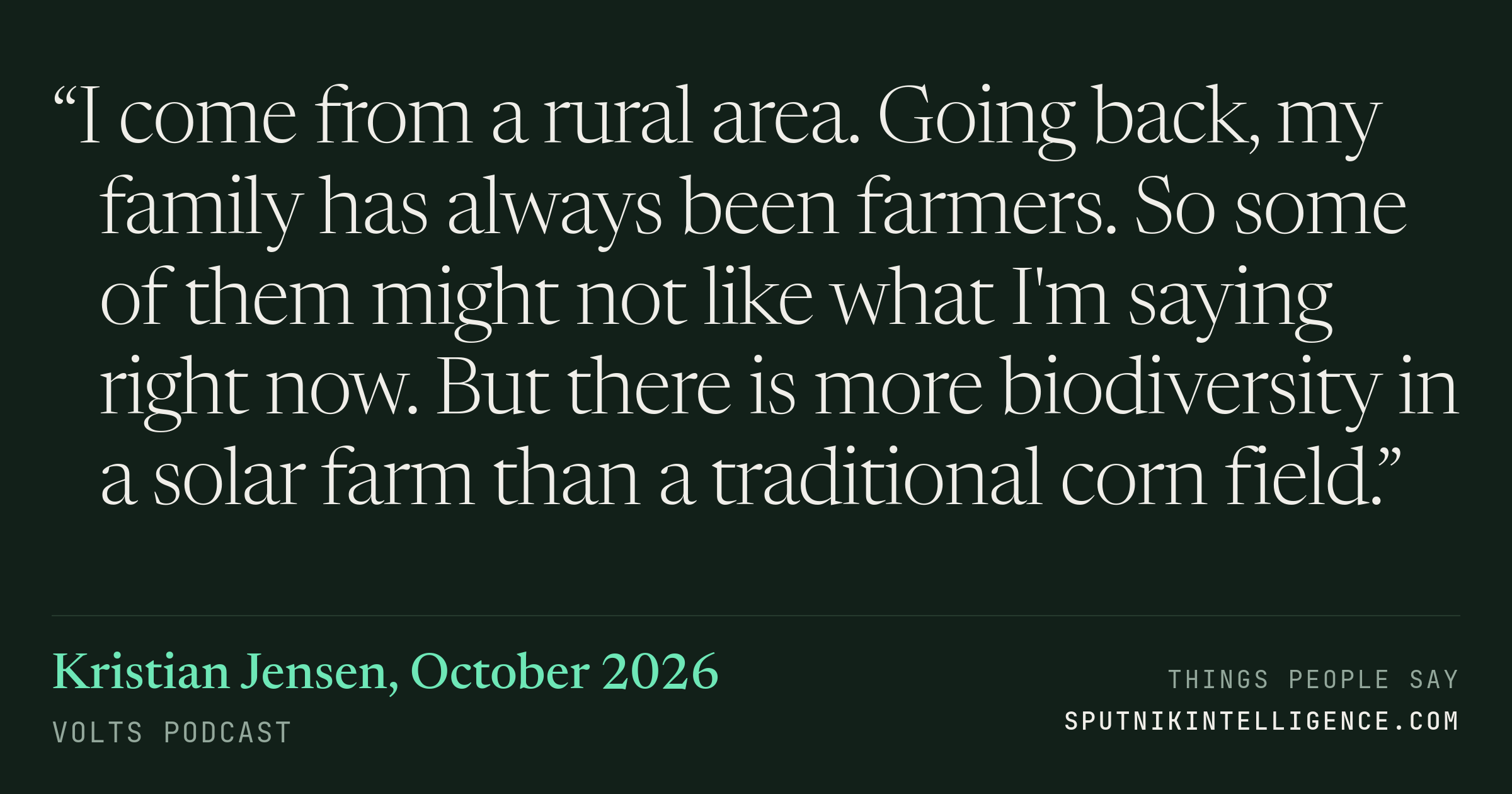
see in the beginning a lot tried to have sheeps together with the solar farm. And what we're seeing right now is some kind of planted crop being used. There are crops that are actually working best in some kind of semi-shadow areas. So it could be under the solar panels. But it needs to be taken into account from the beginning. And it's still early days in exactly how to do that moving forward. We are looking into that and we're trying to also look into how to create biodiversity around the solar farm so that you can actually add to biodiversity. I come from a rural area. Going back, my family has always been farmers. So some of them might not like what I'm saying right now. But there are more biodiversity in a solar farm than a traditional corn field.
Yes.
Because the field, the corn or wheat or barley or whatever you have. It's a
monocrop, right? It's a monocrop. And