TS

Tanya Snook

Things Tanya Says on Podcasts

Where to Find Them

Tanya Snook has been a guest on NN/G UX Podcast and UX Podcast .

Recently: “UX Theatre is Still a Problem (feat. Tanya Snook) | EP 66” on NN/G UX Podcast (November 2026); “#267 UX Theatre with Tanya Snook” on UX Podcast (July 2021).

What They Said

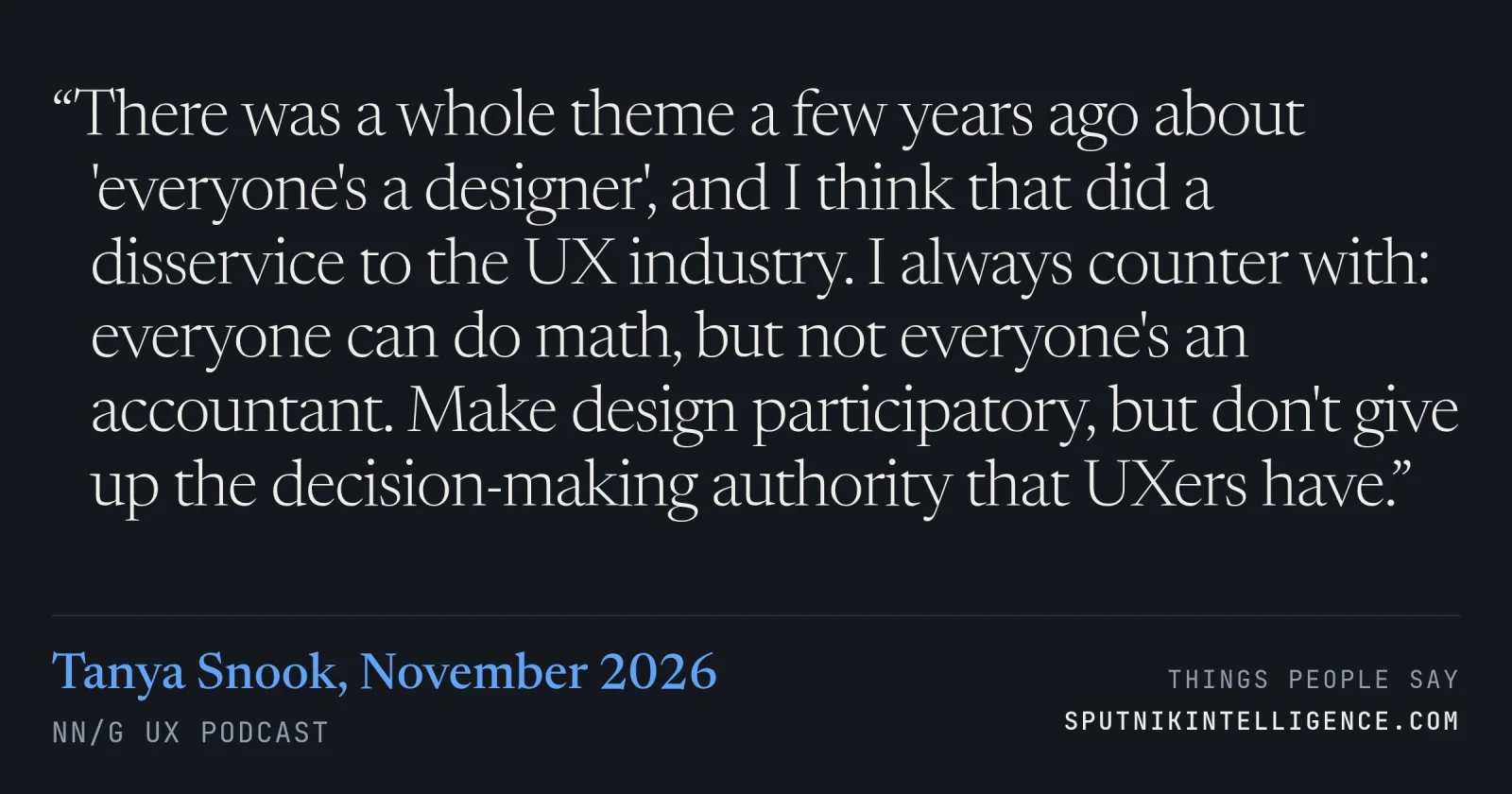
“There was a whole theme a few years ago about 'everyone's a designer', and I think that did a disservice to the UX industry. I always counter with: everyone can do math, but not everyone's an accountant. Make design participatory, but don't give up the decision-making authority that UXers have.” — Tanya Snook, NN/G UX Podcast

Asked what practitioners can do about 'UX theater' (user-centred work done for show), Tanya lists evangelizing, researching a few sprints ahead of developers and asking 'who says?'. She adds that collaboration shouldn't mean giving away design authority.

NN/G UX Podcast · 2026-11-05 Permalink → Listen →
NN/G UX Podcast Around 22:46 into the episode
Tanya Snook

…models, right? Like that's that's that's where it comes into play where you're relating to your different audiences by giving them something that they can relate to without necessarily having them fully understand everything that's involved in UX. So yeah, that's another good way to look at it.

Therese Fessenden

Yeah. Now, okay, I imagine now that there are some people listening who are like, oh no, this is me. This is my team. I didn't realize we were doing this. Do you have any suggestions on what do you think is the best intervention? Is an intervention appropriate? I guess is a better question.

Tanya Snook

There's a lot of stuff that you can actually do no matter what level you're at. And I've written a whole bunch of articles because that was a question that I kept getting from everybody is: okay, but what can I do? You know, I'm a leader or I'm just a practitioner. And really, we have to, I don't know why it is, but UXers, for some reason, we're a profession that has to evangelize constantly in order to be able to have permission to do our jobs. It's a very weird thing, but it's a very real thing. And I don't know if it's because we're still kind of nascent, you know, that like general accounting practices have been around for decades and decades and decades, but like UX practices kind of evolve, especially when you throw AI into the mix or you throw, you know, the evolution even in my career from hand-coded HTML pages to, you know, modular design systems and reactive, interactive pages and applications. So I think evangelizing is definitely something, you know, constantly bringing people back to the fact that there is a process, we should be following it. This is what we've…

Therese Fessenden

Yeah. I feel like that's even more true now than ever before because you have Claude and various AI tools that people are saying, does UX for you? And every time I see it, it's like, I can't watch because I already know there are so many decisions and assumptions that are being made because we can…

Tanya Snook

We have to be careful not to replace ourselves, intentionally replace ourselves with AI. You know, if you're going to do research and you're going to go in and collect all this data, why would you give the computer the ability to analyze that? Like, where's your learning going to happen? How are…

Therese Fessenden

Yeah. And I mean, even thinking, even if you do use design thinking, right? Like the phrase empathize is literally the first step. And if there is no outsourcing, empathy. And as much as Claude might be, you know, start to reach the uncanny valley where it almost seems like it's empathizing and…
Speaker names come from our own diarization. The position is estimated from where the line sits in the episode.
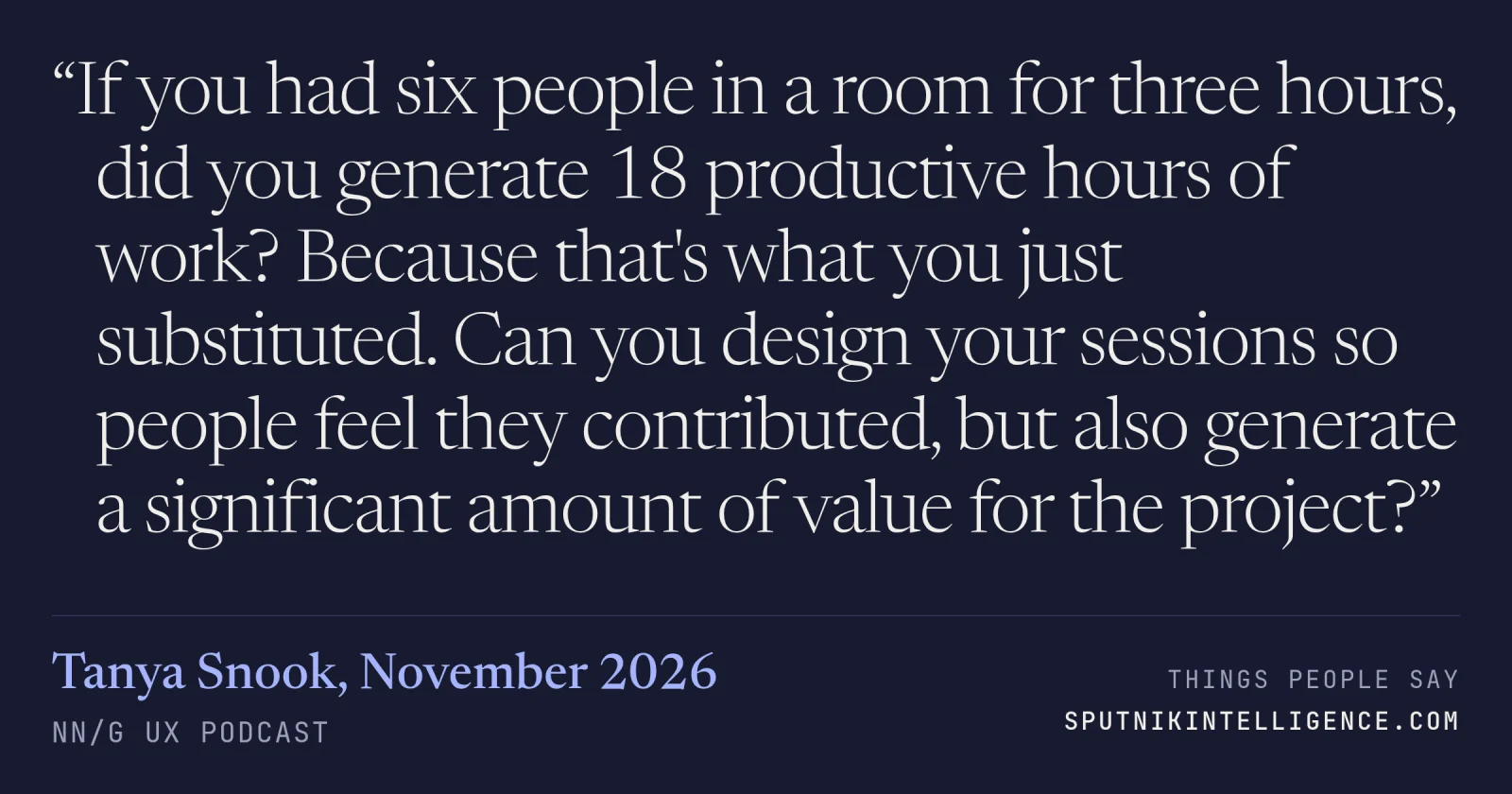
“If you had six people in a room for three hours, did you generate 18 productive hours of work? Because that's what you just substituted. Can you design your sessions so people feel they contributed, but also generate a significant amount of value for the project?” — Tanya Snook, NN/G UX Podcast

Asked for signs that a workshop is performative rather than grounded, Tanya lists no clear outcomes, generic activities and mistaking silence for consensus, then offers this cost test of multiplying attendees by hours.

NN/G UX Podcast · 2026-11-05 Permalink → Listen →
NN/G UX Podcast Around 14:14 into the episode
Tanya Snook

Exactly. Exactly. How old is your data? Is it stale? Yeah.

Therese Fessenden

…there are certain types of workshops that are maybe a little bit more performative than we realize versus some that are genuinely helpful. Are there certain signs that people should be looking for to figure out, like, am I doing something in a truly grounded way or am I not? Like, any tips there?

Tanya Snook

Yeah, for sure. This is definitely part of my wheelhouse is design and collaboration. And, you know, you can go into these sessions and see there's a lot of conversation, but there's no clear outcomes. You know, people might be walking out of a workshop and thinking, what did we just do? Or what are we going to do with any of that? Right. Like, I don't really, I don't really understand what just happened. And often that's from a lack of preparation. That's from a lack of clear goals and clear outcomes and really understanding what people need to do with the outputs the next day. So maybe even it's a lack of good documentation coming out of a workshop and translating those outputs into something useful. It could also be activities that get generic output. So as I was talking about this workshop, this roadshow that went across the country, you know, that was a poor selection and design of activities because the questions weren't targeted enough to get anything meaningful. And they hadn't really done the legwork ahead of time to figure out what…

Therese Fessenden

Yeah, that's a really helpful framing: the 18 hours of productive work. And I think if you pitched that to people, it would probably stop them in their tracks of like, wait, that's a lot of time, right? And maybe in retrospect, if they were thinking about the actual outcome that they wanted, it's…

Tanya Snook

It's not a methodology. You know, if you break it down and you look at where it comes from and how the framework was defined, it's not a methodology. It's a concept. It's a mental model. And it's really meant to show how design flows into itself, how the aspects of the design methodology flow, and…

Therese Fessenden

Absolutely. And I mean, and I often joke too, like in the class, like if you, if you Google Google Images or whatever design thinking framework, there's like probably dozens of different versions of the framework, but a lot of them have a similar, like you're saying, a similar structure where it's…

Speaker names come from our own diarization. The position is estimated from where the line sits in the episode.

Collections They Appear In