RT

Roberto Tallarita

Things Roberto Says on Podcasts

Where to Find Them

Roberto Tallarita has been a guest on The Lawfare Podcast , The Lawfare Podcast: Patreon Edition and Scaling Laws .

Recently: “Lawfare Daily: Anthropic’s Safety Mission vs. Public-Company Pressure with Professor Robreto Tallarita” on Scaling Laws (November 2026); “Lawfare Daily: Anthropic’s Safety Mission vs. Public-Company Pressure” on The Lawfare Podcast: Patreon Edition (November 2026); “Lawfare Daily: Anthropic’s Safety Mission vs. Public-Company Pressure” on The Lawfare Podcast (November 2026).

What They Said

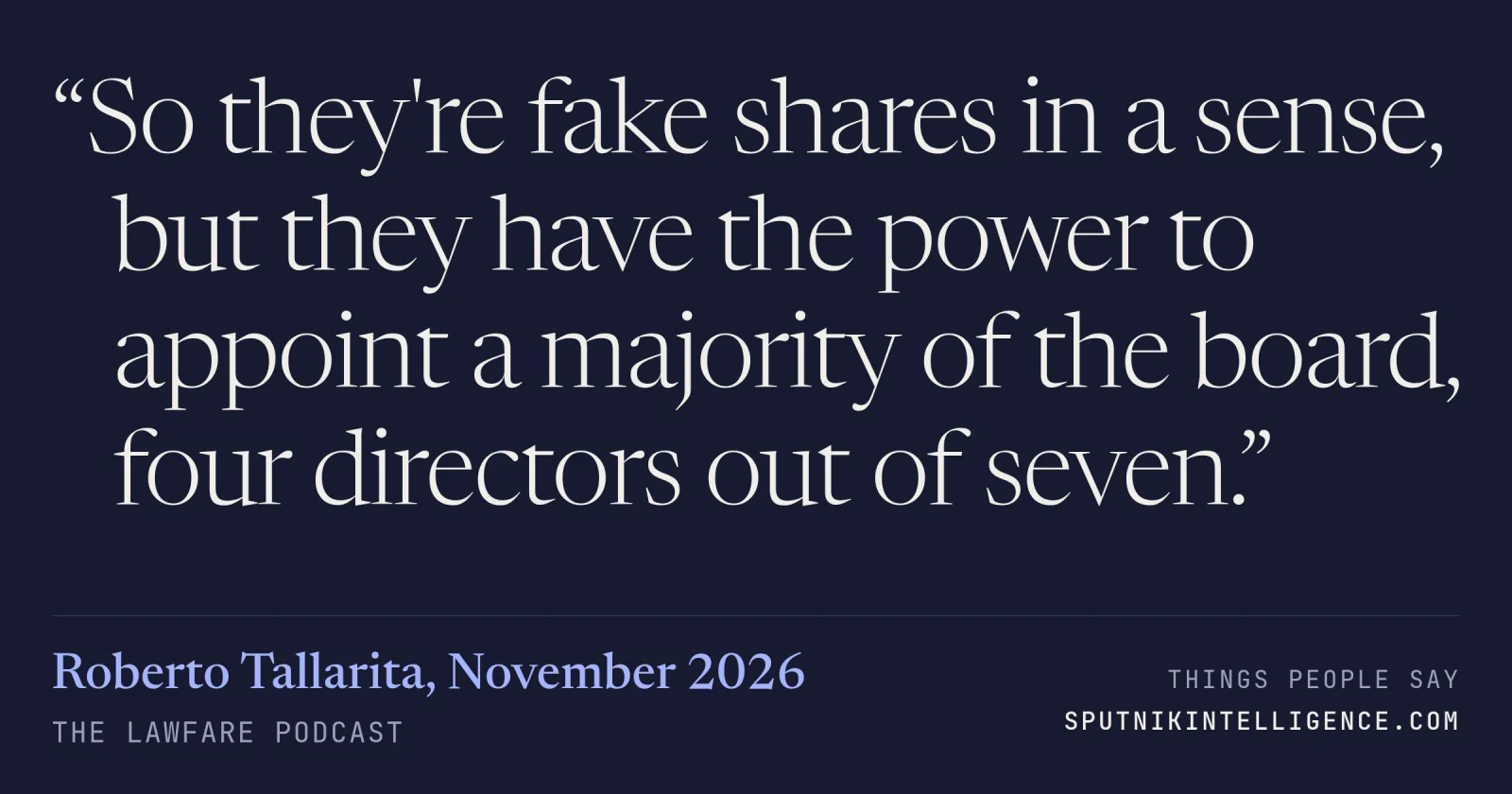
“So they're fake shares in a sense, but they have the power to appoint a majority of the board, four directors out of seven.” — Roberto Tallarita, The Lawfare Podcast

Tallarita is describing the Class T shares held by Anthropic's long-term benefit trust, as laid out in its IPO filing. They carry no other voting rights and no economic rights, yet they let the trust pick four of seven directors, which he calls a pretty radical move.

The Lawfare Podcast · 2026-11-10 Permalink → Listen →
The Lawfare Podcast Around 33:46 into the episode
Roberto Tallarita

…of shares they have. So this is like kind of normal for tech companies. The founders will be in control even if they. Won't no, they will no longer own a majority of the company. But the new thing is the T shares, which is the class of shares in the hands of the long, whatever it's called. The

Kevin Frazier

long-term benefit trust, yes.

Roberto Tallarita

So the T shares, which is the class of shares in the hands of the long-term benefit trust. So this is the idea behind the trust is that the trust, the trustees, are the guardians of the social mission. They should care about building AI for the benefit of humanity. And they have this unusual power despite having these shares with no other kind of voting rights and no economic rights. So they're fake shares in a sense, but they have the power to appoint a majority of the board, four directors out of seven. So the idea is that Anthropic is trying to tell the world we really care about this. We really care about our social mission. We not only choose a public benefit corporation, but we know that, you know, the public benefit corporation, I mean, it's an interesting tool, but it's not that effective. So we actually give the power to appoint a majority of the board, not to the founders, not to the…

Speaker 1

Attention, industry innovators, Greinisches Revieu, the thriving investment hub in Germany, is now an official net zero valley. Good for the planet, great for your business. As part of the Net Zero Valley Network, the region now offers even greater opportunities for investors and green tech…

Kevin Frazier

So we've got this long-term benefit trust. They control the majority of the board. The other three members will be made up of some mix of the founders, and they'll have an opportunity to weigh in on those decisions as well. But again, not a majority. The LB long-term benefit trust will have that.…

Roberto Tallarita

So this is very interesting because If you start digging deeper in the structure, you start seeing details that might become very important in case of a disagreement between profit and the social mission. So it is true that the trust, as we said, appoints four directors out of seven, so a majority.…

Speaker names come from our own diarization. The position is estimated from where the line sits in the episode.
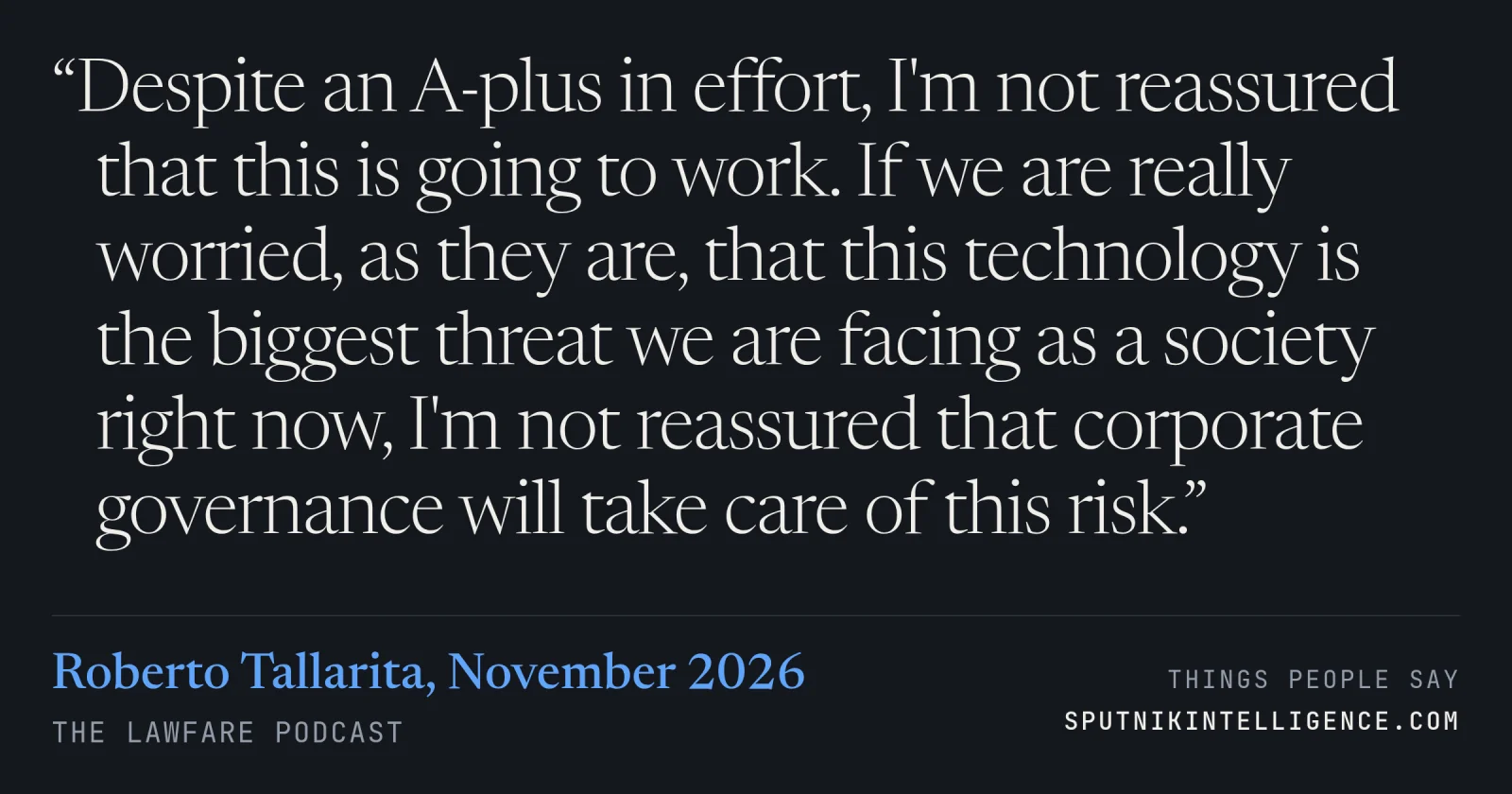
“Despite an A-plus in effort, I'm not reassured that this is going to work. If we are really worried, as they are, that this technology is the biggest threat we are facing as a society right now, I'm not reassured that corporate governance will take care of this risk.” — Roberto Tallarita, The Lawfare Podcast

Tallarita had just said Anthropic's S-1 shows real thought about governance and is not a marketing ploy, and that it spends far more space on profit-versus-mission trade-offs than other public benefit corporations. He then gives his bottom line: sincere effort, but corporate governance may be the wrong tool for a risk of this size.

The Lawfare Podcast · 2026-11-10 Permalink → Listen →
The Lawfare Podcast Around 19:05 into the episode
Roberto Tallarita

…were about shareholders complaining that the boards care too little about them and about profit making. So, weren't really cases about enforcing the social, the social purpose, which is not surprising. That's what shareholders are there for. They're trying to make some money with this investment.

Kevin Frazier

But that's just such a great thing to point out, though, about this design of PBCs to begin with. The only people who can enforce it are most interested in one prong of the balancing.

Roberto Tallarita

…I mean, this is marketing, but I'm not sure. I mean, I have no insider information into the company, but I've, you know, reading the effort here and talking to people who have been closer to this effort, I'm pretty confident that they are sincerely trying to pull off this very difficult balance between purpose and profit. But the reality is that it's very, very hard. And I'm not very reassured. Despite an A-plus in effort, I'm not reassured that this is going to work. If we are really worried, as they are, that this technology is the biggest threat we are facing as a society right now, I'm not reassured that corporate governance will take care of this risk.

Kevin Frazier

So we know that there are certainly going to be shortcomings with a sort of corporate governance alone as the mechanism to avoid some of those worst case outcomes. And as you noted previously, boards traditionally have been thought of as having a hyper-focus on the financial interests. We mitigate…

Roberto Tallarita

So this is the most interesting and creative part of Anthropic's governance structure. But let me immediately say something that will, it's kind of surprising. And the long benefit trust is not 100% focused on safety. Even the trust has a triple mission, as it were. So it has to balance profit…

Kevin Frazier

And just to pause there for one second for the folks who don't read S1s for a living, right? This is the dual class structure, or I guess in this case, multi-class structure, whereas normally we would have one class of shares, every share would get one vote, and this is sort of the traditional. And…

Speaker names come from our own diarization. The position is estimated from where the line sits in the episode.
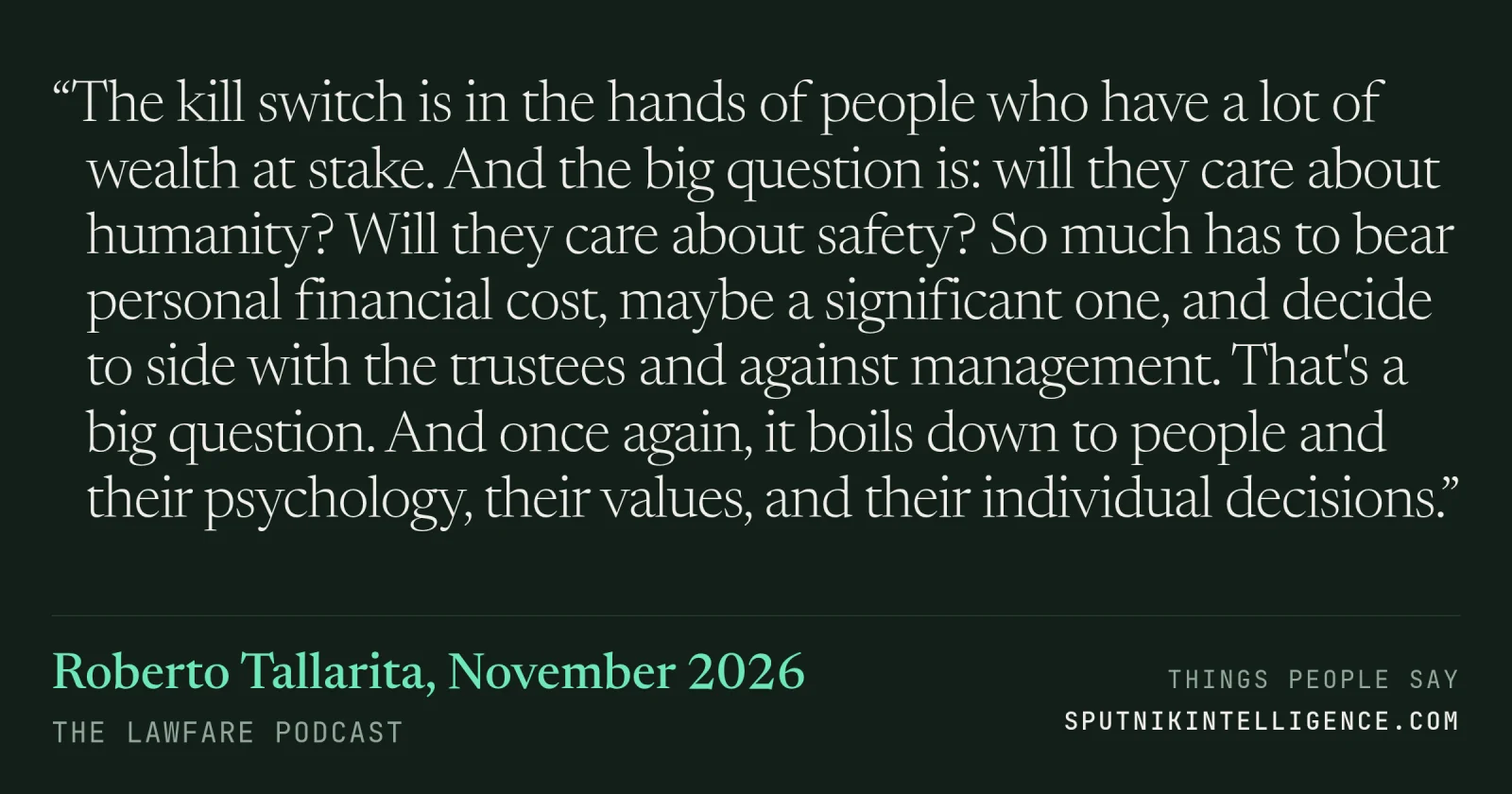
“The kill switch is in the hands of people who have a lot of wealth at stake. And the big question is: will they care about humanity? Will they care about safety? So much has to bear personal financial cost, maybe a significant one, and decide to side with the trustees and against management. That's a big question. And once again, it boils down to people and their psychology, their values, and their individual decisions.” — Roberto Tallarita, The Lawfare Podcast

Frazier asked how Anthropic's long-term benefit trust could be overridden if it went wrong. Tallarita explains that founders plus employees or other shareholders can band together to remove the trust's powers. His point is that every group able to do that has large personal wealth tied to the stock, which is the same pressure the structure is meant to insulate against.

The Lawfare Podcast · 2026-11-10 Permalink → Listen →
The Lawfare Podcast Around 44:02 into the episode
Roberto Tallarita

…is: will they have other kinds of pressures, internal, philosophical, moral, scientific, political? And I don't mean external pressure. I just mean beliefs and values and character and temperament, all kinds of factors that make the difference in terms of what kind of choices a person makes.

Kevin Frazier

…around the long-term benefit trusts in the event that it did go in a poor direction. What is that mechanism in brief? Because I know folks won't need to go fully into the S1, but at a high level, how do you get around the long-term benefit trust if it becomes a problem, for lack of a better phrase?

Roberto Tallarita

So there is a kill switch. There is the possibility for the founders and employees to band together and kill basically the trust. So to get rid of this control rights and control powers of the trustees. It's not easy to activate. There are all kinds of percentages based on different situations. And the important thing is that the founders cannot do this by themselves, which is an important protection. If you're looking at this structure and you're worried that trustees will be allowed to be guardians of the social missions only so long as they don't bother the founders too much, well, you will be reassured to know that the founders cannot fire the trustees or cannot get rid of the trustees unilaterally. They need to get substantial support from the employees as well, the owners of the so-called e-shares, which I guess stands for employees.

Kevin Frazier

Right. Or some combination of either the employees or of the other shareholders. But the fact of the matter remains that. The founders alone aren't going to be able to flip that kill switch.

Roberto Tallarita

Exactly. So, you need some broad consensus across the various constituencies, or at least some combinations of those constituencies to get rid of the trust of the trustees, which means that, I mean, in a sense, you need some mechanism like that. I don't see it as a loophole of the social mission…

Kevin Frazier

Well, just as we say that we've got a democracy or a republic if we can keep it, it sounds like we've got a safety-forward form of corporate governance if we can keep it. So, this will be a very interesting experiment. Roberto, thank you so much for covering a new alignment issue: rogue trustees…

Speaker names come from our own diarization. The position is estimated from where the line sits in the episode.

Collections They Appear In