JC

Jeffrey Cole

Things Jeffrey Says on Podcasts

Where to Find Them

Jeffrey Cole has been a guest on Schwab Network and Motley Fool Hidden Gems Investing .

Recently: “Why the Companies Most at Risk of Disruption Are Usually the Most Successful Ones” on Motley Fool Hidden Gems Investing (October 2026); “AI's Age of Disruption: NVDA, SPCX, INTC Threaten AAPL, MSFT, META Leadership” on Schwab Network (September 2026).

What They Said

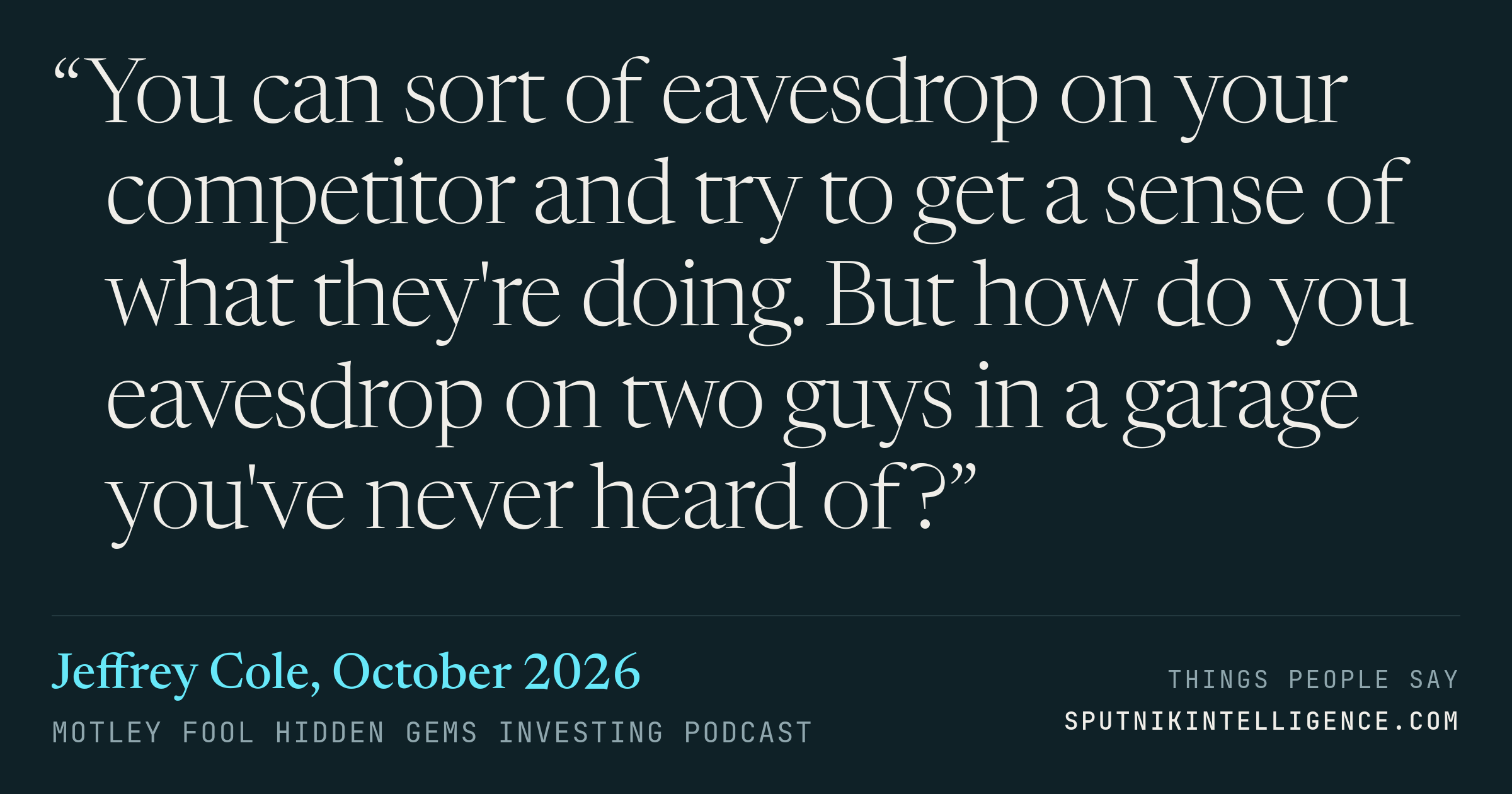
“You can sort of eavesdrop on your competitor and try to get a sense of what they're doing. But how do you eavesdrop on two guys in a garage you've never heard of?” — Jeffrey Cole, Motley Fool Hidden Gems Investing

Cole argues that innovation comes from your competitors but disruption comes from nowhere: retail was upended by a Seattle bookseller, not Walmart, and taxis by software people, not Hertz. His advice is to run your company as if you expect to be disrupted.

Motley Fool Hidden Gems Investing · 2026-10-18 Permalink → Listen →
Motley Fool Hidden Gems Investing Around 08:12 into the episode
Jeffrey Cole

…this year, you have speakers who foolishly are telling graduates living through the worst job market for graduates in the last 70 years in fear that there are no jobs. They're telling them all, seize the opportunity, learn AI, and it's booing and chic jeering. So this, this is the stakes are big.

Rachel Warren

It seems as though disruption almost never comes from where an industry or a company is watching. And I wonder, is there a discipline for auditing a company's vulnerability or an industry's vulnerability to these disruptive changes rather than just scanning the horizon?

Jeffrey Cole

It's darn tough because as you said, innovation comes likely from your competitor, figures out a better way to do what you do and may gain market share. Disruption comes from completely unexpected places. The disruption of the retail business should have come from Walmart or Target, not an upstart bookseller in Seattle. And the disruption of the taxi business, my God, was anything more ripe for disruption than taxis and are just should have come from Yellow Cab or Hertz or Avis, not a bunch of computer nerds in the Silicon Valley who knew nothing about transportation, but knew a lot about algorithms to make things happen. And the disruption of the automobile business should have come from Toyota or General Motors, not from a South immigrant, South African immigrant who didn't know much about transportation. So it does come from all these unexpected places. We use it in the subtitle of the book, but everybody knows this as two guys in a variage.…

Speaker 3

You just found out that your sales team is at risk of missing quota. Don't panic. Just ask Rippling AI. Since it's built on your real-time people and business data, Rippling AI can pull metrics from Rippling and Salesforce into a meeting-ready dashboard showing quota attainment, headcount plan, and…

Rachel Warren

You know, it's interesting because I think there's been a lot, as you noted, a lot of criticism as we're watching the AI revolution. There's been some concerns of people trying to trade. A feared AI bubble to what happened during the dot-com meltdown, which, as you mentioned, was chiefly related to…

Jeffrey Cole

Well, it's a different situation with what we're seeing with AI now, but already market analysts are saying AI and the AI, what they're calling the AI bubble, was the only thing keeping the stock market growing and that it is ripe for collapse. The valuations we're about to see the IPOs of…
Speaker names from our own diarization · position estimated from where the line sits in the episode
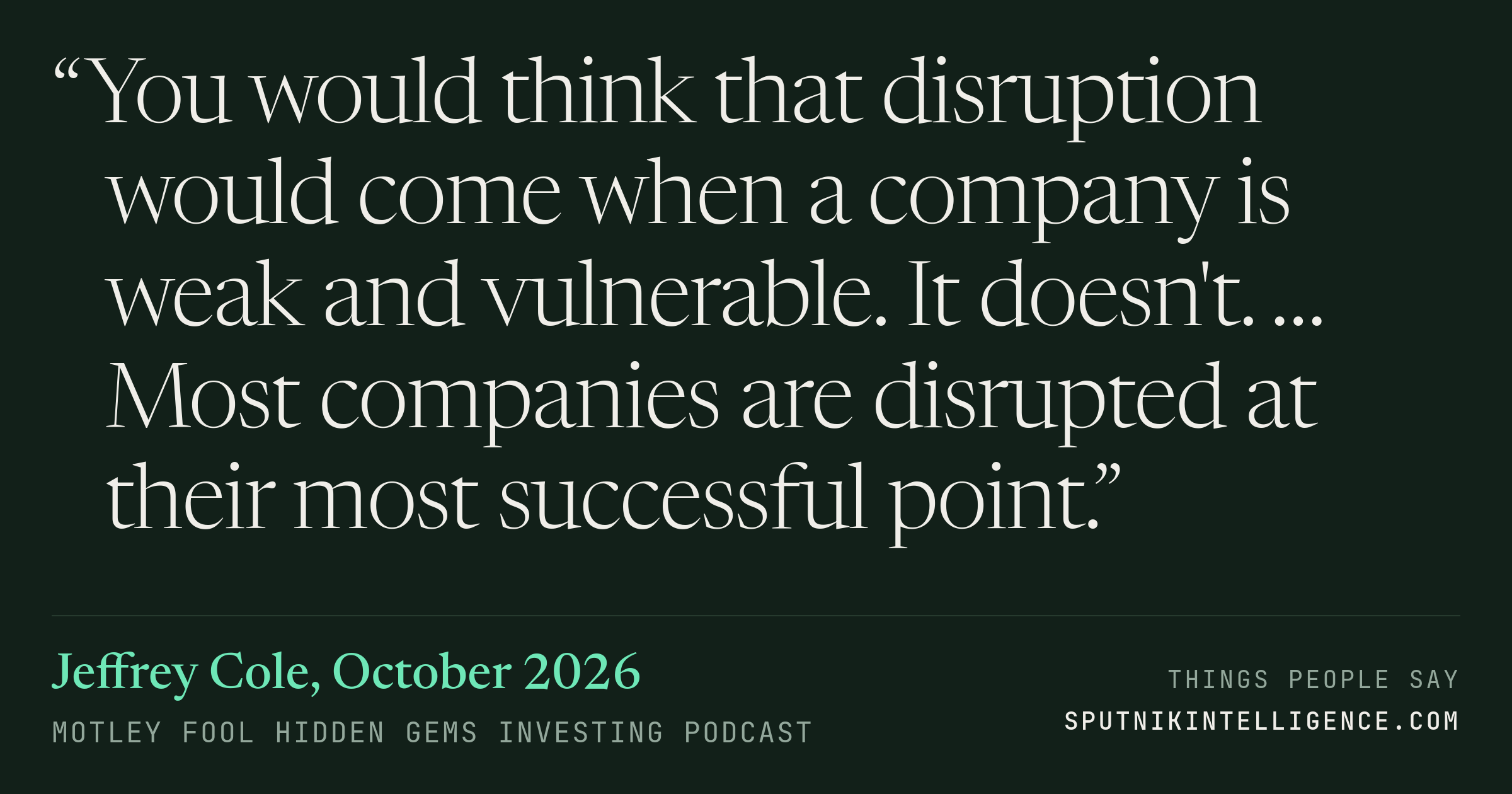
“You would think that disruption would come when a company is weak and vulnerable. It doesn't. … Most companies are disrupted at their most successful point.” — Jeffrey Cole, Motley Fool Hidden Gems Investing

Asked for the early warning signs that a company is vulnerable, Cole points to the music industry: 1999 was its best year ever, and then Napster arrived. He argues that success breeds the complacency that lets a disruptor in.

Motley Fool Hidden Gems Investing · 2026-10-18 Permalink → Listen →
Motley Fool Hidden Gems Investing Around 15:23 into the episode
Jeffrey Cole

…an enormous amount in medicine, but also in business organization, in transportation, logistics, where quantum's capable of is really pretty darned exciting. And except for cracking codes, it's not quite clear where the negative or dark side of quantum might come from. I'm sure people will find it.

Rachel Warren

When we're thinking about an industry that might be vulnerable to disruption, but specifically companies, and obviously there's a few examples you've given, what are kind of the early warning signs that a company might be vulnerable that investors. Well,

Jeffrey Cole

first, one of the most interest, you would think that disruption would come when a company is weak and vulnerable. It doesn't. It comes if actually most companies are disposed. Disrupted at their most successful point. Talk about the music industry, an industry that has always fascinated me, an industry that the consumers wanted to be disrupted because most of us grew up, you know, with a music industry whose business model was extortion. You want two songs? Great. You have to buy 12 songs and spend $17. But Napster…

Speaker 4

UKG is the workforce operating platform with unified HR, payroll, and workforce management, built to solve the unique challenges of frontline work. Powered by PeopleFirst AI and decades of labor data, UKG turns workforce intelligence into real-time decisions around staffing, pay, compliance, and…

Rachel Warren

In deepest jungle, Cartier's Panther spies a wandering bird that circles the skies. A lovebird, lost and missing his mate, is far from his

Speaker 4

path in lonely state. Dry your tears. Now there's a start. Follow my steps to heal your heart. Panther stalks through the leaves with silent grace. Through the power of scent, she finds the trace. Behold, two lovers reunite in the skies. A most precious thrill sparkling in their eyes. Together…

Speaker names from our own diarization · position estimated from where the line sits in the episode