
Dave Nunez

Things Dave Says on Podcasts

Where to Find Them

Dave Nunez has been a guest on MLOps.community (2 times) .

Recently: “Why Stripe Cut 500,000 Internal Docs Down to 5,000?” on MLOps.community (November 2026); “Just when we Started to Solve Software Docs, AI Blew Everything Up // Dave Nunez // #235” on MLOps.community (May 2024).

What They Said

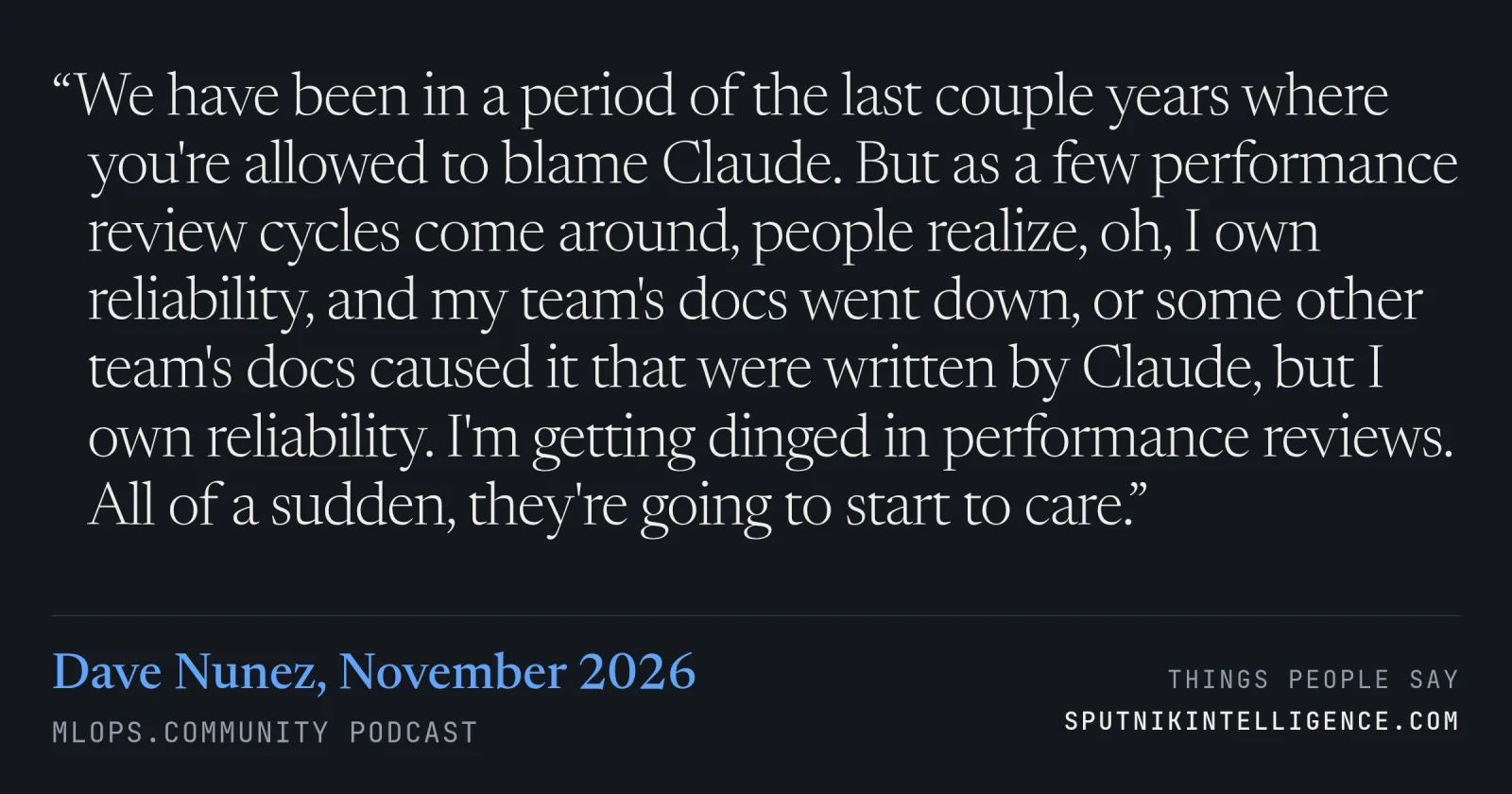
“We have been in a period of the last couple years where you're allowed to blame Claude. But as a few performance review cycles come around, people realize, oh, I own reliability, and my team's docs went down, or some other team's docs caused it that were written by Claude, but I own reliability. I'm getting dinged in performance reviews. All of a sudden, they're going to start to care.” — Dave Nunez, MLOps.community

Asked who owns reliability when an agent makes a mistake, Nunez predicts that engineers will stop being able to blame the agent, and that docs will get named owners like code repos do.

MLOps.community · 2026-11-13 Permalink → Listen →
MLOps.community Around 15:29 into the episode
Dave Nunez

Yeah.

Demetrios Brinkmann

And or the agent is trying to figure it out and it's making mistakes because of documentation. And so you almost don't realize how bad it is until something goes wrong.

Dave Nunez

Yeah. And we have been in a period of the last couple years where you're allowed to blame Claude. You're allowed to blame the agents if something goes wrong. But as a few performance review cycles come around, people realize like, oh, I own reliability and my team's docs went down or some other team's docs caused it that were written by Claude, but I own reliability. I'm getting dinged in performance reviews. All of a sudden, they're going to start to care. Things aren't going to be as like as laissez-faire and YOLO as before of just like trading, you know, blindly trading what Claude says, blindly publishing it, because now you're responsible. So that's the when people ask me about docs, like what tool should we use? What should we do a style guide? I'm like, start with accountability because if you put a name to a doc set, just like a code base or a repo, people will figure it out how to care. And the next step of that is during performance reviews, like put it on the job ladder. Like, are you responsible for the documentation? People will figure it out. It will all cascade. Like, smart people will figure it out. And I think that's just kind of been blown up the last…

Demetrios Brinkmann

Yeah. Well, and that, whereas before, when if or when Claude or Astra or whatever it may be, Codex causes the incident, it's kind of like, oh, because I was testing the limits of the coding agent. And now that's not an excuse. Like, you have to still be an engineer and you have to be the owner of…

Dave Nunez

Yeah, exactly. Especially if you're B2B, like no, like the there are contracts at stake. There's compliance audits. There's like hard stuff at stake where it's not like, you know, the customer's going to be like, ah, yeah, it got us too. No, you have to figure out a way to paper over GitHub if it's…

Demetrios Brinkmann

are some other tricks or ways that you've seen it done well that you've said put names to the accountability? Just have a document that says who owns what, and that will figure itself out. Another one is put owners on documentation. Are there other things that you've seen to work well?

Speaker names come from our own diarization. The position is estimated from where the line sits in the episode.
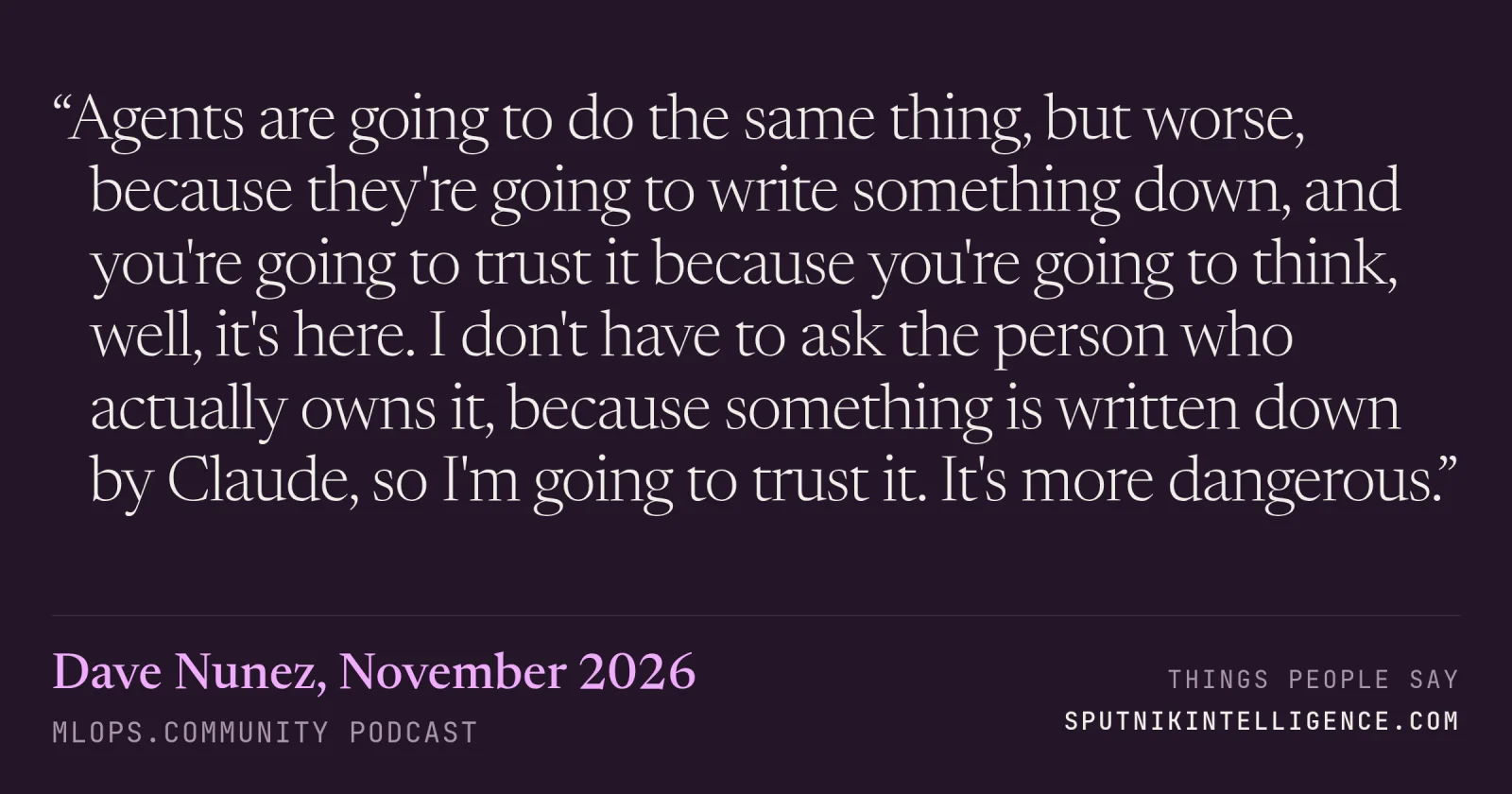
“Agents are going to do the same thing, but worse, because they're going to write something down, and you're going to trust it because you're going to think, well, it's here. I don't have to ask the person who actually owns it, because something is written down by Claude, so I'm going to trust it. It's more dangerous.” — Dave Nunez, MLOps.community

Nunez had just described a friend's weeks-long production incident caused by an agent acting on a stale document, and a similar one at Uber caused by humans not updating docs. His point is that AI-written docs get trusted too easily.

MLOps.community · 2026-11-13 Permalink → Listen →
MLOps.community Around 14:09 into the episode
Dave Nunez

…prototype and then that gets specced out. And then like that alone is so much more useful. So that's probably to answer your question, like I would say, look at the stuff that can just be distilled down to a diagram, a workflow, a checklist, and like get rid of all the old context. Just delete it.

Demetrios Brinkmann

…Notion docs or the Google Docs that give you English, but then you've got code that goes with it. And if the majority of the stuff doesn't match or it just is overwhelming to the agent, you're really rolling the dice on if you're going to get anything valuable back from the query that you've asked.

Dave Nunez

Yeah, absolutely. And code is pretty pristine. That's what the agents were trained on. So what they're optimized for. And if you have dead code, delete it, but agents are going to know like how to traverse that and what to get out of it. But yeah, you're right. They start to get confused when they're taking, okay, this is the code base, but your name is tied to this document conflicting with what's in the code. And it's conflicting in this old JIRA or linear task. So like, I'm just going to flip a coin because I'm meant to please you. And your name is on the code and your name is on the task. Your name's on the doc. So I'm just going to make a call here. And it's so great because I'm like a magnet for friends at companies where they're like, I just heard the other day, somebody was like, we had the worst incident I've ever experienced in my career. It was weeks of cleanup because an agent made the wrong call based on a document. Like it is, this happened to me at Uber, except it was humans not updating the documents. Like agents are going to do the same thing, but worse because they're going to write…

Demetrios Brinkmann

Dude, that just makes me think about the people or the ones who have to actually clean up the mess once it happens because this is almost like a latent problem until it's not. And then you get some kind of an incident and somebody can't figure out what the hell is happening because the…

Dave Nunez

Yeah.

Demetrios Brinkmann

And or the agent is trying to figure it out and it's making mistakes because of documentation. And so you almost don't realize how bad it is until something goes wrong.

Speaker names come from our own diarization. The position is estimated from where the line sits in the episode.
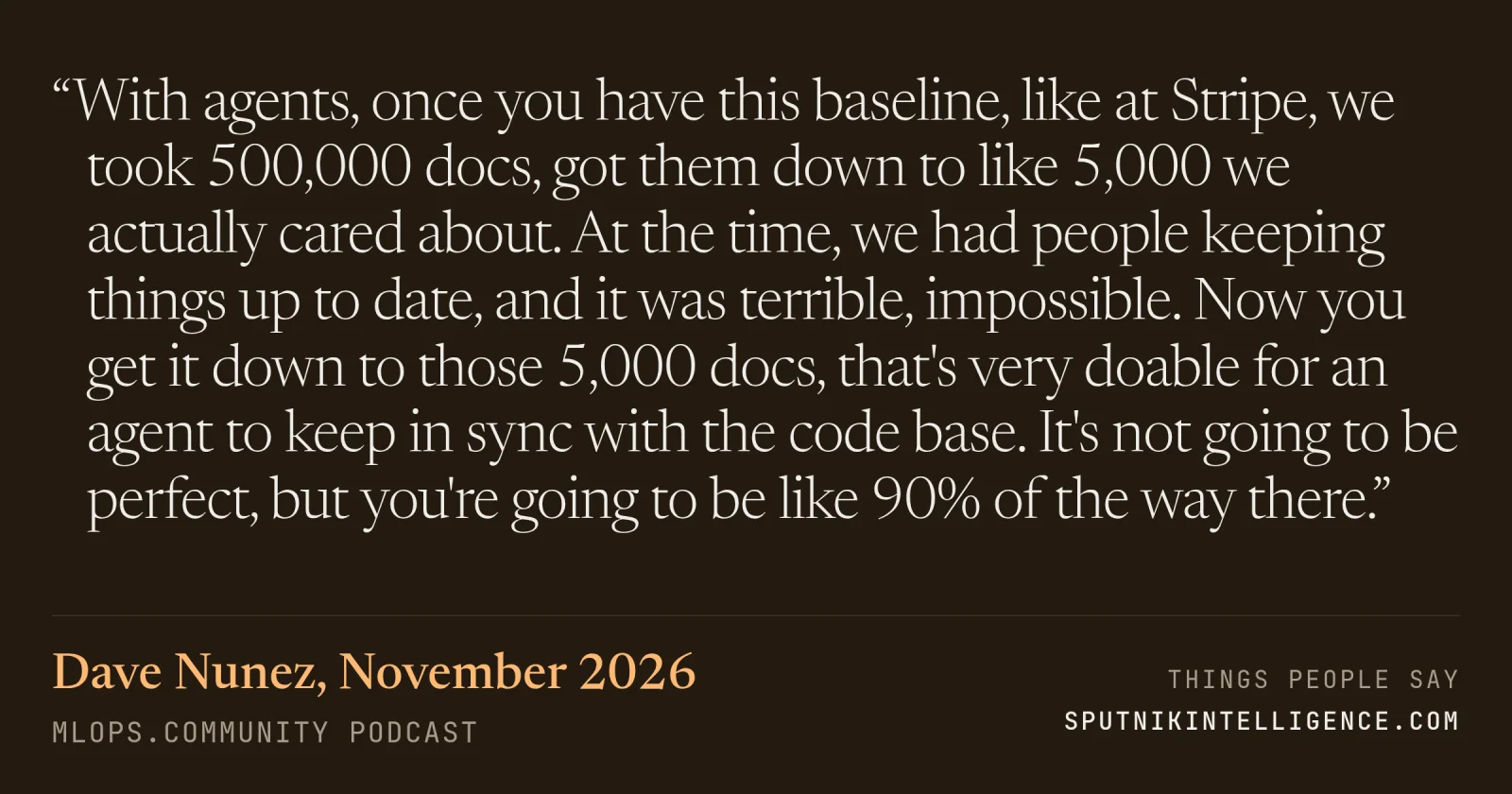
“With agents, once you have this baseline, like at Stripe, we took 500,000 docs, got them down to like 5,000 we actually cared about. At the time, we had people keeping things up to date, and it was terrible, impossible. Now you get it down to those 5,000 docs, that's very doable for an agent to keep in sync with the code base. It's not going to be perfect, but you're going to be like 90% of the way there.” — Dave Nunez, MLOps.community

Nunez was explaining that most internal documentation is junk and has to be cleaned out before agents can use it. Shrinking the doc set to what is worth maintaining is what makes agent-maintained docs feasible.

MLOps.community · 2026-11-13 Permalink → Listen →
MLOps.community Around 10:52 into the episode
Dave Nunez

…we log things and you just need a timestamp. It's funny how people just run in front of Waymo's because they know the Waymo will start. Yeah, you get like cut off because this is like the nicest driver around. So the cars just go around, people run in front, they know it's safe. They don't care.

Demetrios Brinkmann

Stop sign. It's my right of way always. You're not going to get flipped off by the Waymo.

Dave Nunez

I think before we get to the cool shit, like decision records are incredible. And I love, and I'm telling everybody, just write stuff down with a timestamp. You don't need to perfect it or make it like beautiful. You can do that later. If you write it down and keep it in chronological order, you can do stuff with that later. I'm not even, I think internally people just have to clean up their junk. They don't realize that 95 probably, and this has proved out true from doing this exercise at Uber and Stripe and then a bunch of clients when I was advising, probably like one to two percent of the stuff you have is actually useful. 98, 95%, let's be generous, is copies of docs, outdated docs for deprecated features. It's stubs, like just scratch pads. And all of these are Google Docs, they're Notion docs. Like whether people still read them, they're in the context for the agents and they're in your search. So when you go search and they're bloating it, and then a lot of these search tools provide weight for age. So the older it is, the more, I remember we were working with this customer that had like 8,000 employees. And the first thing Internal Docs when I search, they were using Notion to…

Demetrios Brinkmann

I can't tell you how many docs I don't delete because I'm like, there's probably one sentence in there that's actually valuable. Yeah. And I know that it's not important, but that one sentence potentially could have value in the future so that I am too scared to delete it.

Dave Nunez

Yeah, everybody has that. And you remember, oh, that took me so long to create. Like, I don't want to. It's like cleaning out your garage, but it feels so, so good to delete stuff because right when you delete it, you never think about it again. You're not like, and if it was important, who knows?…

Demetrios Brinkmann

even when Internal Docs think about it, because of that search problem, I can't find

Speaker names come from our own diarization. The position is estimated from where the line sits in the episode.

Collections They Appear In