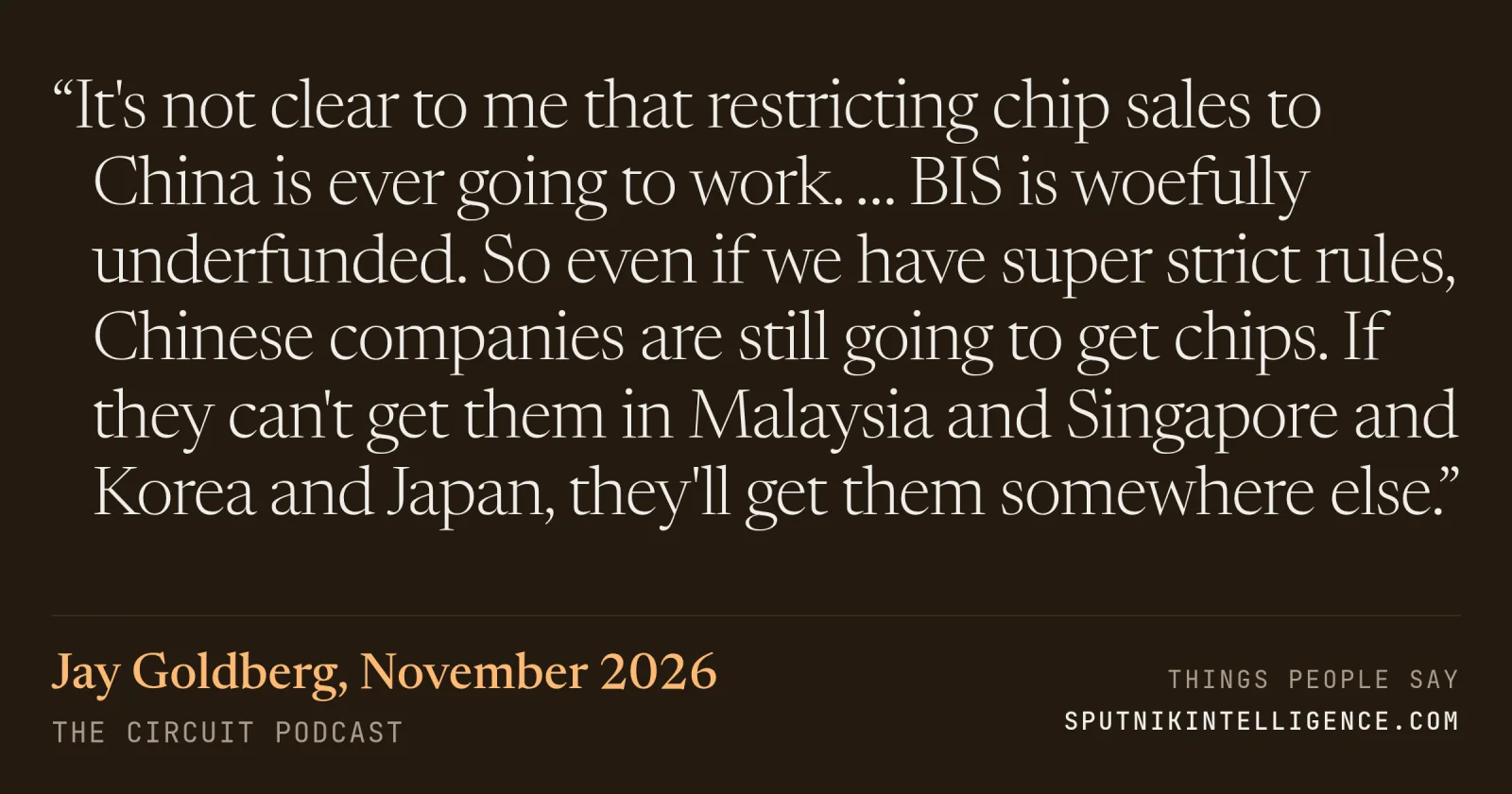
“It's not clear to me that restricting chip sales to China is ever going to work. … BIS is woefully underfunded. So even if we have super strict rules, Chinese companies are still going to get chips. If they can't get them in Malaysia and Singapore and Korea and Japan, they'll get them somewhere else.”
The Circuit · Tech Strategy & Big Tech · November 2026
Context
After the hosts noted senators calling for tighter chip controls following the scandal, Jay questions whether export restrictions can work at all, given how little enforcement capacity the agency that polices them has.
Transcript
restricting chip sales to China.
…any intelligent credit to politicians probably, but like you have to realize how important this company is also to your national security, not just your competitors trying to get access to like your national security. Like why would you do something that jeopardizes this? Like it's, I don't know.
…yeah. And there are all kinds of reasons why, like, I understand very well, personally, how much China is a rival to the United States, a significant adversary and competitor. But maybe this isn't the right way to go about confronting them, right? It's not clear to me that restricting chip sales to China is ever going to work. There aren't enough inspectors and the BIS inspectors in the world. BIS is woefully underfunded. So even if we have super strict rules, Chinese companies are still going to get chips. If they can't get them in Malaysia and Singapore and Korea and Japan, they'll get them somewhere else. There's so much interest there. There's so much demand there. And there's what, 2,000 BIS inspectors total in the world? Or no, that's a whole agency. Like, it's just, there's a mismatch there. All right. So if that's the case, then, right? Limiting access to chips is not effective, and it's not going to actually, it's probably not the best way to do it. There are all these bills that are going…
other part of this: to the degree that China, I mean, again, retaliates or could retaliate. Like, there are a lot of components in the supply chain that we need that come from China to even make the boards that those chips go on. And if they felt like it, right, they could impose a lot of other…
Yeah, I think I don't know. We could get very tinfoiled hat over this. I don't think anything is clear yet. And I don't think all of the most hawkish people's plans are going to come to fruition. But I think it is safe to say that we will see more restrictions on this. But let me ask you this.
Okay, so if this is the line you're taking. It's not great for NVIDIA. Why aren't we cutting off CPU sales from AMD and Intel? Because those play important roles in AI inference. And, you know, why are we drawing the line just with GPUs? Like,
More from The Circuit