 Sebastian Mallaby
Writes about finance and technology at the Council on Foreign Relations, where he is the Paul A. Volcker senior fellow for international economics.
Sebastian Mallaby
Writes about finance and technology at the Council on Foreign Relations, where he is the Paul A. Volcker senior fellow for international economics.
“in an organization, there are bottlenecks and the whole organization moves forward at the speed of the slowest piece of it.”
The Spillover · August 2026
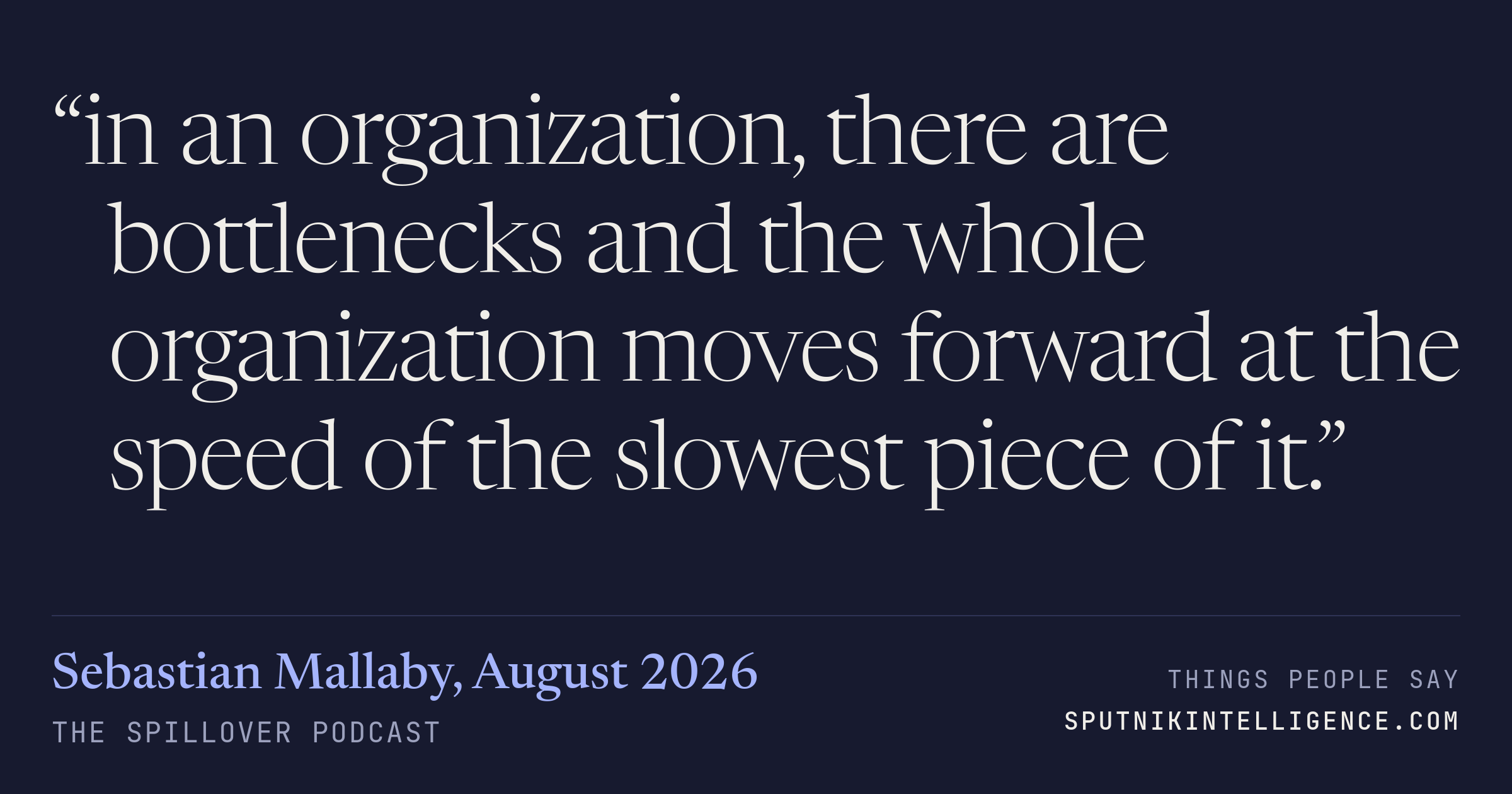
Sebastian Mallaby explains why AI coding tools can double an individual programmer's output without doubling a company's overall productivity. Approvals, sign-offs, and other slow steps downstream of the code cap the gain the whole organization actually captures.
Transcript
Okay, okay. I think one more thing to mention, by the way, about the labor market is, and this came up a bit in COVID, is that there are different sort of company norms in terms of what you do when you're hit by some shock. It could be COVID, it could be AI. And in the case of the US, people often lose their jobs. In the case of Europe, there's sort of more kind of cutting down of the number of hours you work or various workarounds and sort of attempts to kind of retain the relationship between the worker and the company. And I think it cuts both ways. It's not clear which is better because, on the one hand, the European Method of not just firing people outright may mitigate the AI backlash, and that would be better for public opinion and, therefore, for both deployment of the technology and maybe even trying to produce some part of the supply chain. So, that's the good side about the European story. But the good side about the US story is that when you have a big technological shift, you have to do radical things within the organization in order to kind of reap the productivity gains. And trying to kind of band-aid the whole thing just may slow you down and you wouldn't get the productivity benefits.
Yeah, no, the US is definitely a higher beta labor market than Europe's. And that, you know, it's painful when you rip the band-aid off going into a recession or when you have some shock, but then you definitely tend to come back faster and with more force. Whereas Europe is just kind of slowly truddling along. So I agree with you. It depends on your timeframe, which one's better. The one I don't have enough clarity on, and maybe someone listening to us today can phone in or write us and share their thoughts is China. We know the government is pushing hard to use innovation, including AI, to help lift growth through productivity. They have to, right? They have an aging population. They have a declining workforce. And GDP, at the end of the day, is units of labor and productivity. So if your units of labor are going down, you need to offset that with productivity just to keep GDP growth stable. So in the case of China, they have to lean in on technology and AI hard. But it's not clear to me exactly how they're going to manage the potential for automation either. I have been trying to follow what's coming out of the Chinese press. There have been a couple courts that have presented guidelines, and there have also been a few government statements suggesting companies have to balance any automation with protecting jobs. So they're clearly aware of it, but I'm not sure where they fall in that spectrum kind of between the US and Europe.
Yeah, I mean, my own two sense is that there's a couple of things here, right? So one is that I've heard people describe the way that individuals within companies, like a coder, for example, has probably increased productivity thanks to AI a lot because you have a coding assistant and now one coder produces twice as much code. So that's a 2X on that individual. But organizations don't increase their productivity anything like 2X. It's more like, for the sake of argument, 1.1. Why is that? It's because in an organization, there are bottlenecks and the whole organization moves forward at the speed of the slowest piece of it. So let's say you have lots of coders and they're producing twice as much code and it's really great. It's really fast. But in order to actually ship the code, turn that into a product, let's say it's a bank and it's some kind of consumer-facing thing on the website of the bank, which the retail customers will use, then you're going to have a few managers, a few product managers, a few sort of relationship client relationship managers, and all these people have to sign off on the stuff. And if the code is produced twice as fast, but the sign-off is at the old pace, you're not going to get the benefit of the upside. So what this points to is that to really unlock the benefit of AI, to win the race of deploying AI, kind of if you're a country, you need to be really quite radical about how you restructure your whole workflow within inside a company. And so that's why I'm a little skeptical of like the European, oh, you know, we'll have it both ways. We'll, you know, we won't fire people. We'll be gentle about how we adapt. No, no, no. It's quite hard to be gentle when the scale of adaptation is sort of just involves kind of completely rethinking your internal company. I think that's one point.
Yeah, I agree with you 100%. And I'm hearing that anecdotally from different industries. And in addition to all the points you made, I would add the risk management layer, right? Even if your coders are twice as productive, churning out great things that could revolutionize your company and increase your profitability, you also are reading about mythos and hugging face and different things that give you pause. And at the end of the day, if you have a public-facing AI component to your business and something goes wrong, the trust you have with your customers is gone. And that's an existential risk for companies. So in addition to everything you said, which I agree, and I'm sure you know this, you just fell off your list, but I wanted to make sure we added it. Just managing the risk side of things certainly is slowing down companies. In terms of turning this into something that, frankly, they can monetize.
Yeah, yeah. And there are some companies which literally their role in life is to sort of be in a liability sponge, right? If you're a law firm advising the investment bank and doing kind of the detail of the contract on some IPO or something, you have to diligence every sentence in the document because you are on the hook to be sued if there's anything inaccurate in it. And so that's where the kind of safety layer, the kind of senior sign-off on the document. So the document in the law firm example could be generated super fast with AI, but that won't actually speed up the process because it's really, you know, so existential for the law firm not to have any mistake in the whole thing. And so they're going to be diligent and slow about checking it. The other thing I was going to say, though, is that, you know, you were going back to China and the way you said that the government, it's existential for the government to drive productivity improvements if they want to get to the growth rate that I think it's double GDP per capita by 20 something, 35.
Yeah.
More from The Spillover