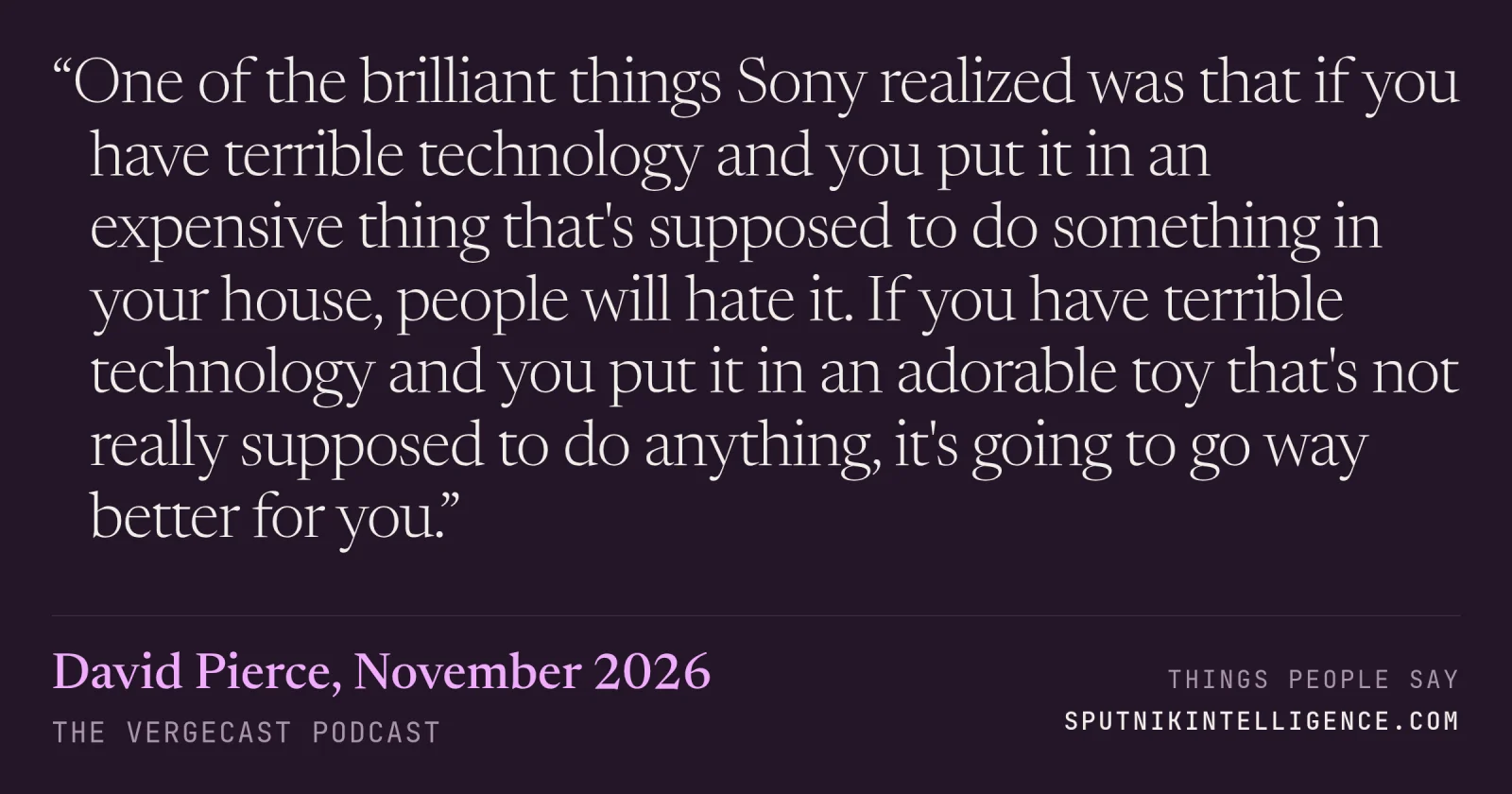
“One of the brilliant things Sony realized was that if you have terrible technology and you put it in an expensive thing that's supposed to do something in your house, people will hate it. If you have terrible technology and you put it in an adorable toy that's not really supposed to do anything, it's going to go way better for you.”
The Vergecast · Tech Strategy & Big Tech · November 2026
Context
The hosts were discussing why Sony built a robot dog in the 1990s instead of a household helper. David argues Sony deliberately hid weak technology inside something cute, a lesson that applies to today's AI gadgets.
Transcript
…next decade, so somewhere in the like the aughts between 2000 and 2010, robots would be everywhere in our home. Jen, this is like what a lot of people in Smart Homeland have been telling you for the last few years. But this seems like Sony and co were early to the thesis here. What's your sense?
…it, definitely. But it was an idea that had been, that people have been wanting to do for a long time. And I guess maybe we're going to find out now where, where the technology kind of came together to be able to make something like this, because that has always been the biggest challenge. Yes.
So you just brought up two things that I think are really interesting about the early days of this project. One is that all of the requisite technology was really bad, and it still was in the 90s. And one of, I think, the like brilliant things that Sony realized was that if you have terrible technology and you put it in a like expensive thing that's supposed to do something in your house, people will hate it. If you have terrible technology and you put it in an adorable toy that's not really supposed to do anything, it's going to go way better for you. So this becomes part of the pitch is like, oh, this thing will suck, but if it's cute, it sucks in a cute way. And then this is great. So there's this great line from a Business Week story about the early days of Aibo. And it says, the outlines of the Aibo business of the future began to take shape in 1993 when this guy named Tosh Doy, who's going to come up in a minute, heard about a competitor's project to develop a house cleaning robot. I thought it was a horrible idea, he recalls. The level of technology hadn't reached the point where it could handle such complex…
Yeah. Yeah. I mean, they were, Rodney Brooks, I think, was the lead on the Roomba and iRobot was the company at the time. But everyone was telling them they wanted something to clean their home. But I think iRobot at that point knew that that wasn't something they couldn't develop something that…
Yeah, so it's circa 1993. I'm not even sure iRobot would disagree with the idea that it was a terrible idea and you definitely couldn't do it. But anyway, so Sony sets out to not do that. They're going to make what they call entertainment robots, which I think is a really cool term and ends up…
No. Just go.
More from The Vergecast