 Dr. Martin Erdmann
The author of books on theology and history
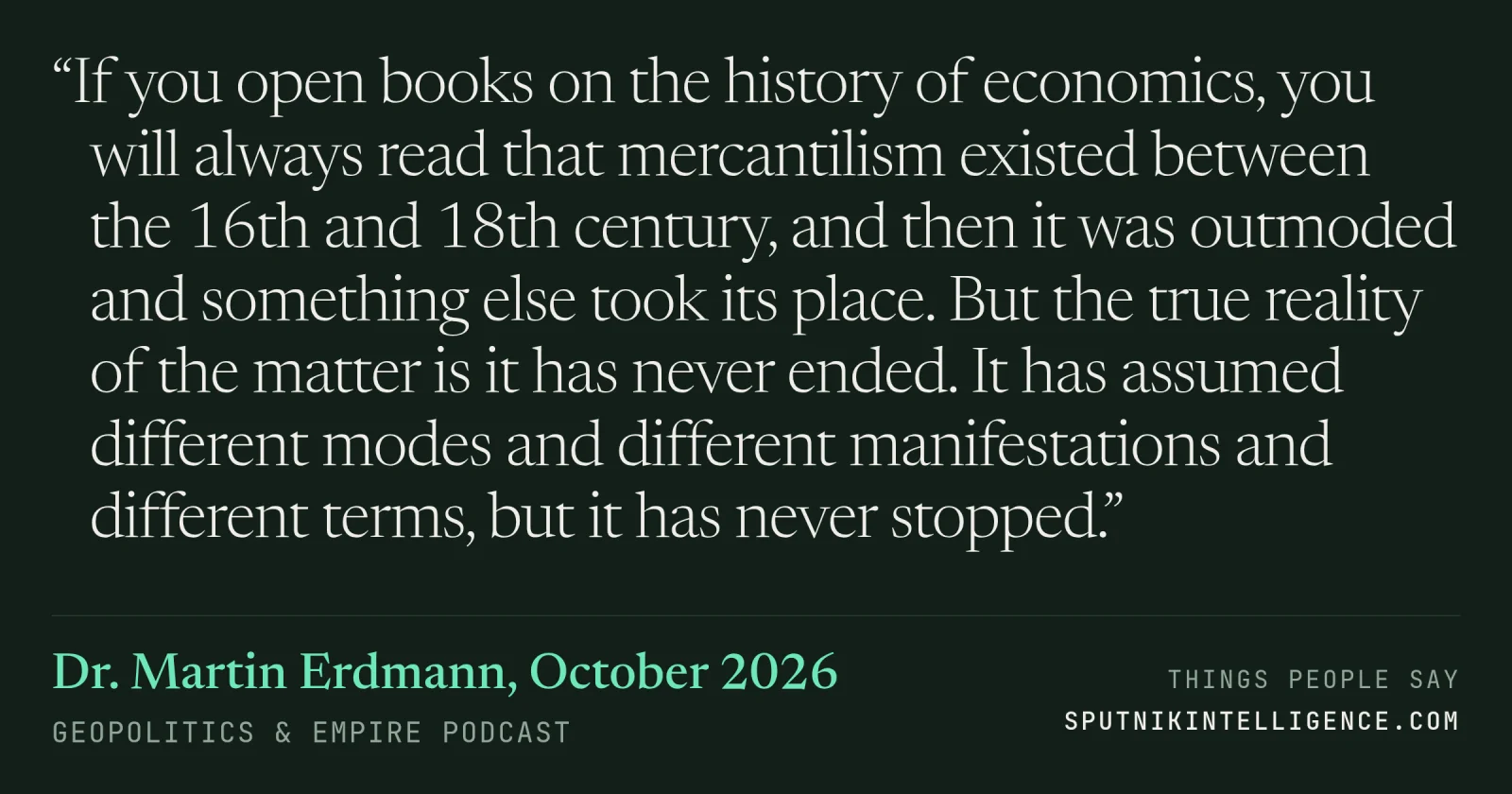
“If you open books on the history of economics, you will always read that mercantilism existed between the 16th and 18th century, and then it was outmoded and something else took its place. But the true reality of the matter is it has never ended. It has assumed different modes and different manifestations and different terms, but it has never stopped.”
Geopolitics & Empire · Geopolitics & World Affairs · October 2026
Context
After the host read passages from Erdmann's book on the return of mercantilism, Erdmann opens by challenging the textbook view that mercantilism was a closed historical chapter. It's his own thesis, offered as an argument.
Transcript
You're welcome. Thank you for inviting me. Thanks for my pleasure.
…power centers and the private interest of the aristocratic ecclesiastical administrative elites in amassing immense wealth in order to gain even greater power than that was back then. And I think it's nothing has changed. It's still the same today. So I'm handing it back to you. Tell us everything.
Well, it's a massive book, as you noted. In the German original version, it's even a larger 525 pages or something like that. So it covers a lot of ground. And obviously, we cannot speak about every specific aspect of it. It would be just too overwhelming. But we can hit on the main points of mercantilism. And I think the most important point to mention is the fact that it has never ended. So if you open history books and you read or economic books or books on the history of economics, you will always read that mercantilism was a system which existed between the 16th and 18th century. And then it was just outmoded and abolished and something else took its place, free economy, a free economic system. So it's just of historical interest to us. And it's interesting to read about that particular policy, which was in effect between the 16th and 18th century, but it has no effect on us today. But the true reality of the matter is it has never stopped, has never ended. It has assumed different modes and different manifestations and different terms were used, but it has never stopped.
And how would you sort of best explain it for people? What is it exactly and why is it bad?
Correct. Well, you have to understand the whole system and when to see how the whole system, individual components of that system adapted to specific time periods and different cultures, different countries. So it was really a system which was worldwide, but it originated in what we call now the…
could I just add, and we can go back and forth in time. What you're describing back then, it feels in many ways still the case today. Because as you said, you'd own your home, you wouldn't have to, let's say, pay rent previously. And it's like you have your own business, you work at your own…
More from Geopolitics & Empire