 Chris Dixon
General partner at Andreessen Horowitz who founded and leads a16z crypto.
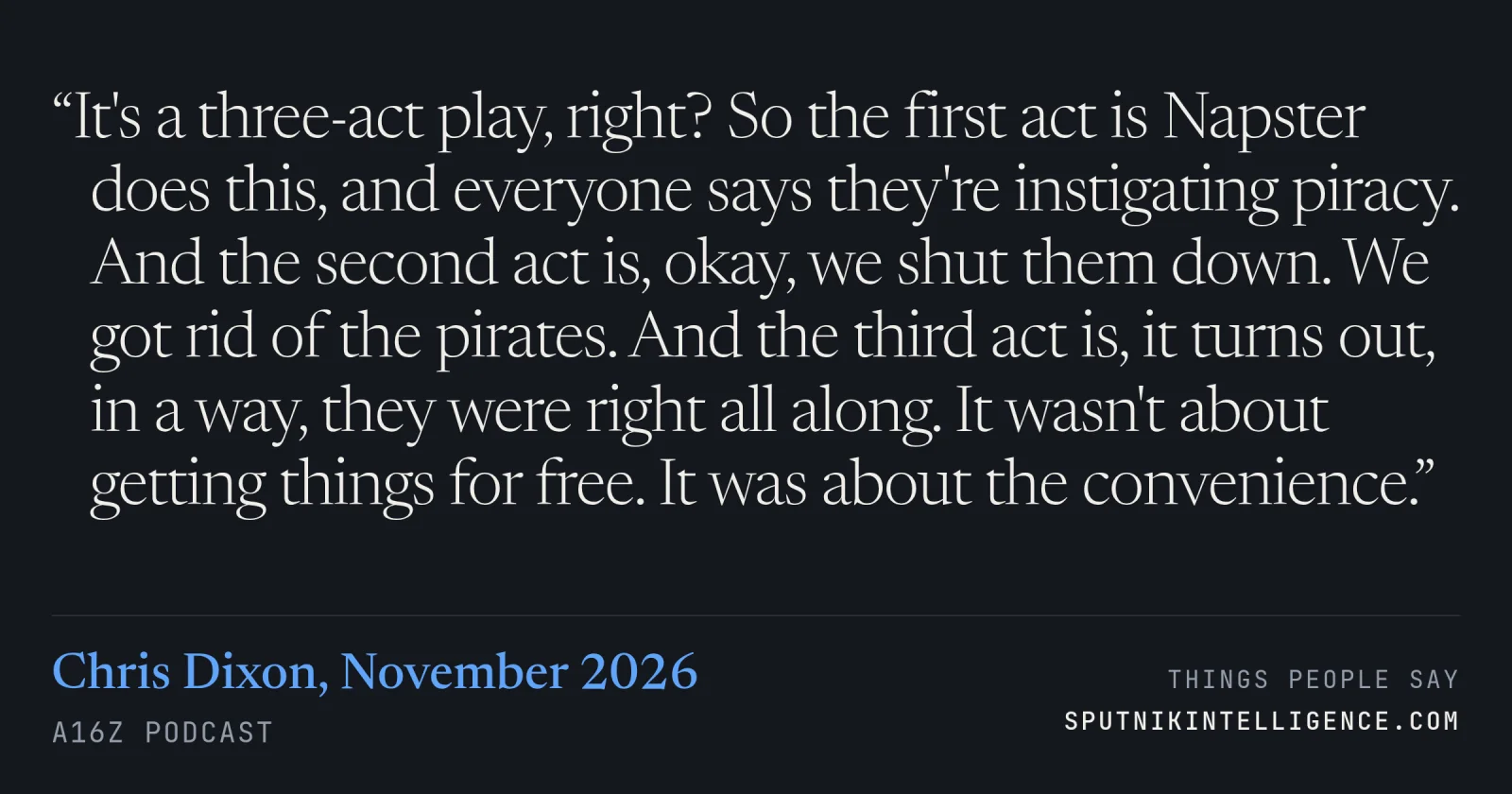
“It's a three-act play, right? So the first act is Napster does this, and everyone says they're instigating piracy. And the second act is, okay, we shut them down. We got rid of the pirates. And the third act is, it turns out, in a way, they were right all along. It wasn't about getting things for free. It was about the convenience.”
a16z Podcast · Startups & Venture · November 2026
Context
Brian McCullough had just argued that Napster was really about unlimited selection and instant gratification. Chris frames the story in three acts: piracy mostly disappeared once legal services made music simple and reasonably priced. The conversation is a 2018 recording that a16z replayed this week.
Transcript
…don't own things. And it's like, well, it's not that that's actually a feature, not a bug from a PNL perspective. That's interesting. So I guess some other interesting ones. So Napster, that was when I learned a little bit more about, I mean, I knew this public story, but that's another one where
…That's what they had. And had they been able to convince anybody, Any one of that in 1999, it would be a completely different media landscape. And the only problem that they had is, you know, don't pick a fight with an industry that has literal mob ties going back to its very founding days. That's
the interesting is it's sort of a three-act, to me, it's a three-act play, right? So the first act is Napster does this, and everyone says they're instigating piracy. And the second act is, okay, we shut them down. We got rid of the pirates. And the third act is, it turns out, in a way, they were right all along. It wasn't about getting things for free. It was about the convenience. And Steve Jobs said the same thing. But like, right in the end, it turns out, like, today, that there's like very little, you know, I mean, there's music piracy and there's movie piracy and there's video game piracy, but for the most part, if
you make it simple enough and have a reasonable price. That's right.
That's right. So it turns out we now know that their value proposition actually was, as they claimed, a great deal of it was about convenience and not about Spotify. 100%.
And so, you know, the direct analogy is Spotify, right? You could have had a Spotify in 1999 or 2000 at the very least. This is, again, classic disruption stuff. You can't convince an industry at the height. You know, 1999, I think, is the height, and they're doing $20 billion because of the CD…
More from a16z Podcast