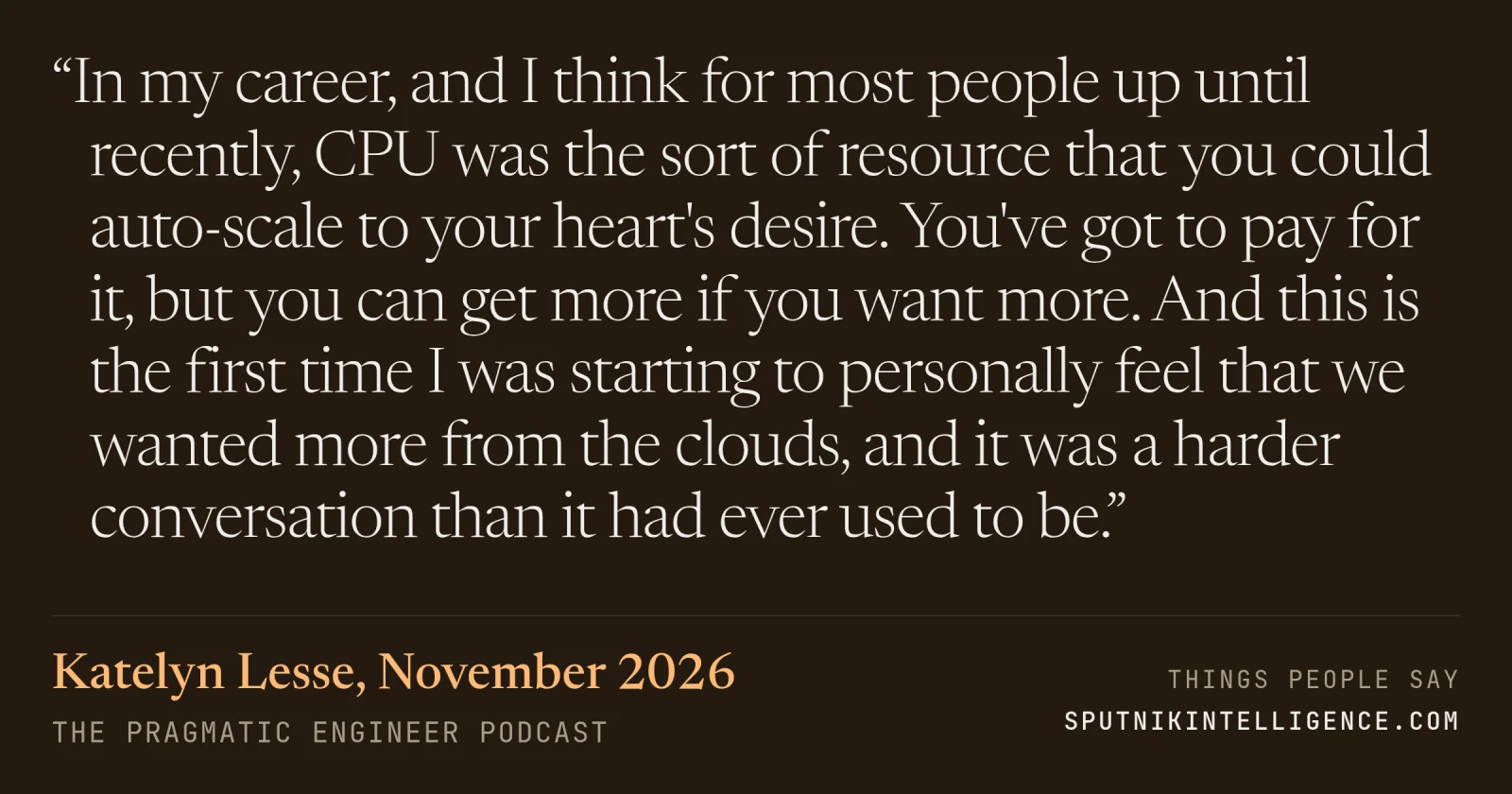
“In my career, and I think for most people up until recently, CPU was the sort of resource that you could auto-scale to your heart's desire. You've got to pay for it, but you can get more if you want more. And this is the first time I was starting to personally feel that we wanted more from the clouds, and it was a harder conversation than it had ever used to be.”
The Pragmatic Engineer · Hands-On Engineering Podcasts · November 2026
Context
Explaining why the Python API became a problem: request volume spiked and the CPU cluster got crunched. Capacity was no longer something she could simply buy from cloud providers, which is the shortage behind the Rust rewrite.
Transcript
I was feeling it directly. Yeah,
so I guess this was inspiring a little bit.
Yes, for sure. This is something that we've been thinking about since, I want to say like late last year, coming into this year, where we were starting to see request volume like really, really, really spike. And I think especially earlier this year, an interesting thing for our team, we ran a Super Bowl commercial and you run a Super Bowl commercial and it's a classic engineering problem where you got to be careful about what sort of spike might you see. And so again, because all of our apps run on the messages API, it's like very much this layer that's serving everything that might spike. Like, you know, a Super Bowl commercial probably doesn't lead someone to like crack open a laptop and build an API integration on the spot, but you might go choose to, you know, download our mobile app and give it a shot. And that's all still running through the API. And so we started to see request volume just like really, really go up. And in that time, you know, that CPU cluster that we were running started to get pretty crunched. And so it's really interesting because in, you know, in my career, and I think for most people up until recently, CPU was the…
because I'm just, I'm reflecting on, you know, what we said about Python and there's all these advantages that seamless, it's easy to build. Plus, I understand that you built your original API, which the messages API is the API, right? It's interchangeable to be horizontal scalable, meaning you can…
Right. And now it's not necessarily exactly. And, you know, it's single threaded. It's like not an efficient system. Our team started by doing some of the classic, you know, we started running in another region, right? And routing traffic. But then, of course, like network bandwidth becomes hard in…
Now, like, okay, you knew you needed something faster, but you could have chosen Go, Java, Rust, C, C. I'm not going to say assembly theoretically, but let's not go there. I know we have a bunch of downsides. How did you? Settle on Rust. I assume that you must have just looked, given that the big…
More from The Pragmatic Engineer